Elucidating Distinct and Common fMRI-Complexity Patterns in Preadolescent Children With Attention-Deficit/Hyperactivity Disorder, Oppositional Defiant Disorder, and Obsessive-Compulsive Disorder
Ru Zhang, Steven Cen, Dilmini Wijesinghe, Leon Aksman, Stuart B. Murray, Christina J. Duval, Danny J.J. Wang, Kay Jann

TL;DR
This study uses brain scans to compare ADHD, ODD, and OCD in children, finding that ADHD and ODD share brain complexity issues, while OCD does not show similar patterns.
Contribution
The study identifies shared and distinct neural complexity patterns in ADHD, ODD, and OCD using rsfMRI data from preadolescent children.
Findings
ADHD and ODD share reduced brain complexity in overlapping regions of executive function networks.
Comorbid ADHD with other disorders shows more widespread complexity reductions than ADHD alone.
OCD does not show significant complexity alterations, whether alone or with comorbidities.
Abstract
The pathophysiology of attention-deficit/hyperactivity disorder (ADHD) is complicated by high rates of psychiatric comorbidities; thus, delineating unique vs shared functional brain perturbations is critical in elucidating illness pathophysiology. We investigated resting-state functional magnetic resonance imaging (rsfMRI)–complexity alterations among children with ADHD, oppositional defiant disorder (ODD), and obsessive-compulsive disorder (OCD), respectively, and comorbid ADHD, ODD, and OCD, within the cool and hot executive function (EF) networks. We leveraged baseline data from 9- to 10-year-old children in the Adolescent Brain and Cognitive Development (ABCD) Study. Data for children who singularly met all DSM-5 behavioral criteria for ADHD (n = 61), ODD (n = 38), and OCD (n = 48), respectively, were extracted, alongside data for children with comorbid ADHD, ODD, OCD, and/or other…
Genes, proteins, chemicals, diseases, species, mutations and cell lines named across the full text — each resolved to its canonical identifier and authoritative record.
Click any figure to enlarge with its caption.
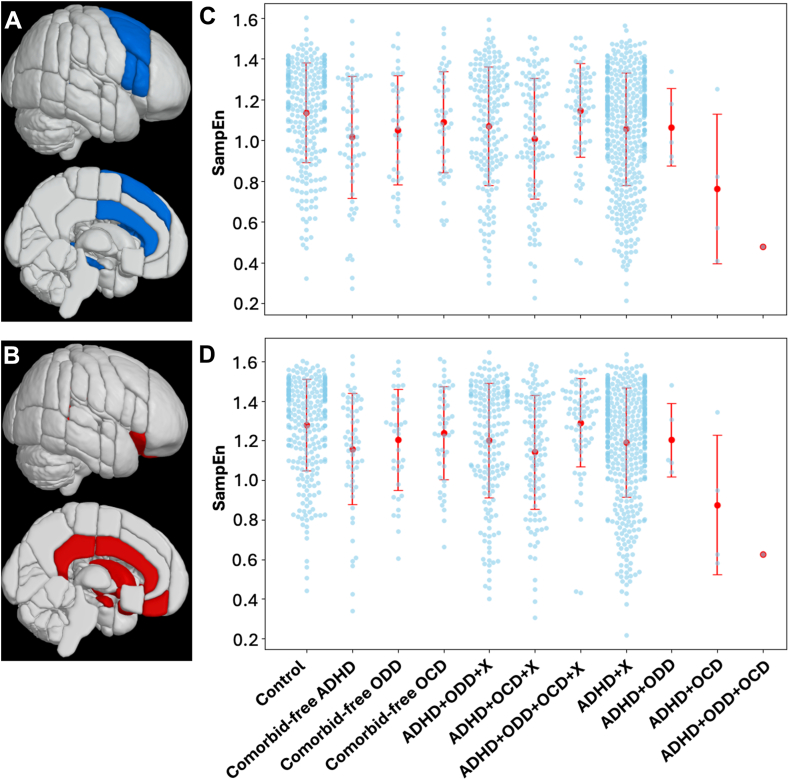 Figure 1
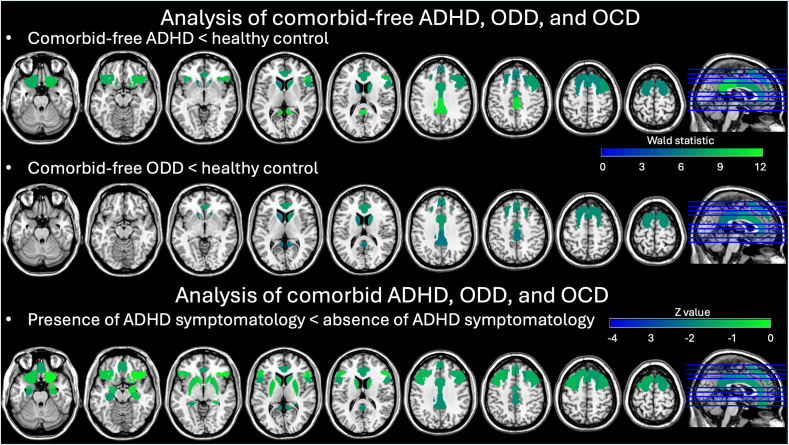 Figure 2
Peer Reviews
No public reviews on file for this paper yet. If you reviewed it on a platform where reviews are public (OpenReview, ICLR, NeurIPS, ICML), you can paste yours below so the community can read it here.
Videos
No videos yet. Explain this paper in a talk, walkthrough, or lecture? Add one.
Taxonomy
TopicsFunctional Brain Connectivity Studies · Attention Deficit Hyperactivity Disorder · Mental Health Research Topics