From calcium pump to metabolic hub: emerging genetic phenotypes and metabolic networks of SERCA2 in skeletal muscle
Shunyi Lei, Yanlong Qu, Jin Yan, Fei Nan, Siyao Liu, Wenhao Pan, Chaoyue Yu

TL;DR
SERCA2 in skeletal muscle is now understood as a key regulator of both calcium balance and metabolism, with implications for muscle diseases and metabolic disorders.
Contribution
This review proposes a unified framework for SERCA2's dual role in calcium and metabolism, highlighting gaps in subtype-specific therapeutic strategies.
Findings
SERCA2 integrates calcium signaling, metabolic homeostasis, and ER stress in skeletal muscle.
Dysregulation of SERCA2 is linked to hereditary myopathies, muscle atrophy, and insulin resistance.
Therapeutic strategies targeting SERCA2 show promise for treating systemic diseases.
Abstract
For decades, the sarco/endoplasmic reticulum Ca2+ ATPase 2 (SERCA2) in skeletal muscle was primarily recognized for its role in orchestrating slow-twitch muscle fiber relaxation—an essential process dependent on its ability to actively sequester cytoplasmic Ca2+ into the sarcoplasmic reticulum (SR) lumen, thereby sustaining intracellular Ca2+ homeostasis critical for muscle contraction-relaxation cycles. However, recent genetic and molecular biology studies have expanded the function of SERCA2 to a core hub integrating Ca2+ signaling, metabolic homeostasis, and endoplasmic reticulum (ER) stress. This novel function is underpinned by a sophisticated multi-layered regulatory network spanning from transcription to post-translational, which ensures that SERCA2 expression and activity dynamically adapt to the dual demands of Ca2+ homeostasis maintenance and metabolic signaling demands.…
Genes, proteins, chemicals, diseases, species, mutations and cell lines named across the full text — each resolved to its canonical identifier and authoritative record.
Click any figure to enlarge with its caption.
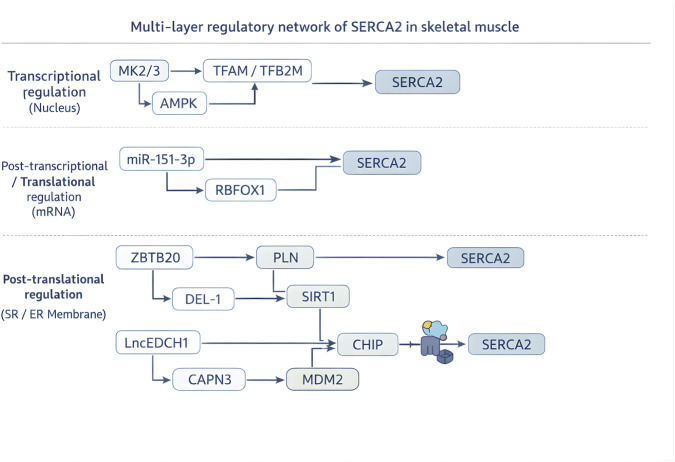 Figure 1
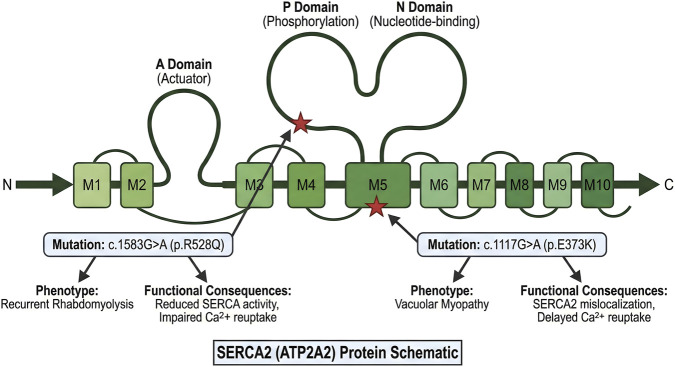 Figure 2
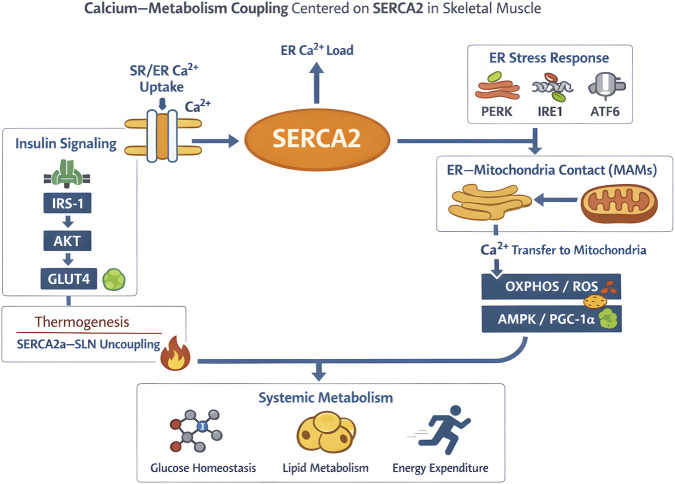 Figure 3
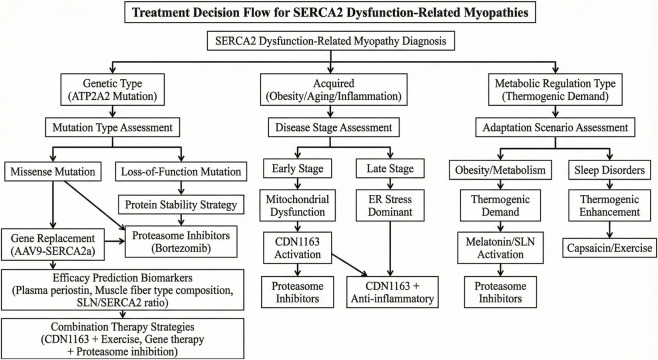 Figure 4
Peer Reviews
No public reviews on file for this paper yet. If you reviewed it on a platform where reviews are public (OpenReview, ICLR, NeurIPS, ICML), you can paste yours below so the community can read it here.
Videos
No videos yet. Explain this paper in a talk, walkthrough, or lecture? Add one.
Taxonomy
TopicsCardiomyopathy and Myosin Studies · Ion channel regulation and function · Muscle Physiology and Disorders