Therapeutic potential of exerkines in neurodegenerative and mental disorders: a narrative review
Suwol Yang, Hye-Won Sang, Seoyeon Kim, Eun-Jeong Cho, Youngju Choi, Dong Woo Kang, Young C. Jang, Dong-Ho Park, Hyo-Bum Kwak, Jang Soo Yook

TL;DR
This review explores how molecules released during exercise, called exerkines, may help treat brain disorders like Alzheimer's and depression by improving brain health.
Contribution
The paper provides a comprehensive review of exerkines' roles in neurodegenerative and mental disorders, focusing on preclinical findings and future therapeutic directions.
Findings
Exerkines like BDNF, irisin, and IL-6 can cross the blood-brain barrier and improve brain function.
Exerkines modulate the brain microenvironment and reduce neuroinflammation.
Rodent studies show exerkines promote neurogenesis and synaptic plasticity.
Abstract
Neurodegenerative and mental disorders impose significant global disease burdens and pose serious social and economic challenges. Physical exercise (PE) exerts beneficial effects on brain health, contributing to a reduction in the risk of Alzheimer’s disease (AD), Parkinson’s disease (PD), depression, anxiety, and post-traumatic stress disorder (PTSD). To understand these effects of PE, a variety of molecules released from various tissues in response to PE have been discovered, which are collectively called ‘exerkines’. In particular, the skeletal muscle acts as an endocrine organ, secreting exerkines and is included in the category of myokines that facilitate direct or indirect crosstalk between the muscle and the brain. Although muscles actively interact with organs such as the liver, pancreas, and adipose tissue, the precise mechanisms of muscle–brain communication have yet to be…
Genes, proteins, chemicals, diseases, species, mutations and cell lines named across the full text — each resolved to its canonical identifier and authoritative record.
Click any figure to enlarge with its caption.
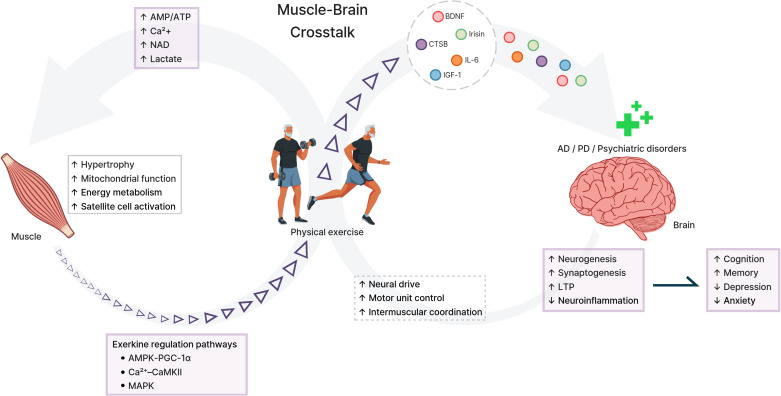 Figure 1
Peer Reviews
No public reviews on file for this paper yet. If you reviewed it on a platform where reviews are public (OpenReview, ICLR, NeurIPS, ICML), you can paste yours below so the community can read it here.
Videos
No videos yet. Explain this paper in a talk, walkthrough, or lecture? Add one.
Taxonomy
TopicsAdipose Tissue and Metabolism · Regulation of Appetite and Obesity · Adipokines, Inflammation, and Metabolic Diseases