Thyroid cytology Bethesda category III (AUS/FLUS): surgical follow-up and histologic outcomes in a tertiary-care setting
Zgjim Limani, Rinë Limani, Shkelzen Reçica, Labinota Kondirolli, Etnik Bajraktari, Brikenë Blakaj Gashi, Drita Miftari Pazhari

TL;DR
This study examines the surgical outcomes of thyroid cases classified as indeterminate, finding a significant malignancy rate and highlighting the importance of follow-up strategies.
Contribution
The study provides real-world malignancy rate estimates for Bethesda category III thyroid cases in a tertiary-care setting without routine molecular testing.
Findings
A malignancy rate of 41.9% was observed in definitively linked cytology–histology cases.
A more conservative malignancy estimate of 30.6% was found when considering all operated cases.
AUS/FLUS cases often led to surgical intervention, emphasizing the need for clear counseling and ultrasound-informed follow-up.
Abstract
Indeterminate thyroid cytology, specifically category III atypia/follicular lesion of undetermined significance (AUS/FLUS), poses a diagnostic challenge and affects patient management. A retrospective review of cases reported as AUS/FLUS was conducted using the institutional thyroid fine needle aspiration (FNA) registry (2013–2022). Proportions were reported with 95% confidence intervals (CIs). Direct registry correlation and a larger all-operated sensitivity denominator were examined to capture real-world outcomes. AUS/FLUS comprised 243 out of 1,872 FNAs (13.0%; 95% CI: 11.5–14.6). Of these, 186 patients (76.5%; 95% CI: 70.8–81.4) underwent surgery. Histologic follow-up identified 57 malignancies, resulting in a malignancy rate of 41.9% (95% CI: 34.0–50.3) among definitively linked cytology–histology cases (n = 136), and a more conservative estimate of 30.6% (95% CI: 24.5–37.6) when…
Genes, proteins, chemicals, diseases, species, mutations and cell lines named across the full text — each resolved to its canonical identifier and authoritative record.
Click any figure to enlarge with its caption.
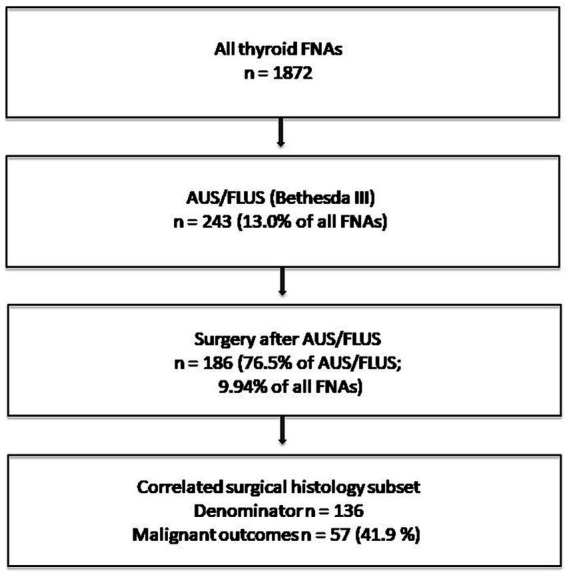 Figure 1
Peer Reviews
No public reviews on file for this paper yet. If you reviewed it on a platform where reviews are public (OpenReview, ICLR, NeurIPS, ICML), you can paste yours below so the community can read it here.
Videos
No videos yet. Explain this paper in a talk, walkthrough, or lecture? Add one.
Taxonomy
TopicsThyroid Cancer Diagnosis and Treatment · Thyroid and Parathyroid Surgery · Head and Neck Anomalies