Markovnikov hydroamination of terminal alkenes by phosphine redox catalysis
Flora Fan, Kassandra F. Sedillo, Alexander J. Maertens, Abigail G. Doyle

TL;DR
A new catalytic system using phosphine and photoredox catalysts enables a chemical reaction that was previously only possible with transition metals.
Contribution
The study introduces a novel main-group catalytic mechanism mimicking transition metal reactivity for alkene functionalization.
Findings
A phosphine–photoredox system enables Markovnikov hydroamination of terminal alkenes with N–H azoles.
The mechanism involves a phosphine radical cation activating alkenes for nucleophilic amination.
This offers a new pathway for main-group catalysis in chemical synthesis.
Abstract
Main-group catalysts that mimic transition metal reactivity can expand substrate tolerance and enable transformations not possible at present with metal catalysis1. The discovery that PIII and PV phosphorus intermediates can undergo transition-metal-like two-electron chemistry raises the question of whether radical PIV intermediates can mimic other elementary steps in organometallic chemistry2,3. Here we describe a phosphine–photoredox catalyst system that promotes intermolecular Markovnikov hydroamination of unactivated terminal alkenes with numerous classes of N–H azoles, a reaction that is not possible with late transition metal catalysis. Experimental and computational mechanistic studies support a new elementary step for main-group catalysis, in which a phosphine radical cation activates the alkene to nucleophilic amination by the azole, a step otherwise associated with transition…
Genes, proteins, chemicals, diseases, species, mutations and cell lines named across the full text — each resolved to its canonical identifier and authoritative record.
Click any figure to enlarge with its caption.
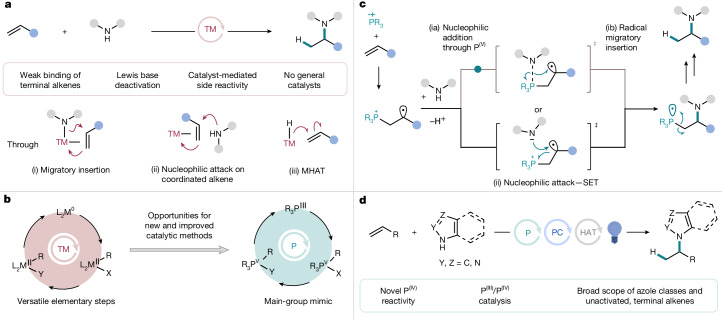 Figure 1
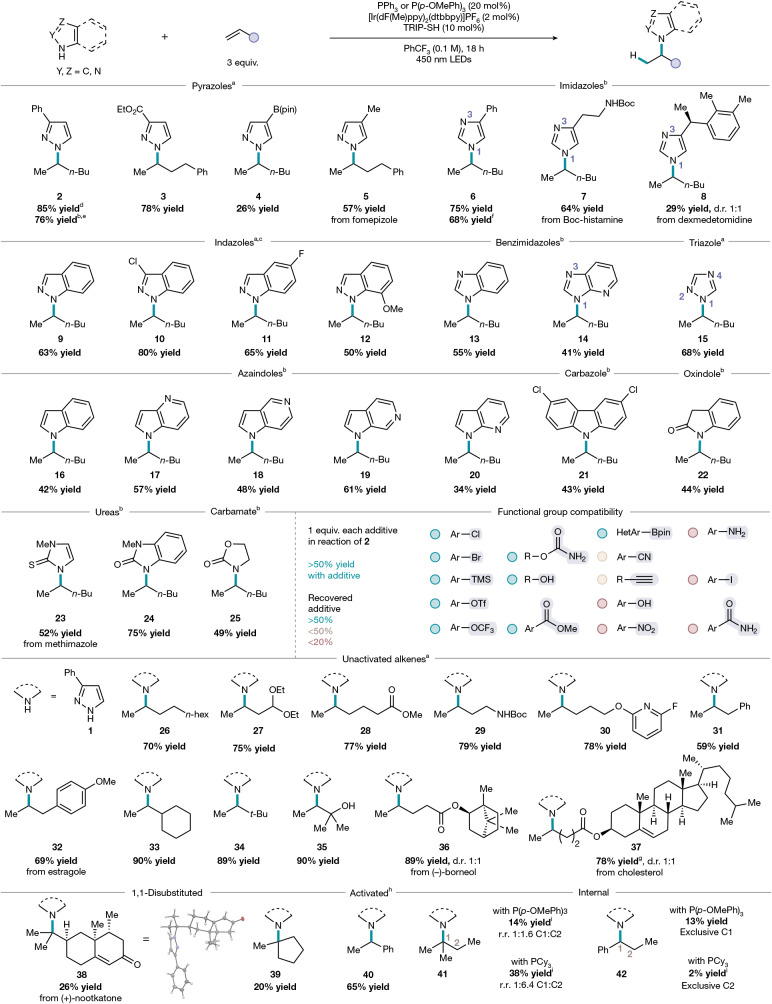 Figure 2
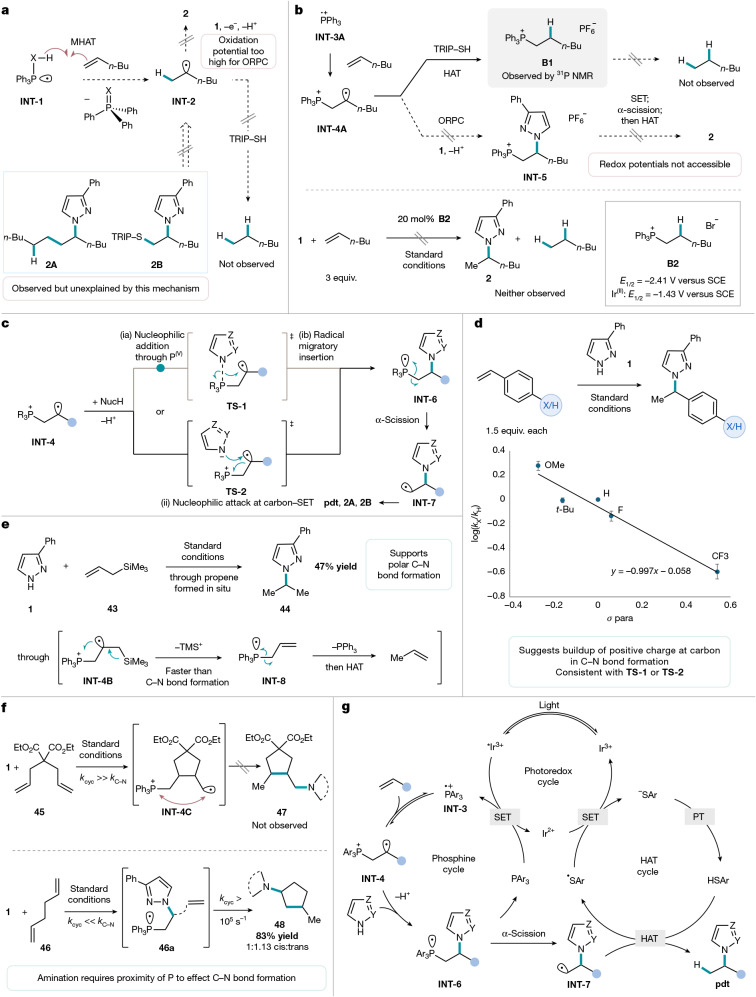 Figure 3
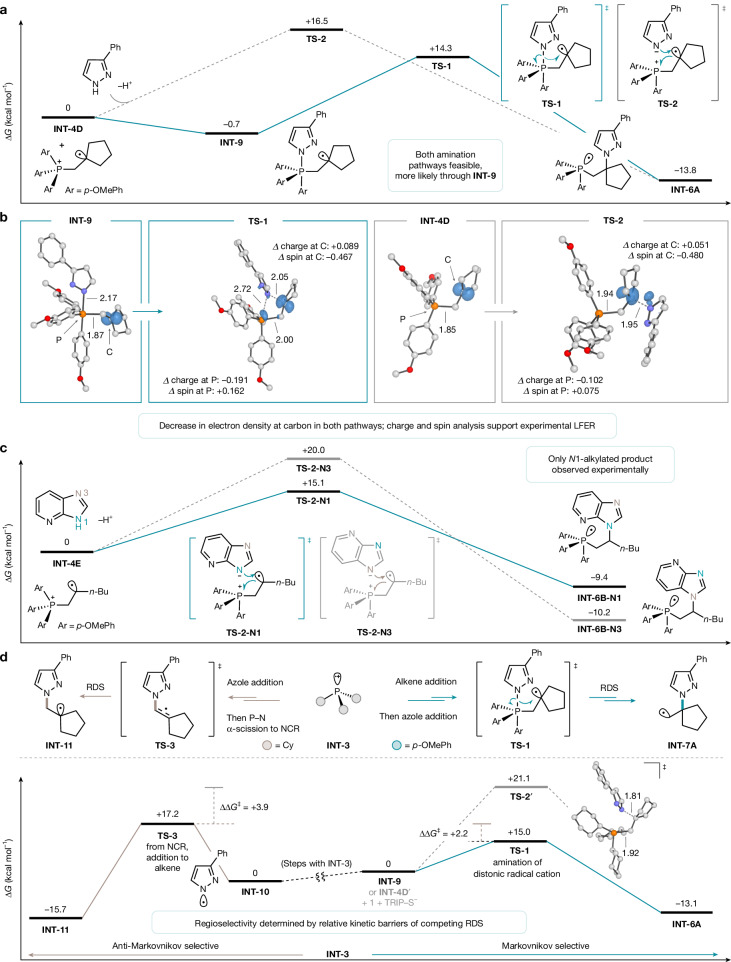 Figure 4
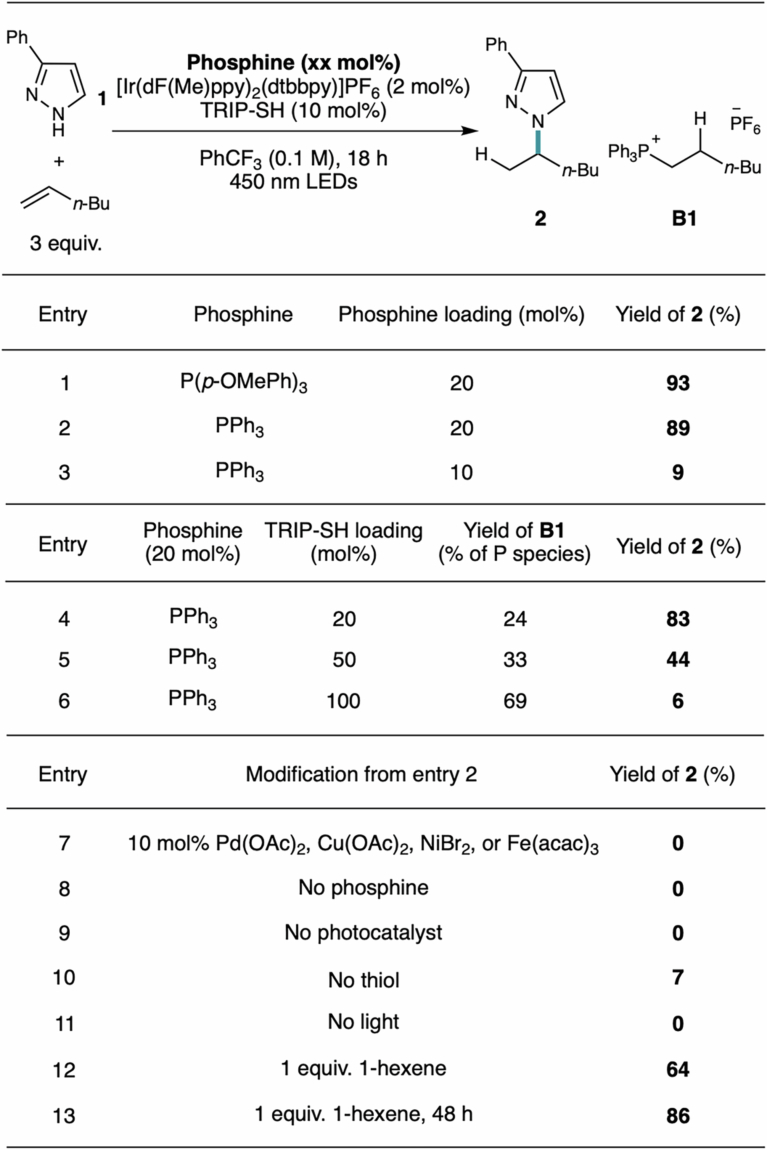 Figure 5
Peer Reviews
No public reviews on file for this paper yet. If you reviewed it on a platform where reviews are public (OpenReview, ICLR, NeurIPS, ICML), you can paste yours below so the community can read it here.
Videos
No videos yet. Explain this paper in a talk, walkthrough, or lecture? Add one.
Taxonomy
TopicsCatalytic C–H Functionalization Methods · Asymmetric Hydrogenation and Catalysis · Catalytic Alkyne Reactions
Main
Catalytic methods to construct carbon–nitrogen (C–N) bonds are widely sought because of the prevalence of amine functionality in molecules in the biomedical, agrochemical and fine chemical industries. Hydroamination, the formal addition of an N−H bond across an unsaturated C−C bond, is a particularly valuable transformation for C(sp^3^)–N bond formation because it exploits the abundance and structural variety of alkene and amine starting materials to form products with high atom economy under redox-neutral conditions^4,5^. However, these reactions do not occur without a catalyst. Late transition metal (TM)-catalysed alkene hydroamination has been extensively developed^6–8^, taking advantage of different elementary steps involving a metal and alkene, such as (i) migratory insertion; (ii) nucleophilic attack on a metal–alkene complex; or (iii) metal-catalysed hydrogen atom transfer (MHAT)^9,10^ (Fig. 1a). Despite the numerous catalysts identified and synthetic advances resulting from their development, a general solution to catalytic intermolecular, Markovnikov hydroamination of unactivated, terminal alkenes is not available^8^, and only limited examples exist for this reaction class using azoles as nitrogen sources^11–13^. As unactivated terminal alkenes are produced on manufacturing scale and comprise a substantial portion of the feedstock^14,15^, and azoles are widely represented in medicinal chemistry, materials science and agrochemistry^16^, they both offer underutilized and attractive substrate classes for C(sp^3^)–N bond formation through hydroamination. Fig. 1. Introduction.a, TM-catalysed nucleophilic amination with terminal alkenes and limitations (red box). MHAT, metal-catalysed hydrogen atom transfer. b, Mimicking TM catalysis with phosphorus. c, Unexplored activation modes in phosphorus catalysis. SET, single electron transfer. d, Phosphine-catalysed Markovnikov-selective hydroamination with terminal alkenes.
In 2014, the Hartwig group reported that an Ir catalyst promotes the addition of indoles to terminal aliphatic alkenes by turnover-limiting migratory insertion to give hydroamination products with Markovnikov selectivity^11^. More recently, the Akai and Zhang groups described an MHAT approach to Markovnikov-selective hydroaminations between terminal aliphatic alkenes and benzotriazoles using Co catalysis, in which only singular examples of other azoles, tetrazole and benzimidazole were demonstrated^12,13^. The specificity of these solutions to a singular azole class can be attributed to the propensity of TMs to undergo deactivation by azole coordination^17,18^ or unproductive side reactions, such as azole oxidative addition^19,20^. More generally, progress in this area has been impeded by the fact that unactivated, terminal alkenes are weak ligands for TMs, and side products arising from alkene isomerization commonly outcompete the desired, often thermally neutral, transformation^6–8,21^.
Recently, researchers have sought to mimic elementary steps of TMs using abundant main-group elements and develop main-group catalysts that expand reactivity in synthetic reactions that are challenging for TM catalysis^1,2,22,23^. Organophosphorus derivatives have been shown to undergo two-electron reduction and/or oxidation, oxidative addition, ligand exchange and reductive elimination in stoichiometric contexts^24–26^, and have emerged as versatile redox-active main-group catalysts for C–F and C–N bond formation (Fig. 1b)^27–30^. Apart from representing sustainable alternatives to late TMs, organophosphorous derivatives often show complementary functional group compatibility, such as to Lewis-basic substrates. With this in mind, we questioned whether it might be possible to mimic the elementary steps involved in TM-catalysed nucleophilic alkene functionalization with a phosphine catalyst, and in doing so, develop a generally applicable catalytic method for intermolecular, Markovnikov-selective hydroamination of azoles and unactivated terminal alkenes (Fig. 1c).
Here, we report a cooperative phosphine–photoredox catalyst system that achieves Markovnikov hydroamination between a broad range of N–H azoles and terminal, aliphatic alkenes (Fig. 1d). Our experimental and computational mechanistic studies indicate that phosphine radical cations promote nucleophilic amino-phosphination of alkenes by two competing, energetically feasible pathways, (ia and ib) and (ii) in Fig. 1c, which mimic inner- and outer-sphere mechanisms for TM-catalysed alkene functionalization in industrially important reactions, such as the Pd-catalysed Wacker process and Pd-catalysed alkene amination^31,32^. However, because the phosphine-catalysed mechanism is initiated by an open-shell P^IV^ species, polar addition of the nucleophile is accompanied by either a radical migratory insertion or an intramolecular electron transfer into the adjacent P–C anti-bonding orbital, in which the latter represents an unusual example of the microscopic reverse of a spin-centre shift process^33^. Subsequent functionalization of the resulting M–C bond proceeds by a one-electron (M = P) rather than two-electron (M = TM) mechanism, which is also distinct from most TM-catalysed nucleophilic alkene functionalization reactions. We anticipate that these similarities and differences will offer new opportunities for the design of synthetic transformations using phosphine catalysis.
Reaction development
Previously, our laboratory reported that PCy_3_ catalyses the hydroamination of alkenes with primary sulfonamides^34^ and in collaboration with the Knowles group, hydroamination of alkenes with N–H azoles^35^, both mediated by a visible light photoredox co-catalyst in a P^(III/IV)^ cycle. These reactions proceeded with anti-Markovnikov selectivity, consistent with a mechanism involving the generation of a nitrogen-centred radical that undergoes anti-Markovnikov addition to the alkene. During our recent exploration of a low-performing substrate combination, the reaction of 3-phenylpyrazole with methylene cyclopentane, we discovered that use of P(p-OMePh)3 as a catalyst unexpectedly afforded a complete switch in regioselectivity to Markovnikov hydroamination. As this regioselectivity outcome is prevalent for late TM-catalysed alkene hydrofunctionalization reactions, we were intrigued by the underlying reaction mechanism and its synthetic implications. To this end, we sought to optimize the reaction for unactivated, terminal alkenes, explore its synthetic scope and understand the phosphine-dependent change of mechanism for C(sp^3^)–N bond formation.
With 1-hexene as the alkene partner, we found that using 20 mol% of either P(p-OMePh)3 or PPh_3_, 2 mol% of [Ir(dF(Me)ppy)2(dtbbpy)]PF_6_ photocatalyst and 10 mol% of 2,4,6-triisopropylbenzenethiol (TRIP-SH) catalyst with 450 nm LEDs gave high yield and exclusive Markovnikov selectivity for the intermolecular hydroamination with 3-phenylpyrazole (1) to form N-alkylated product 2 (Extended Data Table 1, entries 1 and 2). Reducing the phosphine catalyst loading to 10 mol% significantly hindered activity (Extended Data Table 1, entry 3). Notably, other triaryl and alkylphosphine catalysts were unreactive (Supplementary Table 3). Increasing the thiol loading led to reduced yield of product 2 (Extended Data Table 1, entries 4–6) with concomitant increase in formation of phosphonium by-product B1. Given the unique regioselectivity outcome of the hydroamination, we questioned whether trace TM may be present. Including 10 mol% of Pd(OAc)2 or other metal salts such as Cu(OAc)2, NiBr_2_ or Fe(OTf)3 (Extended Data Table 1, entry 7) as an additive completely shut down reactivity. Furthermore, control studies indicated no reactivity without light (entry 11), which is inconsistent with the presence of trace amounts of a TM impurity serving to catalyse the reaction. Although using only 1 equivalent (equiv.) of alkene led to reduced yield at 18 h (entry 12), the yield could be restored by allowing the reaction to run for 48 h (entry 13), demonstrating the utility of the method for Markovnikov hydroamination of more valuable alkene coupling partners. Notably, most late TM-catalysed hydroamination reactions with aliphatic terminal alkenes require a large excess of reaction partner (>5 equiv.) due to the weak binding of these substrates, regardless of the amine identity^8,36,37^.
Azole and alkene scope
Next, we sought to evaluate the scope of N–H azoles tolerated in the reaction (Fig. 2). We began our exploration with substituted pyrazoles, as this heterocycle class is one of the 10 most common in drugs approved by the US Food and Drug Administration^16^. Apart from 3-phenylpyrazole, 3-carboethoxypyrazole (3) is a competent substrate, undergoing Markovnikov-selective hydroamination in 78% yield. Although a pyrazole bearing a boronic ester substituent reacted in 36% yield (4), the utility of boronate esters for further derivatization by cross-coupling indicates the moderate success of this substrate is nonetheless a useful advance. Fomepizole (5), an alcohol dehydrogenase inhibitor, was N-alkylated in 57% yield. 4-Phenylimidazole (6), belonging to another highly prevalent heterocycle class in medicinal chemistry, underwent hydroamination in good yield. Biologically active compounds with the imidazole core, such as the neurotransmitter histamine (7) and the sedative dexmedetomidine (8) reacted with exclusive N-site selectivity.Fig. 2. Azole and alkene scope.Reactions were performed on a 0.5 mmol scale using 1.0 equiv. of azole and 3.0 equiv. of alkene, PPh_3_ or P(p-OMePh)3 (20 mol%), [Ir(dF(Me)ppy)2_dtbbpy]PF_6 (2 mol%), and TRIP-SH (10 mol%) irradiating with 450 nm LEDs for 18 h. Isolated yield reported as an average of two runs. ^a^PPh_3_ was used as the phosphine catalyst. ^b^P(p-OMePh)3 was used as the phosphine catalyst. ^c^Reaction run at 0.05 M with 2 × 427 nm Kessil lamps. ^d^Isolated yield from reaction performed on 5 mmol scale. ^e^Reaction run with P(p-OMePh)3 (20 mol%), analytical ^1^H NMR yield determined by comparison to an internal standard of 1,3,5-trimethoxybenzene, reaction set up on the bench, sparging with N_2_ for 5 min followed by addition of alkene, instead of in a glovebox. ^f^Analytical ^1^H NMR yield determined by comparison to an internal standard of 1,3,5-trimethoxybenzene, reaction set up under Schlenk technique instead of in a glovebox. ^g^Reaction run with 2.0 equiv. of alkene. ^h^Reaction run with P(p-OMePh)3 (20 mol%), 1.2 equiv. of alkene and TRIP-SH (20 mol%). ^i^Analytical ^1^H NMR yield determined by comparison to an internal standard of 1,3,5-trimethoxybenzene.
Fused bicyclic heterocycles that contain multiple sites (at nitrogen(s) or carbon) on both rings for possible alkylation were also amenable to hydroamination under the same set of conditions. For example, unsubstituted indazole (9); 3-chloroindazole (10), which contains a halide handle for downstream cross-coupling; and 5-fluoroindazole (11), which provides a medicinally relevant fluorine substituent^38^, underwent hydroamination in good yield. Despite its steric hindrance, 7-methoxyindazole afforded 50% yield of product 12 under the standard reaction conditions. In the PCy_3_-catalysed anti-Markovnikov-selective hydroamination^35^, 4-azabenzimidazole favoured the N3-alkylated isomer using methylene cyclopentane as an alkene partner (N1*:N*3 regioisomeric ratio 1:1.2). By comparison, 4-azabenzimidazole results in exclusively the N1-alkylated isomer 14 under these Markovnikov-selective conditions using P(p-OMePh)3 as a catalyst, pointing to a distinct mechanism for C–N bond formation.
Incorporating another nitrogen atom in the form of 1,2,4-triazole (15) did not affect N-site selectivity, and the reaction proceeded with exclusive N1-alkylation. The indole core (16) is abundant in bioactive compounds, and 4-, 5-, 6- and 7-azaindoles (17–20) were all competent substrates under the catalytic conditions, providing a useful handle to perform nitrogen scanning in medicinal chemistry library campaigns^39^. Carbazole (21), oxindole (22), a partially saturated N–H azole, thiourea (23) and benzourea (24), and fully saturated carbamate (25) were also reactive in this hydroamination method, demonstrating that nitrogen nucleophiles other than unsaturated azoles are compatible. Although the standard reaction conditions call for the use of a glovebox, setting up the reaction under ambient conditions followed by N_2_ sparging or using the standard Schlenk technique demonstrated similar reactivity; products 2 and 6 were obtained in 76% and 68% yield with N_2_ sparging and the Schlenk technique compared with 85% and 75% yield using the glovebox, respectively. Furthermore, the model reaction with 3-phenylpyrazole proved scalable in batch to gram-scale (see Supplementary Information section 5 for further details), demonstrating the potential utility of this photocatalytic protocol for industrial applications. An additive screen showcased aryl chlorides, bromides and triflates to be compatible under the reaction conditions, demonstrating complementary functional group tolerance to TM-catalysed methods. Additives containing functional handles susceptible to oxidation or reduction under photochemical conditions (for example, aniline, phenol) were unsurprisingly less tolerated in the reaction.
Next, we surveyed the scope of terminal alkenes (Fig. 2). Unactivated monosubstituted terminal aliphatic alkenes such as 1-decene (26) proceeded with good yield, and various polar functional groups, including acetals (27), esters (28) and Boc-protected amines (29) were well-tolerated, providing additional handles for downstream derivatization of the products. Lewis-basic heterocycles, such as a pyridine moiety (30), did not affect reactivity. Allylbenzene, a substrate that is susceptible to alkene isomerization with TM catalysts^40^, led to a single N-alkylation product (31) under the phosphine-catalysed reaction conditions. Furthermore, the structurally similar estragole, a naturally abundant phenylpropene, afforded the hydroaminated product (32) in 69% yield.
Moreover, terminal alkenes bearing di-substitution at the allylic position, such as vinylcyclohexane (33), proceeded with high yield under these phosphine–photoredox conditions. 3,3-Dimethyl-1-butene (34), which may undergo a 1,2-methyl shift to a more stable carbocation once coordinated to a TM centre, underwent hydroamination in excellent yield. Whereas alcohols could serve as competing nucleophiles, a tertiary alcohol was also compatible, probably because of its steric encumbrance, and afforded a privileged 1,2-aminoalcohol scaffold (35). Bioactive alkenes derived from natural products and steroids, such as (L)-borneol (36) and cholesterol (37), gave a 1:1 mixture of diastereomeric N-alkylated products in high yield, and hydroamination was selective for the terminal rather than internal alkene. Despite the inclusion of a nucleophilic phosphine catalyst, the insect repellent nootkatone (38) could also be used chemoselectively for reaction with the terminal alkene, bypassing potential competitive Baylis–Hillman reactivity with the enone and delivering a highly congested C–N bond. The low yield likely results from 1,1-di-substitution of the starting alkene, as also illustrated by (39), suggesting the steric profile of the alkene as an important factor in reactivity. Styrene (40), an activated terminal alkene, underwent Markovnikov hydroamination with 3-phenylpyrazole in 65% yield. Whereas internal alkenes (41) and (42) exhibited low reactivity, the hydroamination regioselectivity was strongly phosphine-dependent, with P(p-OMePh)3 delivering greater Markovnikov or exclusively Markovnikov selectivity, respectively, compared with that obtained with PCy_3_ in these case studies. Overall, this hydroamination method effectively couples together a range of N–H azoles and functionalized terminal alkenes with exclusive N-site selectivity and Markovnikov regioselectivity, encompassing substrates both compatible and incompatible with TM catalysis under a general set of conditions.
Mechanistic investigation
Given the well-precedented use of TMs for Markovnikov-selective nucleophilic alkene functionalization, we proposed that PAr_3_-catalysed Markovnikov selectivity could result from a mechanism analogous to metal catalysis, such as (i) migratory insertion; (ii) nucleophilic attack on a metal–alkene complex; or (iii) MHAT.
MHAT represents an alkene functionalization mechanism common to TM-catalysed Markovnikov transformations^12,13,41^, such as the Mukaiyama hydration, that could be responsible for the phosphine-catalysed Markovnikov hydroamination reaction (Fig. 3a). As potential support for this proposal, the Studer group has reported a phosphine-promoted alkene hydrogenation through MHAT from a phosphoranyl radical INT-1 (ref. ^41^). Adventitious water, or the azole, could serve as the source of a hydrogen atom in the hydroamination reaction, followed by C–N bond formation through oxidative radical polar crossover of the resulting secondary carbon radical INT-2. However, no hydrogenation by-products are observed (for example, hexane), even with increased thiol loading. Furthermore, the minor by-products detected (2A and 2B) imply the intermediacy of a primary radical, which is incompatible with this mechanism. We also ruled out the MHAT mechanism on the basis that it would require reduction of the P^V^ by-product^42^—a stoichiometric reagent in the Studer hydrogenation—and oxidation of the unactivated secondary radical INT-2, neither of which is feasible given the photocatalyst potentials^43^.Fig. 3. Mechanistic studies.a, Considering a MHAT mechanism; side products isolated and characterized. OPRC, oxidative radical polar crossover. b, Ruling out alternative reactivity pathways from distonic radical cation; reaction performed on a 0.1 mmol scale with [Ir(dF(Me)ppy)2_dtbbpy]PF_6 (2 mol%), TRIP-SH (10 mol%) and PhCF_3_ (0.1 M), irradiating with 450 nm LEDs for 18 h, absence of products observed by ^1^H NMR of reaction mixture. SCE, saturated calomel electrode. c, Proposed C–N bond formation involving nucleophilic amination through (ia) nucleophilic addition and (ib) migratory insertion or (ii) nucleophilic addition, intramolecular SET. d, Hammett relationship from competition studies performed on a 0.1 mmol scale with 1.0 equiv. 3-phenylpyrazole and 1.5 equiv. each of styrene and para-substituted styrene; relative yields obtained in triplicate as a proxy for log(kX/kH) were determined by ^1^H NMR spectroscopic analysis. e, Isolated yield on a 0.5 mmol scale; propene observed by ^1^H NMR for a 0.1 mmol scale reaction in toluene-d8 in a J-Young tube. f, Radical cyclization experiments. Top, absence of N-alkylated product observed by ^1^H NMR of reaction mixture; bottom, isolated yield on a 0.5 mmol scale with PPh_3_ (20 mol%) as phosphine catalyst. g, Proposed mechanism for Markovnikov selectivity.
We thus turned to nucleophilic alkene functionalization mechanisms (i) and (ii), which would both involve the intermediacy of a phosphine radical cation (INT-3A) (Fig. 3b, top). To evaluate these proposals, we sought evidence that the phosphine was the primary quencher of the excited-state photocatalyst. Stern–Volmer studies indicate that both PPh_3_ and P(p-OMePh)3 quench the excited-state photocatalyst (Supplementary Fig. 2). Therefore, phosphine radical cation (INT-3A) is likely a productive intermediate in Markovnikov-selective hydroamination. P(p-OMePh)3, a more electron-rich phosphine, is required when using azole substrates that can undergo competitive oxidation by the excited-state photocatalyst (Supplementary Fig. 4). Alkenes are known to add to phosphine radical cations to form distonic radical cations (INT-4) with the positive charge primarily localized on phosphorus and the spin primarily localized on carbon^34,44^. Accordingly, radical functionalization of this intermediate at carbon is known in a limited but growing number of cases^29,45,46^, most commonly by HAT or intramolecular radical cyclization onto the aryl substituents on phosphorous^44,47,48^ (Fig. 3b, top). Our observation that increased thiol loading reduced product yield and increased phosphonium salt (B1) formation in the optimization studies (Extended Data Table 1, entries 4–6) is consistent with the intermediacy of a distonic radical cation (INT-4A), which could undergo competitive HAT with TRIP-SH. Notably, monitoring a standard reaction by ^31^P NMR showed that B1 is not consumed under the reaction conditions, and hexane, a formally hydrogenated by-product that could result from C–P cleavage of the phosphonium, is not observed. Subjecting B2, a phosphonium salt analogue of B1, to the catalytic conditions in the absence of added phosphine led to no desired hydroamination product (Fig. 3b, bottom), indicating that neither direct P–C scission of B2, nor reduction of B2 to its corresponding phosphoranyl radical followed by α-scission, are occurring under the reaction conditions. Reduction of the phosphonium to the phosphoranyl radical (E1/2 = –2.41 V compared with SCE) by Ir^(II)^ (E1/2 = –1.43 V compared with SCE) or Ir^(III)*^ (E1/2 = –0.92 V compared with SCE) is thermodynamically unlikely^43^. As a result, we concluded that phosphonium salts B1, and INT-5, which could arise from oxidative radical polar crossover and nucleophilic trapping from INT-4A, are not productive intermediates in C–N bond formation.
Hence, we propose that C–N bond formation proceeds from INT-4 to generate phosphoranyl radical INT-6—implicating a nucleophilic amination of the distonic phosphine radical cation INT-4—an elementary step that is not known, to the best of our knowledge. Analogous to the pathways (i) and (ii) in which TMs catalyse nucleophilic alkene functionalization, two pathways can be considered for nucleophilic amination of the distonic radical cation INT-4: (ia) nucleophilic attack of azole at phosphorus to afford a P^V^ intermediate, followed by (ib) radical migratory insertion to the carbon-centred radical through TS-1 or (ii) direct nucleophilic addition–intramolecular SET between the azole and distonic radical cation (TS-2) (Fig. 3c). Pathway (ii) can be considered as the microscopic reverse of a spin-centre shift (SPS) process^33^, in which addition of a polar nucleophile, the azole, pushes the odd electron into an adjacent anti-bonding orbital. Although the acceptor orbitals in most SPS processes are π* in character, this proposed mechanism suggests that similar chemistry is also possible with P–C anti-bonding orbitals. Subsequent α-scission from phosphoranyl radical INT-6 to give terminal radical INT-7 is kinetically facile and thermodynamically favourable (∆G^‡^ = +6.3 kcal mol^−1^, ∆G = –14.7 kcal mol^−1^; see Supplementary Fig. 44). Notably, the generation of by-products 2A and 2B is consistent with the intermediacy of INT-7 and indicates that this activation mode could enable the development of a suite of regioselective alkene difunctionalization reactions.
We sought to experimentally evaluate the feasibility of the nucleophilic amination step based on physical organic reactivity principles. In TM-catalysed nucleophilic amination of alkenes, the carbon that undergoes C–N bond formation develops a partial positive charge following coordination to the metal centre. Under the hypothesis that a similar process could be occurring in our system by either of the nucleophilic amination pathways (i) or (ii), we investigated a potential linear free-energy relationship (LFER) through competition studies using substituted styrene partners and N–H azole 1 (Fig. 3d). An LFER was observed with σp values, but not radical σ values (Supplementary Figs. 33 and 34) with a ρ value of –1.0. Similar ρ values have been observed for TM-catalysed nucleophilic functionalization reactions of styrenes in relation to alkene coordination^49–52^. In our system, the alkene addition step to the phosphine radical cation, which would also exhibit a negative LFER, has been suggested to be fast and reversible^44,46^. Therefore, the negative ρ value is more likely to be a readout of the rate-determining C–N bond formation step, consistent with build-up of positive charge at carbon in the bond-forming transition state (see below). Consistent with this step being rate-determining, an inverse secondary kinetic isotope effect (kH/kD = 0.95) was observed by competition experiment using styrene-α-d1 (Supplementary Information section 9).
We proposed that if a nucleophilic amination is responsible for C–N bond formation, an alkene bearing a β-silicon group could interrupt C–N bond formation by an intramolecular elimination and electron transfer according to the β-silyl effect, providing further evidence for the polar nature of the C–N bond formation (Fig. 3e). In this case, β-elimination of trimethylsilyl cation would be expected to afford phosphoranyl radical INT-8 from INT-4B, which on α-scission and HAT, would generate propene in situ. If silyl radicals were to be eliminated instead, a phosphonium by-product would be detected, which could not undergo subsequent P–C cleavage. Under standard reaction conditions, reaction of N–H azole 1 with allyltrimethylsilane (43) afforded N-iso-propylated product 44 in 47% yield with observation of propene, consistent with the proposed nucleophilic functionalization of the distonic radical cation.
As a final test of the proposed C–N bond formation, we sought to evaluate radical cyclization substrates 45 and 46 (Fig. 3f). We proposed that if C–N bond formation is assisted by P—either in the stepwise (i) or concerted mechanism (ii)—radical cyclization substrates that displace the C-centred radical from the phosphonium before C–N bond formation would not afford aminated products. Specifically, with diethyl diallylmalonate (45), the proposed distonic radical cation would be expected to undergo fast intramolecular 5-exo-trig cyclization^53,54^ to INT-4C before intermolecular C–N bond formation. As the carbon radical in INT-4C is located further from the cationic phosphorus, we expected that C–N bond formation would not take place. Consistent with this hypothesis, we observe no N-alkylated products, but phosphine is fully consumed according to ^31^P NMR, likely to be phosphonium salt after competitive HAT. Conversely, with a radical cyclization substrate that would undergo slow radical cyclization from the distonic radical cation, but fast cyclization from the resulting primary radical post-α-scission, we would expect formation of N-alkylated product. With 1,5-hexadiene (46), we observed 83% yield of 48, which we attribute to formation by a favourable 5-exo-trig cyclization (k ≈ 2 × 10^5^ s^−^^1^) (ref. ^53^) from the terminal radical that results from α-scission of 46a.
We then turned to DFT to provide additional support for the feasibility of the nucleophilic amination step and further distinguish between a stepwise (ia) nucleophilic addition followed by (ib) migratory insertion or a (ii) direct nucleophilic addition—intramolecular single electron transfer (SET). Using P(p-OMePh)3 as a catalyst, methylene cyclopentane as an alkene and 3-phenylpyrazole as an azole, we found a stable pentavalent phosphorane INT-9 that proceeds through TS-1 to phosphoranyl radical INT-6A (Fig. 4a, solid pathway), supporting the first pathway for nucleophilic amination. Comparison of the P–N and P–C bond lengths in INT-9 and TS-1 suggests an asynchronous migratory insertion, which led us to identify a transition state TS-2 that would arise from pathway (ii), which has a higher activation energy but is still kinetically feasible (∆G^‡^ = +16.5 kcal mol^−1^, ∆G = –13.8 kcal mol^−1^) (Fig. 4a, dotted pathway). An NBO charge and spin analysis on INT-9 and TS-1, and INT-4D and TS-2, respectively (Fig. 4b), shows a similar loss of electron density at carbon and an increase in radical spin density at phosphorus, consistent with our LFER (Fig. 3d), suggesting that either nucleophilic amination pathway could be operative.Fig. 4DFT computational studies.a, Reaction coordinate of proposed C–N bond formation with 3-phenylpyrazole, methylene cyclopentane and P(p-OMePh)3 phosphine catalyst. Free energies were calculated at the (U)M06-2X/def2-TZVP/SMD(Toluene)//(U)M06-2X/def2-SVP level of theory and reported in kcal mol^−1^. Reaction coordinates are not drawn to scale. b, NBO spin density difference plots of nucleophilic amination pathways. NBO charge and spin density values obtained from calculations performed at the same level of theory and basis set. Hydrogen atoms are omitted for clarity and bond lengths are reported in angstroms. c, N1-site selectivity of substrate 14 supported by kinetic barrier differences in the nucleophilic addition–intramolecular SET step. Calculations were performed at the (U)M06-2X/def2-TZVP/SMD(Toluene)//(U)M06-2X/def2-SVP level of theory. Energy values are reported in kcal mol^−1^, and reaction coordinates are not drawn to scale. d, General scheme and computational investigation of phosphine-dependent regioselectivity outcomes with 3-phenylpyrazole and methylene cyclopentane substrates. Reference ground states are set to distinct intermediates for comparison of the rate-determining step (RDS), and relative kinetic barriers and thermodynamic free energies for P(p-OMePh)3 (black) and PCy_3_ (grey) were calculated at the (U)M06-2X/def2-TZVP/SMD(Toluene)//(U)M06-2X/def2-SVP level of theory. Energy values are reported in kcal mol^−1^. Hydrogen atoms are omitted for clarity and bond lengths are reported in angstroms. NCR, nitrogen-centred radical.
Given the structural variety of azoles that are compatible in the reaction, we wondered if the likelihood of either pathway could be distinguished by substrate identity, with direct nucleophilic addition–intramolecular SET between the azole and distonic radical cation preferred for bulkier azoles. To interrogate this possibility further, we calculated the potential energy surface of this nucleophilic amination pathway for azabenzimidazole 14. For the Markovnikov-selective conditions, we did not find a stable pentacoordinate INT-9-type intermediate for this substrate combination representative of pathway (i). However, transition states corresponding to direct nucleophilic addition–intramolecular SET were identified, representative of pathway (ii). To validate the feasibility of this pathway, we questioned whether our calculations could rationalize the complete N1-site selectivity observed experimentally. Under the proposed C–N bond formation manifold, the computed activation barriers for N1 compared with N3 alkylation have a ΔΔG‡ of 4.9 kcal mol^−1^ favouring N1 alkylation (Fig. 4c). Distortion–interaction analysis of the two transition states suggests a greater interaction between the azole and distonic radical cation for N1 nucleophilic attack, as well as reduced distortion from the ground state for the distonic radical cation (see Supplementary Table 53 for computational details), consistent with steric control on the transition state imparted by the differences in azole structure and subsequent approach to the distonic radical cation.
Last, we sought to understand the influence of phosphine identity on reaction regiochemical outcome (Fig. 4d). Our previous report for anti-Markovnikov selectivity indicated NCR addition to the alkene to be both rate- and selectivity-determining. Under the Markovnikov conditions, nucleophilic amination is proposed to be rate-determining. The selectivity switch between the anti-Markovnikov-selective PCy_3_ and Markovnikov-selective P(p-OMePh)3 catalysts likely arises from differences in relative kinetic barriers of the two competing rate-determining steps. To probe this hypothesis, we calculated the potential energy surface of the Markovnikov nucleophilic amination pathway for PCy_3_ as the phosphine catalyst and compared it with that arising with P(p-OMePh)3 when methylene cyclopentane was used as the alkene partner. When P(p-OMePh)3 is the catalyst, alkene addition is followed by a fast and irreversible nucleophilic amination through migratory insertion transition state TS-1 (∆G^‡^ = +15.0 kcal mol^−1^, ∆G = –13.1 kcal mol^−1^) from a transient pentavalent phosphorus intermediate INT-9, leading to the Markovnikov product. In comparison, following azole addition and α-scission, NCR INT-10 addition to the alkene through TS-3 was calculated to be kinetically disfavoured by +2.2 kcal mol^−1^ (∆G^‡^ = +17.2 kcal mol^−1^, ∆G = –15.7 kcal mol^−1^). However, with PCy_3_, Markovnikov C–N bond formation was calculated to occur directly through nucleophilic addition –intramolecular SET of distonic radical cation INT-4D′ through TS-2′ (∆G^‡^ = +21.1 kcal mol^−1^, ∆G = –6.5 kcal mol^−1^), and was computed to be kinetically and thermodynamically less favourable than NCR addition by +3.9 kcal mol^−1^, ultimately leading to anti-Markovnikov selectivity. Distortion–interaction analysis of TS-1 and TS-2′ suggests similar distortion and interaction effects for both transition states from the ground state distonic radical cation and azole (Supplementary Table 55). Therefore, it is likely that entropic penalties for INT-4D′ to TS-2′ contribute most significantly to the disparity in kinetic barriers. Furthermore, delocalization of the P–C phosphoranyl radical INT-6A into the aromatic π-system of P(p-OMePh)3 stabilizes the intermediate, and to a greater extent, TS-1, in contrast to what is possible with PCy_3_ (ref. ^55^).
Based on these combined experimental and computational observations, we propose the following catalytic cycle for the Markovnikov hydroamination (Fig. 3g). Trivalent phosphine PAr_3_ is oxidized through a photocatalytic reductive quenching cycle to INT-3. Alkene addition into INT-3 generates distonic radical cation INT-4. INT-4 undergoes the proposed nucleophilic addition–intramolecular SET (ii) or (ia) nucleophilic addition–(ib) migratory insertion C–N bond formation to INT-6. The P–C(sp^3^) bond of INT-6 undergoes preferential homolysis to form INT-7 and regenerate the trivalent phosphine. HAT with the thiol catalyst furnishes the N-alkylated product and simultaneously closes the photocatalytic cycle after electron transfer and proton transfer.
In conclusion, we leverage the reactivity of distonic phosphine radical cations with nucleophilic partners to develop a regioselective intermolecular hydroamination of a range of unactivated, terminal alkenes with numerous, distinct N–H azoles. The catalytic protocol complements existing radical-based anti-Markovnikov strategies and Markovnikov-selective, TM-catalysed methods that often face substrate limitations. Our mechanistic understanding of the phosphine-catalysed nucleophilic alkene functionalization step suggests avenues for extending the reactivity to the development of other valuable synthetic methods.
Methods
Experimental and computational procedures for this study are available in the Supplementary Information.
Online content
Any methods, additional references, Nature Portfolio reporting summaries, source data, extended data, supplementary information, acknowledgements, peer review information; details of author contributions and competing interests; and statements of data and code availability are available at 10.1038/s41586-026-10263-7.
Supplementary information
Supplementary InformationThis file contains the following sections: (1) general information; (2) control experiments and reaction optimization; (3) functional group robustness screen; (4) general procedure B and characterization; (5) other procedures and characterization; (6) X-ray crystal structure; (7) evaluation of by-products; (8) synthesis of alkenes; (9) mechanistic investigations; (10) DFT studies; (11) references; and (12) NMR characterization. Peer Review File