Prevalence of Plasmodium falciparum histidine rich protein 2/3 gene deletions affecting rapid diagnostic test performance in travellers
Olivia Detzlhofer, Felix Lötsch, Jessica Kirchner, Renate Schneider, Matthias Weiss-Tessbach, Stefan Winkler, Julia Walochnik, Lorenz Schubert

TL;DR
This study found that Plasmodium falciparum gene deletions affecting malaria rapid diagnostic tests are rare in travelers but still a concern for future testing strategies.
Contribution
The study reports the prevalence of pfhrp2/3 gene deletions in a traveler cohort and highlights implications for diagnostic testing.
Findings
Pfhrp2/3 deletions were found in 3.5% of patients in the study cohort.
Over half of the patients had traveled to countries expected to exceed the WHO deletion threshold by 2028.
No double deletions of pfhrp2/3 were observed in the sample.
Abstract
In this traveller cohort, pfhrp2/3 deletions occurred in 4 of 115 (3.5%) patients, with no double deletions observed. Notably, 51.3% of patients had visited countries anticipated to surpass the WHO 5% pfhrp2/3 threshold by 2028. Continued monitoring of pfhrp2/3 deletions in non-endemic settings is needed to guide testing strategies.
Genes, proteins, chemicals, diseases, species, mutations and cell lines named across the full text — each resolved to its canonical identifier and authoritative record.
Click any figure to enlarge with its caption.
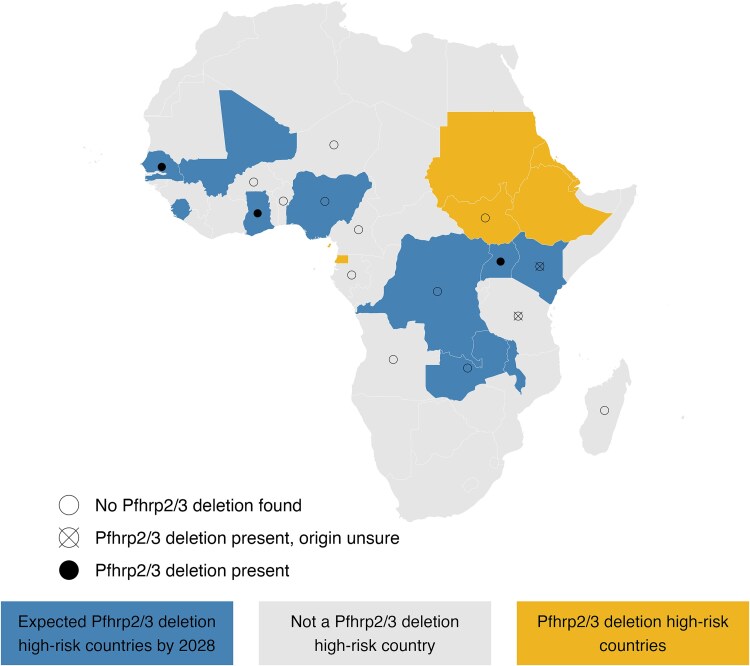 Figure 1
- —Karl Landsteiner Gesellschaft
Peer Reviews
No public reviews on file for this paper yet. If you reviewed it on a platform where reviews are public (OpenReview, ICLR, NeurIPS, ICML), you can paste yours below so the community can read it here.
Videos
No videos yet. Explain this paper in a talk, walkthrough, or lecture? Add one.
Taxonomy
TopicsMalaria Research and Control · Travel-related health issues · Toxoplasma gondii Research Studies
Malaria remains a considerable risk for international travellers. In 2022, a total of 6131 malaria cases were reported across the European Union and European Economic Area.1 Timely diagnosis is critical to prevent severe disease and complications, underscoring the need to maintain proficiency in malaria diagnostics.2
Light microscopy is the diagnostic gold standard, as it allows prompt diagnosis, species identification and estimation of parasite density, which serves as a proxy for disease severity. However, its reliability is dependent on well-trained laboratory personnel, which has been a reason for the widespread implementation of RDTs as complementary diagnostic tools.3 The histidine rich protein (HRP) 2, an antigen produced by the parasite, is the primary target for Plasmodium falciparum-specific RDTs. Plasmodium falciparum also expresses HRP3, which can compensate for the absence of HRP2 in HRP2-based RDTs.4 Deletions of pfhrp2 and pfhrp3 (pfhrp2/3) causing false negative RDTs, have been challenging malaria control strategies in numerous African countries. The World Health Organisation (WHO) has published guidelines to monitor pfhrp2/3 gene deletions, and recommended an adaptation of national testing strategies if ≥5% of symptomatic P. falciparum infections are missed by HRP2-based RDTs. African countries already exceeding the WHO threshold of 5% are Djibouti, Eritrea, Ethiopia, Sudan, South Sudan and Equatorial Guinea, whereas several other countries are expected to reach the 5% threshold by 2028.5 The increasing prevalence of pfhrp2/3 deletions is likely to affect healthcare providers and laboratory personnel in non-endemic settings, however their implication for diagnostic strategies is less well defined.6 Accordingly, the objective of this study was to describe the prevalence of pfhrp2/3 gene deletions and assess their potential impact on malaria diagnostic strategies at the Austrian National Reference Laboratory.
This retrospective laboratory-based observational study was conducted to describe the prevalence of pfhrp2/3 gene deletions in all P. falciparum-positive samples referred to the Austrian national reference laboratory during 2019–2024. The Austrian national reference laboratory receives the majority of cases from Eastern Austria, in addition to a proportion of cases from other regions.1 Baseline demographics, and information on the disease and treatment were obtained from the electronic patient information system. Detailed descriptions of the PCR and qPCR protocols, as well as the statistical analysis methods, are provided in the Supplementary material.7^,^8 The study protocol was approved by the Ethics Committee of the Medical University of Vienna, Austria (ECS 1150/2022) and all study-related procedures were conducted in accordance with the Declaration of Helsinki. This study was conducted and reported in accordance with the STROBE guidelines.
Overall, 115 patients were included into the analysis. All patients for whom the travel history was known had travelled to Africa (Table 1). Only one (0.9%) patient had been travelling to an already described pfhrp2/3 high risk country, namely South Sudan. However, 59 (51.3%) patients had travelled to a country which is suspected to reach the 5% threshold by 2028.5
The median age of the cohort was 39.2 (25.2–49.5) years, and only 32.5% (25 of 115) were female. In 46 of 115 patients (40%) information on disease severity was available, 12 of these (26.1%) experiencing severe malaria. Treatment regimens for patients with severe malaria comprised artesunate (n = 5, 41.7%), artesunate and clindamycin (n = 2, 16.7%), quinine and doxycycline (n = 1, 8.3%), artemether/lumefantrine (n = 3, %) and not reported (n = 1, 8.3%). Uncomplicated malaria had been treated with artemether/lumefantrine in all cases.
The analyses revealed four pfhrp2 or 3 gene deletions (4 of 115, 3.5%), but no case of deletions of both genes in one same sample. Pfhrp2 gene deletions were detected in a patient from Ghana and in a patient from Uganda. The pfhrp3 gene deletions were found in a patient who had travelled to Kenya and Tanzania and in a patient who had travelled to Senegal. Figure 1 gives an overview of countries travelled by patients treated for malaria at our centre as well as their pfhrp2/3 gene deletion status. Characteristics of patients with pfhrp2/3-deleted P. falciparum malaria are given in Supplementary Table 1.
The emergence of pfhrp2/3 gene deletions has challenged diagnostic strategies in countries primarily reliant on HRP2-based RDTs for P. falciparum infection. While the impact of these deletions in endemic settings has been increasingly described, their implications for diagnostic strategies in non-endemic centres remain less well defined. In general, the WHO recommends an adaptation of diagnostic strategy for regions where ≥5% of symptomatic P. falciparum infection are missed by HRP2-based RDTs. In this study, comprising all malaria tropica patients diagnosed at the Austrian national reference laboratory over the past 5 years, pfhrp2/3 deletion was 3.5%, remaining below the WHO threshold. However, more than half of the travellers (52.8%) had returned from countries considered at high risk of reaching this threshold by 2028.
Alternative testing strategies include light microscopy, PCR or alternative non-HRP based RDTs. Light microscopy, the current gold standard, allows prompt diagnosis and species identification, while not needing complex equipment. However, accurate interpretation depends on the availability of experienced microscopists, which may be challenging in smaller hospitals that encounter malaria cases infrequently. In such contexts, PCR-based methods might be a suitable alternative.9 Additionally, new RDT combinations might be of value. A recent analysis of RDTs in a high-risk setting combining HRP2 and PfLDH in a single test line, demonstrated better test results (77%) in comparison to HRP2-based RDTs (55.9%), however a significant number of infections is still missed.10
The main limitation of this study is its single-centre design, which reflects the prevalence of pfhrp2/3 gene deletions observed at the Austrian national reference laboratory. Consequently, the prevalence of pfhrp2/3 gene deletions may differ in centres caring for patient populations with more frequent travel to regions at high risk for pfhrp2/3 gene deletions.
In conclusion, the overall prevalence of pfhrp2/3 gene deletions among travellers over the past five years remained low. Given the expected rise in pfhrp2/3 deletions in several African countries, non-endemic reference centres should continue monitoring for pfhrp2/3 deletions to guide national diagnostic testing strategies.
Supplementary Material
Supplementary_file_pfhrp_travellers_research_letter_revision_taag007
The reference list from the paper itself. Each links out to its DOI / PubMed record.
- 1European Centre for Disease Prevention and Control . Malaria. In: ECDC. Annual Epidemiological Report for 2022. Stockholm: ECDC, 2024.
- 2Seringe E, Thellier M, Fontanet A et al. Severe imported Plasmodium falciparum malaria, France, 1996-2003. Emerg Infect Dis 2011;17:807–13. 10.3201/eid 1705.101527.21529388 PMC 3321778 · doi ↗ · pubmed ↗
- 3World Health Organization . World Malaria Report 2024: Addressing Inequity in the Global Malaria Response. Geneva: World Health Organization, 2024.
- 4Feleke SM, Reichert EN, Mohammed H et al. Plasmodium falciparum is evolving to escape malaria rapid diagnostic tests in Ethiopia. Nat Microbiol 2021;6:1289–99. 10.1038/s 41564-021-00962-4.34580442 PMC 8478644 · doi ↗ · pubmed ↗
- 5World Health Organization . Response Plan to pfhrp 2 Gene Deletions, 2nd edn. Geneva: World Health Organization, 2024.
- 6Watson OJ, Tran TN, Zupko RJ et al. Global risk of selection and spread of Plasmodium falciparum histidine-rich protein 2 and 3 gene deletions. Nat Med 2025;31:3372–9. 10.1038/s 41591-025-03974-3.41053448 PMC 12532711 · doi ↗ · pubmed ↗
- 7Schneider R, Lamien-Meda A, Auer H, Wiedermann-Schmidt U, Chiodini PL, Walochnik J. Validation of a novel FRET real-time PCR assay for simultaneous quantitative detection and discrimination of human plasmodium parasites. Plo S One 2021;16:e 0252887. 10.1371/journal.pone.0252887.34086817 PMC 8177637 · doi ↗ · pubmed ↗
- 8Kreidenweiss A, Trauner F, Rodi M et al. Monitoring the threatened utility of malaria rapid diagnostic tests by novel high-throughput detection of plasmodium falciparum hrp 2 and hrp 3 deletions: a cross-sectional, diagnostic accuracy study. E Bio Med 2019;50:14–22. 10.1016/j.ebiom.2019.10.048. · doi ↗