Changing Practices of Opportunistic Salpingectomies and Oophorectomies From 1997 to 2017: A Nationwide Study
Jenni Hakkarainen, Aapeli Nevala, Nea Malila, Janne Pitkäniemi, Annika Auranen

Abstract
Genes, proteins, chemicals, diseases, species, mutations and cell lines named across the full text — each resolved to its canonical identifier and authoritative record.
Click any figure to enlarge with its caption.
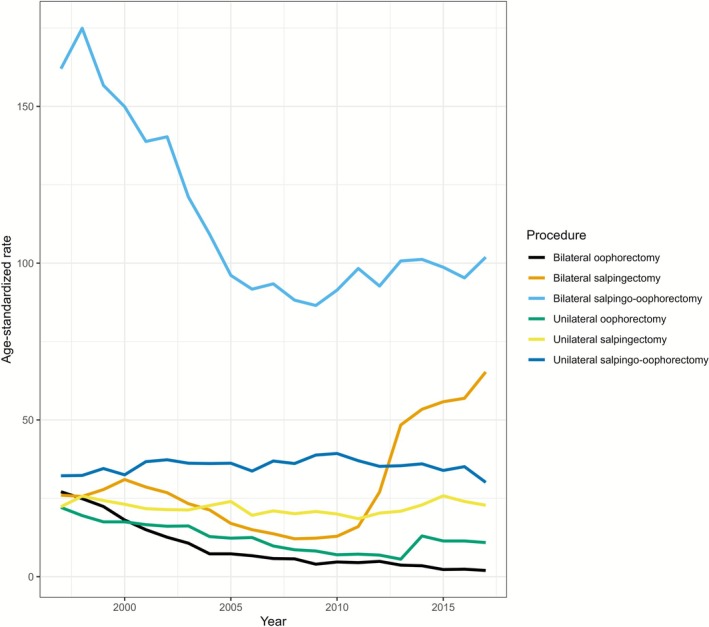 Figure 1
- —the Finnish Society of Obstetrics and Gynecology
- —Syöpäsäätiö10.13039/501100010711
Peer Reviews
No public reviews on file for this paper yet. If you reviewed it on a platform where reviews are public (OpenReview, ICLR, NeurIPS, ICML), you can paste yours below so the community can read it here.
Videos
No videos yet. Explain this paper in a talk, walkthrough, or lecture? Add one.
Taxonomy
TopicsOvarian cancer diagnosis and treatment · Gynecological conditions and treatments · Reproductive Biology and Fertility
In gynaecology, surgical removal of the ovaries (oophorectomy) and the Fallopian tubes (salpingectomy) has been performed as opportunistic procedures at the time of hysterectomy. Due to the vital role of ovaries in women's well‐being, the early 2000s saw a decrease in the use of opportunistic oophorectomy [1]. The incidence of opportunistic salpingectomy at the time of hysterectomy, however, has increased since the 2010s due to growing evidence of the tubal origin of high‐grade serous‐ovarian cancer justifying the removal of the Fallopian tubes for ovarian cancer prevention [2, 3, 4]. In recent decades, both globally and in Finland, the incidence of hysterectomy has undergone major changes [5], but while the proportion of salpingectomies performed during hysterectomy has increased, the actual population‐level incidence of salpingectomies remains largely unknown.
Therefore, to gain further insight into population level incidence, we examined national trends in the age‐standardised incidence (Finnish standard population 2015 per 10^5^ women‐years) of salpingectomies and oophorectomies in Finland over 20 years, from 1997 to 2017. We obtained data on hospital visits with adnexal procedure (Surgery involving the fallopian tubes and/or ovaries) from the Care Register for Health Care (HILMO), maintained by the Finnish Institute for Health and Welfare. We classified the procedures using the Nordic Classification of Surgical Procedures (NCPS). Bilateral salpingectomy codes were available from 2017 onward. Prior to 2017, it was possible to indicate bilaterality with a specific code for bilaterality; however, this practice was inconsistently implemented across hospitals. Therefore, when this specific code was not used, we interpreted salpingectomies at the time of hysterectomy as bilateral salpingectomies if there was no specific diagnosis code for tubal pathology. The study was approved by the Finnish Institute for Health and Welfare (Permit no. THL/367/6.02.00/2019; March 5, 2019).
From 1997 to 1999, the mean annual number of bilateral salpingo‐oophorectomies was 4113 (incidence 163.9/10^5^). The number decreased during 2006–2008 to 2442 (90.7/10^5^), then increased slightly in 2015–2017 to 2835 (98.5/10^5^) (Figure 1). At the beginning of the study period in 1997–1999, the mean annual number of bilateral salpingectomies was 766 (incidence 26.5/10^5^). The lowest mean annual number, 381 (13.6/10^5^), was observed in 2006–2008 followed by an increase to 1586 (59.3/10^5^) in 2015–2017. The median age at the time of any surgery, including bilateral salpingectomy, increased from 53.0 years in 1997–1999 to 55.1 in 2015–2017. The median age at the time of bilateral salpingectomy (without oophorectomy) decreased from 47.1 years in 1997–1999 to 45.8 years in 2015–2017. In 1997–1999, 36.2% of hysterectomies included salpingectomy (annually 4396 procedures), with the proportion increasing to 54.3% (3230 annual procedures) in 2015–2017. However, the total number of hysterectomies has decreased over time from 12 450 procedures in 1998 to 5991 in 2017 [5].
Our evaluation of the Finnish registry data shows that the implementation of the current recommendations promoting opportunistic removal of the Fallopian tubes at the time of hysterectomy has been successful in Finland. Even so, the overall rate of salpingectomies was still lower in 2015–2017 compared to the beginning of the study period, explained by decreased overall incidence of hysterectomy during the study period. The lack of an unambiguous coding to separate bilateral and unilateral salpingectomy until 2017 is a limitation in this study, but we find our interpretation justified, based on national clinical coding practice. The main purpose of this study was to obtain the correct population‐at‐risk numbers for future estimation of ovarian cancer incidence, accounting for the surgical removal of the ovaries and the Fallopian tubes. Our ongoing research on ovarian cancer incidence in Finnish will examine whether surgery‐corrected incidence rates differ from the non‐corrected rates.
Author Contributions
J.H. contributed to the data summary review and manuscript formation; J.H., A.A. and J.P. contributed to the planning of the study and the manuscript organisation; and A.N. contributed to the statistical programming and performed statistical analysis. All authors contributed to the manuscript preparation.
Funding
Cancer Foundation Finland granted financial support for this research. J.H. has received a personal grant from the Finnish Society of Obstetrics and Gynecology.
Conflicts of Interest
The authors declare no conflicts of interest.
The reference list from the paper itself. Each links out to its DOI / PubMed record.
- 1W. H. Parker , M. S. Broder , Z. Liu , D. Shoupe , C. Farquhar , and J. S. Berek , “Ovarian Conservation at the Time of Hysterectomy for Benign Disease,” Obstetrics and Gynecology 106, no. 2 (2005): 219–226.16055568 10.1097/01.AOG.0000167394.38215.56 · doi ↗ · pubmed ↗
- 2T. Zadabedini Masouleh , H. Etchegary , K. Hodgkinson , B. J. Wilson , and L. Dawson , “Beyond Sterilization: A Comprehensive Review on the Safety and Efficacy of Opportunistic Salpingectomy as a Preventative Strategy for Ovarian Cancer,” Current Oncology 30 (2023): 10152–10165.38132373 10.3390/curroncol 30120739 PMC 10742942 · doi ↗ · pubmed ↗
- 3R. S. Mandelbaum , C. L. Adams , K. Yoshihara , et al., “The Rapid Adoption of Opportunistic Salpingectomy at the Time of Hysterectomy for Benign Gynecologic Disease in the United States,” American Journal of Obstetrics and Gynecology 223, no. 5 (2020): 721.e 1–721.e 18.10.1016/j.ajog.2020.04.02832360846 · doi ↗ · pubmed ↗
- 4C. Fisch , M. E. Gelderblom , B. Slangen , et al., “Implementation of Opportunistic Salpingectomy for Ovarian Cancer Prevention: Analyzing Clinical Practice and Key Characteristics,” Acta Obstetricia et Gynecologica Scandinavica 104, no. 8 (2025): 1539–1549.40470705 10.1111/aogs.15128 PMC 12283169 · doi ↗ · pubmed ↗
- 5J. Hakkarainen , A. Nevala , E. Tomás , et al., “Decreasing Trend and Changing Indications of Hysterectomy in Finland,” Acta Obstetricia et Gynecologica Scandinavica 100 (2021): 1722–1729.33797081 10.1111/aogs.14159 · doi ↗ · pubmed ↗