Adaptation and performance evaluation of Perendale, Dorper, and Suffolksheep in Bangladesh
Nure Hasni Desha, Sadia Afrin, Md. Mahmudul Hasan Pasha, Md Nahid Hassan Chawdhury, Md. Zillur Rahman

TL;DR
This study evaluates the performance of three exotic sheep breeds in Bangladesh, finding that Dorper sheep perform best for meat production.
Contribution
The study provides empirical data on the adaptation and performance of Perendale, Dorper, and Suffolk sheep in Bangladesh.
Findings
Dorper sheep had the highest birth weight and daily weight gain in early months.
Suffolk sheep produced the most wool per shearing.
Dorper sheep had the shortest lambing interval and high survivability rates.
Abstract
The research was conducted to adapt the Perendale, Dorper, and Suffolk sheep and evaluate their productive and reproductive performances. Data from 82 pure exotic sheep were recorded within the period of 2016–2024. The considered traits were birth weight, live weight at 3 (BWT3), 6 (BWT6), 9 (BWT9), and 12 months (BWT12), adult weight (2–3 years), average daily weight gain at 0–3 (ADG0-3), 3–6 (ADG3–6), 6–9 (ADG6–9), and 9–12 (ADG9–12) months of age, wool production, age at first conception, gestation length, litter size, age at first lambing, lambing interval, and days open. The data were analyzed using R software version 4.4.2. Breed had no significant effect on productive and reproductive traits except BWT3, ADG0-3, wool production per sheep per shearing, and average lambing interval. The highest BWT3 (kg) and ADG0-3 (gm/day) were found in Dorper sheep, followed by Suffolk and…
Genes, proteins, chemicals, diseases, species, mutations and cell lines named across the full text — each resolved to its canonical identifier and authoritative record.
Click any figure to enlarge with its caption.
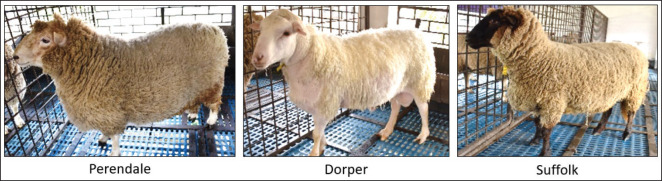 Figure 1
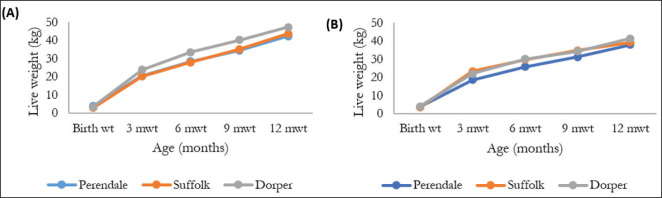 Figure 2
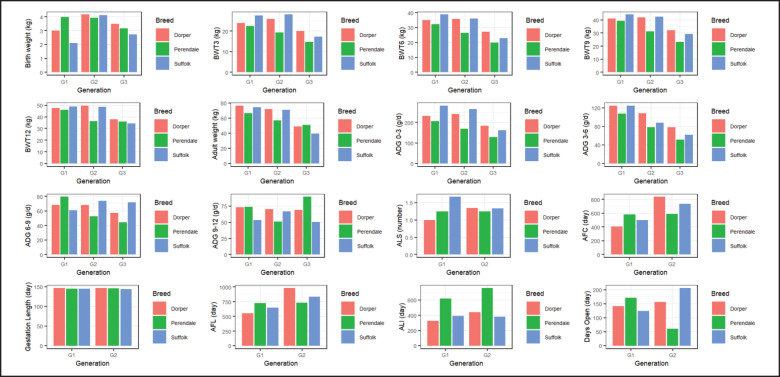 Figure 3
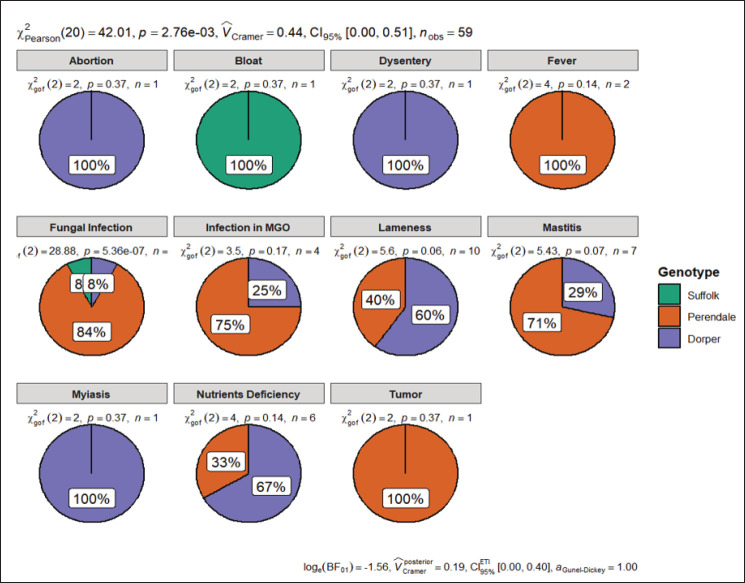 Figure 4
| Parameters | Breed | References | ||
|---|---|---|---|---|
| Perendale | Dorper | Suffolk | ||
| Birth weight (kg) | 3.33 |
[ | ||
| 4.09 |
[ | |||
| 4.12 |
[ | |||
| 5.5 | 5.7 |
[ | ||
| 4.94 |
[ | |||
| 4.8 |
[ | |||
| 4.21 |
[ | |||
| 4.30 |
[ | |||
| 3-month body weight (kg) | 23.8 |
[ | ||
| 25.57 |
[ | |||
| 21.5 |
[ | |||
| 23.8 |
[ | |||
| 6-month body weight (kg) | 36.7 |
[ | ||
| 48.7 |
[ | |||
| 9-month body weight (kg) | 47.8 |
[ | ||
| 12-month bodyweight (kg) | 63.5 |
[ | ||
| 34.6 |
[ | |||
| 40.4 |
[ | |||
| ADG0-3 (gm/day) | 240-280 |
[ | ||
| 219.0 |
[ | |||
| 300 |
[ | |||
| ADG3-6 (gm/day) | 180 |
[ | ||
| Gestation length (day) | 147 |
[ | ||
| 146.20 |
[ | |||
| Litter size (number) | 1.54 |
[ | ||
| 1.63 |
[ | |||
| 1.8 |
[ | |||
| 1.75 |
[ | |||
| 1.32 |
[ | |||
| Age at first lambing (day) | 570 |
[ | ||
| 717.9 |
[ | |||
| Average lambinginterval (day) | 398 |
[ | ||
| Survivability of lamb (%) | 91.0 |
[ | ||
| 93.4 |
[ | |||
| 81.0 |
[ | |||
| Parameters | Breed | SEM | |||
|---|---|---|---|---|---|
| Perendale | Suffolk | Dorper | |||
| Production traits- | |||||
| Birth weight (kg) | 3.79 (54) | 3.22 (13) | 3.67 (15) | 0.1948 | 0.1923 |
| BWT3 (kg) | 19.39b (52) | 22.19ab (13) | 23.15a (15) | 1.0343 | 0.03139 |
| BWT6 (kg) | 26.99 (51) | 29.09 (12) | 32.11 (15) | 1.5221 | 0.08321 |
| BWT9 (kg) | 32.61 (48) | 34.97 (12) | 37.85 (15) | 1.8168 | 0.1459 |
| BWT12 (kg) | 39.94 (42) | 40.88 (11) | 45.28 (12) | 2.1588 | 0.2754 |
| Adult weight (kg) | 61.21 (32) | 57.20 (09) | 67.73 (09) | 3.6511 | 0.321 |
| ADG0-3 (gm/day) | 173.12b (52) | 210.86a (13) | 216.52a (15) | 10.76 | 0.009646 |
| ADG3-6 (gm/day) | 82.51 (51) | 76.66 (12) | 99.48 (15) | 7.51 | 0.2367 |
| ADG6-9 (gm/day) | 60.12 (48) | 71.48 (12) | 63.78 (15) | 5.5061 | 0.4387 |
| ADG9-12 (gm/day) | 63.36 (42) | 56.87 (11) | 70.46 (12) | 6.2202 | 0.5329 |
| Wool production/sheep/ shearing (kg) | 1.73a (04) | 2.02a (04) | 0.46b (04) | 0.3139 | 0.01484 |
| Reproduction traits- | |||||
| Age at first conception (day) | 584.94 (16) | 677.00 (04) | 695.00 (03) | 47.083 | 0.2599 |
| Gestation length (day) | 145.19 (16) | 144.25 (04) | 146.67 (03) | 0.5702 | 0.1591 |
| Litter size (number) | 1.25 (16) | 1.42 (04) | 1.22 (03) | 0.134 | 0.6885 |
| Age at first lambing (day) | 729.81 (16) | 788.50 (04) | 841.67 (03) | 44.9156 | 0.3215 |
| Average lambing interval (day) | 635b (08) | 383a (04) | 382.5a (02) | 70.4999 | 0.03348 |
| Days open (day) | 152.63 (16) | 186.25 (04) | 149.67 (02) | 26.0233 | 0.694 |
| Parameters | Season | SEM | ||||
|---|---|---|---|---|---|---|
| Early summer | Late summer | Winter | Rainy | |||
| Production traits- | ||||||
| Birth weight (kg) | 3.72a (46) | 2.35b (06) | 3.95a (28) | 2.80ab (02) | 0.213 | 0.004594 |
| BWT3 (kg) | 20.44 (45) | 18.12 (05) | 20.84 (28) | 25.20 (02) | 1.188 | 0.52119 |
| BWT6 (kg) | 29.05 (44) | 22.52 (05) | 27.51 (28) | 37.40 (02) | 1.744 | 0.14815 |
| BWT9 (kg) | 35.34 (40) | 27.00 (05) | 32.62 (28) | 45.35 (02) | 2.036 | 0.06939 |
| BWT12 (kg) | 41.72 (38) | 30.70 (05) | 41.45 (20) | 51.35 (02) | 2.441 | 0.08468 |
| Adult weight (kg) | 61.40 (28) | 35.00 (01) | 61.67 (19) | 78.60 (02) | 4.122 | 0.1706 |
| Reproduction traits- | ||||||
| Age at first conception (day) | 609.45b (11) | - | 640.09b (11) | 407.00a (01) | 37.426 | 0.01243 |
| Gestation length (day) | 144.64 (11) | - | 145.64 (11) | 147.00 (01) | 0.55 | 0.2038 |
| Litter size (number) | 1.30 (11) | - | 1.27 (11) | 1.00 (01) | 0.133 | 0.7064 |
| Age at first lambing (day) | 752.27b (11) | - | 775.18b (11) | 554.00a (01) | 35.75 | 0.009183 |
| Average lambing interval (day) | 585.5 (08) | - | 473.4 (05) | 326.0 (01) | 77.222 | 0.71893 |
| Days open (day) | 155.27 (11) | - | 162.36 (11) | 142.00 (01) | 28.212 | 0.9924 |
| Breed | Lamb (0–3 months of age) | Growing (3–8 months of age) | ||
|---|---|---|---|---|
| Survivability (%) | Mortality (%) | Survivability (%) | Mortality (%) | |
| Perendale | 96.3 (52) | 3.70 (02) | 98.08 (51) | 1.92 (01) |
| Suffolk | 92.31 (12) | 7.69 (01) | 100 (12) | 0 |
| Dorper | 100 (15) | 0 | 100 (15) | 0 |
Peer Reviews
No public reviews on file for this paper yet. If you reviewed it on a platform where reviews are public (OpenReview, ICLR, NeurIPS, ICML), you can paste yours below so the community can read it here.
Videos
No videos yet. Explain this paper in a talk, walkthrough, or lecture? Add one.
Taxonomy
TopicsGenetic and phenotypic traits in livestock · Livestock Farming and Management · Livestock Management and Performance Improvement
Introduction
Bangladesh is a country with a diverse range of livestock species, where small ruminants play a significant role, and sheep constitute the third-largest livestock population, numbering 3.903 million [1]. The sheep enterprises in Bangladesh have historically relied on indigenous types, contributing significantly to the improvement of the livelihoods of landless, marginal, and small-scale farmers, as well as to the country's income generation [2–8]. Indigenous sheep are well-adapted to the local environment, with minimal feed requirements, higher production performance, greater disease resistance, and superior meat quality [9-11]. However, they often exhibit lower growth rates and wool quality compared to foreign breeds [12,13].
Several programs have been implemented to introduce exotic sheep germplasm with the aim of improving native sheep in the country, but these efforts have not been sustained in the long run [14]. In 2016, the Bangladesh Livestock Research Institute (BLRI) imported 42 sheep of three exotic breeds (Suffolk, 13; Perendale, 14; and Dorper, 15) from Australia to enhance the production performance of native sheep [15]. These breeds were chosen for their well-established productive and reproductive attributes, which are widely recognized in terms of growth performance, fertility, and meat quality. The primary goal of introducing these breeds at BLRI was to assess their adaptability and improve the productivity of local sheep populations through crossbreeding programs. Furthermore, selective breeding among these imported breeds has been undertaken to proliferate their numbers and assess their suitability for scaling up. Suffolk is a British breed known for its fast growth, high-quality meat, and ease of lambing [16].
Perendale, established in New Zealand, is known for its dual-purpose meat and wool production, easy-care lambing, good mothering, and lamb survival, as well as its ability to flourish in harsh, hilly terrain [17]. Dorper, which originated in South Africa, is recognized for its hardiness, rapid weight increase, and adaptability to a wide range of climatic conditions, including desert settings [18-21]. Each of these breeds has been extensively studied in its country of origin, where it has been optimized through decades of selective breeding programs. However, their performance in tropical environments, such as Bangladesh, characterized by high environmental temperatures, high humidity, seasonal flooding, and a prevalence of diseases, remains largely undocumented. To make informed decisions about the potential of these breeds, it is essential to have a thorough understanding of their overall performance, including sexual maturity, prolificacy, lambing interval, milk production, body weight gain, disease susceptibility, and mortality rates, in our country. This study will show a detailed comparison between the productive and reproductive performance of these imported sheep breeds in Bangladesh and the established benchmarks from their countries of origin. By evaluating their performance, this research will help to understand whether these foreign breeds can be sustainably utilized to enhance sheep production in Bangladesh, as well as their effective integration into the national livestock development strategy. Thus, the research aimed to evaluate the productive, reproductive, and adaptation performance of Perendale, Dorper, and Suffolk sheep in Bangladesh.
Materials and Methods
Ethical approval
The Animal Experimentation and Ethics Committee of Bangladesh Livestock Research Institute approved this study project (Reference no.: AEEC/BLRI00117/2023). All rules and regulations for animal care were strictly adhered to during animal handling.
Location of the study area
The experiment was conducted at the BLRI Exotic Sheep Research Farm in Savar, Dhaka. The average daily temperature and relative humidity of the area range from 15°C to 34°C and 48.71%–85.9%, respectively.
Flock management
Experimental animal
Data from a total of 82 pure exotic sheep (Dorper, Perendale, and Suffolk) were managed from 2016 to 2024. The experimental population comprised 25 males and 29 females of the Perendale breed, 9 males and 6 females of the Dorper breed, and 5 males and 8 females of the Suffolk breed, respectively (Fig. 1).
Different breeds of sheep.
Housing and feeding
Animals were kept in intensive management in a permanent slatted-floor house elevated above the ground level. At 1.5% of their body weight, the animals were fed a concentrate diet in the morning that included 17% CP and 11 MJ ME/kg DM, which was based on broken maize, wheat bran, khesari bran, soybean meal, and protein concentrate, as well as green grasses (Napier pakchong, Oats, Maize, and Australian sweet jumbo), which were provided on an ad libitum basis. Fresh water was supplied in adequate quantities at all times. The concentrate mixture was formulated using the following feed ingredients: wheat bran (30%), broken maize (30%), soybean meal (20%), khesari bran (16%), protein concentrate (1.5%), di-calcium phosphate (1%), salt (1%), and vitamin–mineral premix (0.5%).
Breeding
To preserve the pure bloodline, the breeding program was managed in a way that minimized inbreeding. An estrous female naturally mated with the ram in accordance with the established mating chart. Throughout the year, ewes were permitted to produce lambs as part of a natural, controlled breeding scheme.
Health and disease
Sheep were vaccinated against peste des petits ruminants and treated regularly to manage both internal and external parasites through deworming and dipping with a 0.5% malathion solution. To maintain biosecurity, a footbath containing potassium permanganate solution was always managed in front of the animal shed.
Shearing
Wool was sheared twice a year in March–April and September–October.
Traits studied
The productive traits considered were birth weight (kg), live weight (kg) at 3 (BWT3), 6 (BWT6), 9 (BWT9), and 12 (BWT12) months, adult weight (2–3 years, kg), average daily weight gain (gm/day) at 0–3 (ADG0–3), 3–6 (ADG3–6), 6–9 (ADG6–9), and 9–12 (ADG9–12) months of age, and wool production (per sheep per shearing, kg). The reproductive traits considered were age at first conception (in days), gestation length (in days), litter size (number of lambs), age at first lambing (in days), lambing interval (in days), and days open (in days). In addition, the prevalence of disease and the survivability of lambs were also documented. The average daily gain was calculated by the following formula:
ADG (gm/day) = {(final live weight (kg)—initial body weight (kg))/number of days} × 1,000
The results obtained were compared with the published performance records of the breeds (Table 1).
Breed, generation, and season were considered as the fixed effects. The year-round seasonal impacts were noted as early summer (March–April), late summer (May–June), rainy season (July–October), and winter (November–February).
Experimental design and statistical analysis
The sample size was unbalanced because of natural service and breed differences. The experimental design was a 3-factor completely randomized design (CRD 3 factor). The model is used to determine the effect of breed, generation, and season on different productive and reproductive performances:
Y_ijk_ = μ + B_i_ + G_j_ + S_k_ + e_ijk_
Where,
Y_ijk_ = Record of Y^th^ animal born in j^th^ breed under jthgeneration in K^th^ season
μ = Overall population mean for any of the considered trait
B_i_ = Effect of i^th^ breed (where i = Perendale, Dorper and Suffolk sheep breed)
G_j_ = Effect of j^th^ generation (where j = first, second and third generation)
S_k_ = Effect of k^th^ season of birth (where k = early summer, late summer, rainy, and winter season)
e_ijk_ = Random residual error
Recorded data were assembled into a Microsoft Excel worksheet, arranged, and analyzed by R-software version 4.4.2 with the “doebioresearch” package. The Shapiro-Wilk normality test was performed to measure the normality of the data. Mean comparison test was performed by Duncan’s Multiple Range Test. To compute the multiple bar graph and disease graph, the “ggplot2,” “patchwork,” and “ggstatsplot” packages were used.
Results and Discussion
Productive performance
The productive performance of exotic sheep is shown in Table 2. Breed had no significant effect on productive traits except BWT3, average ADG0-3, and wool production per sheep per shearing. The highest BWT3 (kg) and ADG0-3 (gm/day) were found in Dorper sheep, followed by Suffolk and Perendale, and the values were 23.15, 22.19, and 19.39; and 216.52, 210.86, and 173.12, respectively. In the case of wool production per sheep per shearing (kg), the highest production was 2.02, followed by 1.73 and 0.46, found in Suffolk, Perendale, and Dorper, respectively. There was no significant effect of season on any of the production traits, except for birth weight (Table 3). The highest birth weight was observed in the winter season, followed by early summer, the rainy season, and late summer, with values of 3.95, 3.72, 2.80, and 2.35 kg, respectively.
The cumulative growth performance of different exotic male and female sheep is shown in Figure 2. Among the males, the growth performance was highest in the Dorper breed except for the birth weight, which was found to be higher in the Perendale breed. The cumulative birth weight (kg) was 3.96, 2.88, and 3.42, and BWT12 (kg) was 42.32, 43.65, and 47.26 for the males of the Perendale, Suffolk, and Dorper breeds, respectively. Although the Dorper female was superior in growth performance among the breed, the Suffolk was also found to be superior in the cases of BWT3 and BWT9. The cumulative birth weight (kg) was 3.59, 3.42, and 4.03, and BWT12 (kg) was 37.98, 39.3, and 41.3 for the females of the Perendale, Suffolk, and Dorper breeds, respectively. In both sexes, the highest growth performance was observed in the Dorper breed, followed by the Suffolk and Perendale breeds, respectively. The average birth weight of females was higher than that of males, but the overall growth performance was found to be higher in males. Compared to the current result, higher birth weight (4.26 kg) and BWT3 (22.65 kg) were found, but in the case of BWT12, a lower value was reported for Perendale sheep [22]. In another study [23], the average BWT3 of Perendale sheep was found to be 31.33 kg, which is much higher than the current findings. In the case of Suffolk sheep, the average birth weight (BWT3) and average daily gain (ADG0-3) of the present study were significantly lower than the findings reported in [24], which listed the birth weight (BWT3) and average daily gain (ADG0-3) as 4.94 kg and 300 gm/day, respectively. In other studies [25,26], birth weights of 5.7 and 4.8 kg were found for Suffolk sheep, which are also significantly higher than the current findings. Relatively higher BWT6 was found (48.7 kg) compared to the present findings [27].
Cumulative growth performance of different exotic males (A) and females (B).
However, a relatively lower birth weight (3.33 kg) of Dorper sheep was reported [19], whereas higher birth weights were also reported [25,28,29] with values of 4.12, 5.5, and 4.09 kg, respectively, compared to the current findings. Likewise, a similar BWT3 (23.8 kg) but higher ADG0-3 (219.0 gm/day) than the present study was reported [28]. The average BWT6, BWT9, and BWT12 of Dorper sheep were noted as 36.7, 47.8, and 63.5 kg, respectively [29], which is much higher than the present result. Likewise, the wool production of Perendale sheep was significantly lower than the findings [22] that reported an average wool production of 2.75 kg per sheep. The variations in the results may be attributed to several factors, including geographical differences, environment, management, and adaptation. In general, the performance of any breed decreases compared to its country of origin when it is transported to another country. As the population size was very small, especially unbalanced among the breeds, more research is needed for a better understanding.
Reproductive performance
The reproductive performance of sheep may vary due to several factors, including the breeding potential of the breeding season, nutritional state, environment, location, health status, and other factors [28,30-32]. Table 2 shows the reproductive performance of different exotic sheep. There was no significant difference between breeds except for the average lambing interval. The lowest lambing interval was observed in Dorper sheep, followed by Suffolk and Perendale, with average values of 382.5, 383, and 635 days, respectively. The effect of season on different reproductive traits is narrated in Table 3. A significant effect of season was found in the cases of age at first conception and age at first lambing. The lowest age at first conception (day) and age at first lambing (day) were observed in the rainy season, followed by early summer and winter, and the average values were 407, 609.45, and 640.09; and 554, 752.27, and 775.18, respectively. Different research also found a significant influence of season on age at the first lambing [28,33]. A relatively lower age at the first lambing (346 days) was found by researchers [28], compared to the current findings. In another study [30], a higher age at the first lambing (day) was noted compared to the present result, as observed in short rain (676), long rain (653), and dry season (990). The current findings showed that the gestation length (days) of Suffolk (144.25) and Dorper (146.67) sheep was lower than the findings of another research [24,34], which reported 146.20 days for Suffolk and 147 days for Dorper, respectively. In the present study, the average litter size of Perendale sheep was found to be 1.25, which is lower than the findings [22] that reported an average litter size of 1.54. Likewise, in Suffolk sheep, a lower litter size (1.42) was found, which is lower than the findings reported as 1.63 and 1.8, respectively [24,35]. In the case of Dorper sheep, a lower litter size (1.22) was also found than the findings [34] that reported an average litter size of 1.54. The average lambing interval (in days) of Dorper sheep was found to be 382.5, which is significantly lower than the findings [30] that reported an average lambing interval of 398 days. Variation in lambing interval results in the significant effect of area, genotype, lambing season, parity, and the combined effect of different genetic and non-genetic factors [31]. However, breed-specific references for all reproductive traits were not found to compare with the current result.
Generation-wise productive and reproductive performance of different exotic sheep is described in Figure 3. Since the number of observations varied, no consistent trend was observed in different traits across successive generations. The performances did not reveal any significant trend that would facilitate a concrete selection decision. In general, it took a comparatively longer duration to produce two successive generations in our country context. However, no such review was found that describes the performance of the studied sheep breed by generation.
Generation-wise productive and reproductive performance of exotic sheep.(BWT3 = Body weight at 3 months of age; BWT6 = Body weight at 6 months of age; BWT9 = Body weight at 9 months of age; BWT12 = Body weight at 12 months of age; ADG = Average daily weight gain; ALS = Average litter size; AFC = Age at first conception; AFL = Age at first lambing; ALI = Average lambing interval.
Disease and survivability of exotic sheep
The most frequently occurring disease was fungal infection (42.37%), followed by lameness (16.94%), mastitis (13.56%), nutrient deficiency (10.17%), infection in male genital organs (6.78%), fever (3.39%), dysentery (1.69%), bloat (1.69%), tumor (1.69%), and myiasis (1.69%). The occurrence of fungal infections might be attributed to the country's hot and humid climatic conditions. Within the breed, the highest disease frequency was observed in Perendale sheep, followed by Dorper and Suffolk sheep. No such review was found that describes the disease frequency of the aforementioned sheep breed.
Table 4 shows the survivability of different exotic sheep. Among all the breeds, survivability was higher in the growing stage compared to the lamb stage. The average survivability rate of lambs and growing sheep was 96.34 and 98.73, respectively. The survivability of Dorper sheep was found to be significantly higher than the previous findings [25,28,34], which were recorded as 81%, 91%, and 93.4%, respectively. Although no previous review was found for Perendale and Suffolk sheep, the survivability rate was also found to be appreciable for these breed (Fig. 4).
*Disease frequency of different exotic sheep. (MGO= Male genital organ).
Conclusion
The performance of exotic sheep varies not only due to their genetic makeup but also to non-genetic factors such as environment, management, and others. Although the productive and reproductive performances of the exotic sheep are lower than in their country of origin, they are well adapted to our country's environment. Furthermore, the maximum population size of Perendale sheep in successive generations indicates a high degree of adaptation of the breed compared to Dorper and Suffolk. The highest growth performance of Dorper sheep suggests the breed could be useful for producing meat-type crossbred sheep. As the sample size is small, no concrete decision could be made regarding selection. By applying the genetic and non-genetic improvement model, superior exotic sheep can be incorporated to enhance the native sheep of Bangladesh.
The reference list from the paper itself. Each links out to its DOI / PubMed record.
- 1Department of Livestock Services (DLS), Bangladesh http://dls.gov.bd/site/view/annual_reports/Accessed 14 October 2024
- 2Asaduzzaman M Alam MG Jha PK Bari F On-farm management, breeding practice and constraints between two sheep breeds in Bangladesh J Anim Prod 20216211524 https://doi.org/10.5455/ijlr.20201026053211
- 3Islam SS Hasan MS Ghosh N Islam MM Prospects and problems of indigenous sheep production in south-western coastal regions of Bangladesh J Agric Sci-Sri Lanka 20211615466 https://doi.org/10.4038/jas.v 16i 1.9183
- 4Samad MAA five-decade systematic review of research progress on production and management of small ruminants in Bangladesh J Vet Med One Health Res 202131191 https://doi.org/10.36111/jvmohr.2021.3(1).0026
- 5Hossain M Rahman M Hashem M Productive performances of native sheep in Bangladesh Meat Res 20233117 https://doi.org/10.55002/mr.3.1.43
- 6Mowsume SA Khandoker MA Ahmed S Hasni N Disha MM Khatun A et al.Growth performance of native sheep under semi-intensive production system in Bangladesh Int J Livest Res 2023131207
- 7Sun MA Rahman S Islam SS Islam MS Mondol D Rahman MM Effect of grazing hour on growth performance of crossbred sheep from southwest coastal region of Bangladesh Int J Agric Res Innov Tech 20241411047 https://doi.org/10.3329/ijarit.v 14i 1.74536
- 8Rahman MH Haque MN Hemayet MA Ahmed S Dynamics of Sheep Diseases and Disorders in the Coastal Areas of Bangladesh: analyzing Frequency and Patterns SAARC J Agric 202523111122 https://doi.org/10.3329/sja.v 23i 1.78036