Hypoosmolarity inhibits ammonia oxidation by terrestrial and freshwater Nitrosopumilaceae members
Joo-Han Gwak, Adebisi Olabisi, Ui-Ju Lee, Christiana Abiola, Seongjun Lee, Hackwon Do, Yun Ji Choi, Jay-Jung Lee, Man-Young Jung, Nico Jehmlich, Martin von Bergen, Michael Wagner, Samuel Imisi Awala, Zhe-Xue Quan, Sung-Keun Rhee

TL;DR
Low salinity inhibits ammonia oxidation by certain archaea in soil and freshwater, while bacteria thrive under similar conditions.
Contribution
This study reveals hypoosmolarity as a key factor influencing the distribution of ammonia-oxidizing archaea and bacteria.
Findings
Ammonia-oxidizing bacteria (AOB) thrive under low salinity, while archaea (AOA) are inhibited.
AOA from the Nitrosopumilaceae family are particularly sensitive to hypoosmolarity.
AOB and comammox strains are less affected by low salinity compared to AOA.
Abstract
Salinity strongly influences the physiology and distribution of nitrifying microorganisms, yet the effects of low salinity remain understudied. This study investigates the impact of hypoosmolarity on different groups of ammonia oxidizers in soil and freshwater reservoirs, as well as in pure culture isolates. In soil microcosms amended with ammonium, at low salinity levels (~120 μS/cm), comparable to values commonly found in pristine terrestrial and freshwater environments, the abundance of ammonia-oxidizing bacteria (AOB), dominated by Nitrosomonas oligotropha, significantly increased. In contrast, the growth of ammonia-oxidizing archaea (AOA), dominated by “Candidatus Nitrosotenuis” of the Nitrosopumilaceae family, was stimulated by high salinity (~760 μS/cm). In ammonium-fed freshwater microcosms, the abundance of AOB, dominated by N. oligotropha, significantly increased under both…
Genes, proteins, chemicals, diseases, species, mutations and cell lines named across the full text — each resolved to its canonical identifier and authoritative record.
Click any figure to enlarge with its caption.
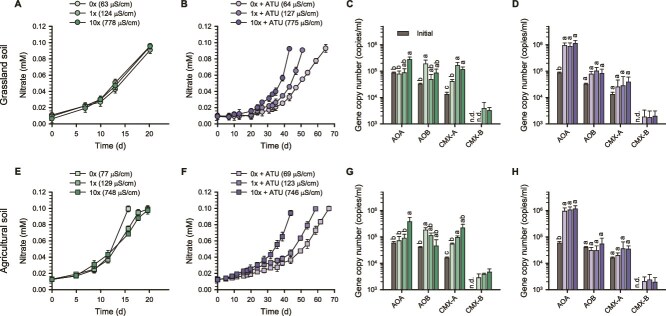 Figure 1
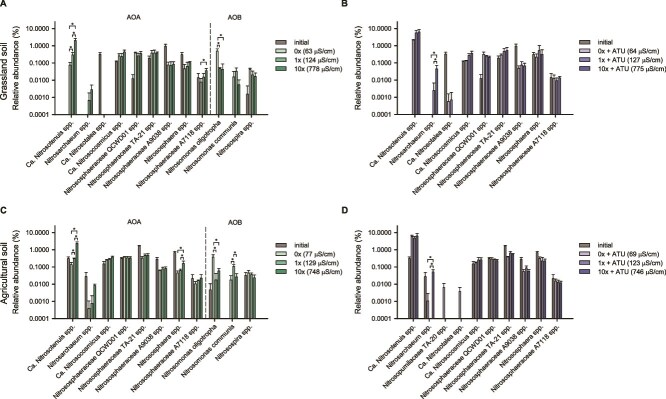 Figure 2
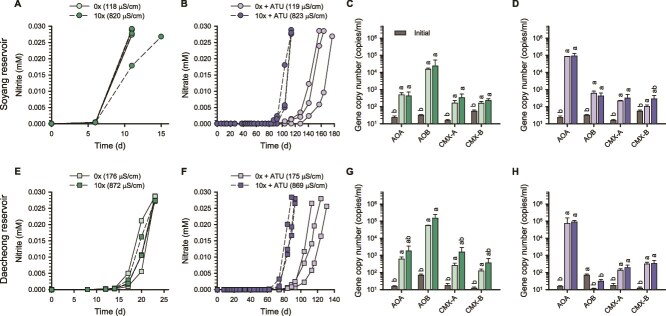 Figure 3
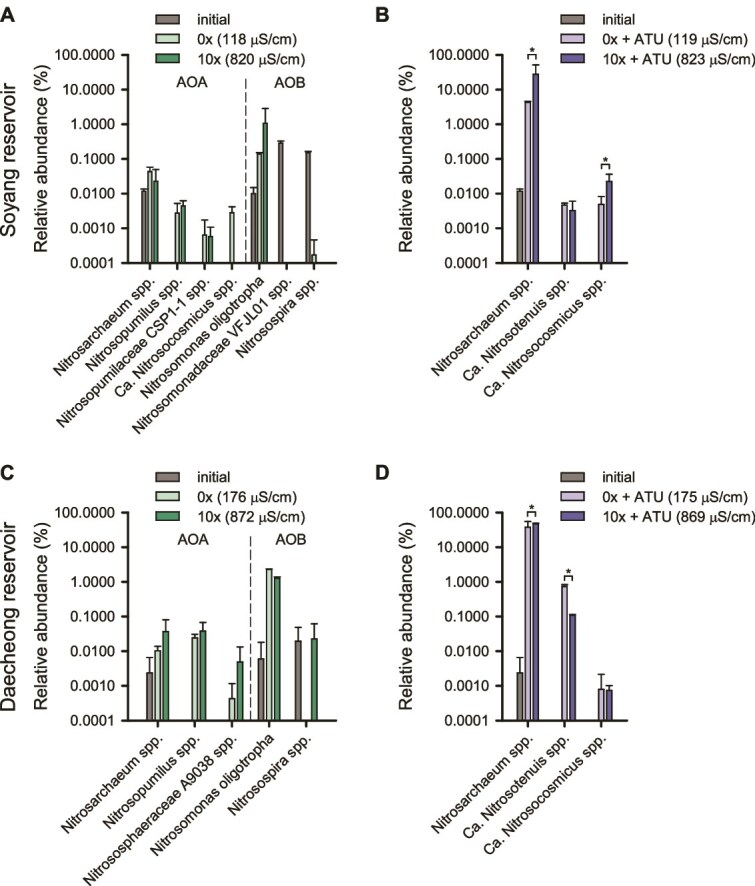 Figure 4
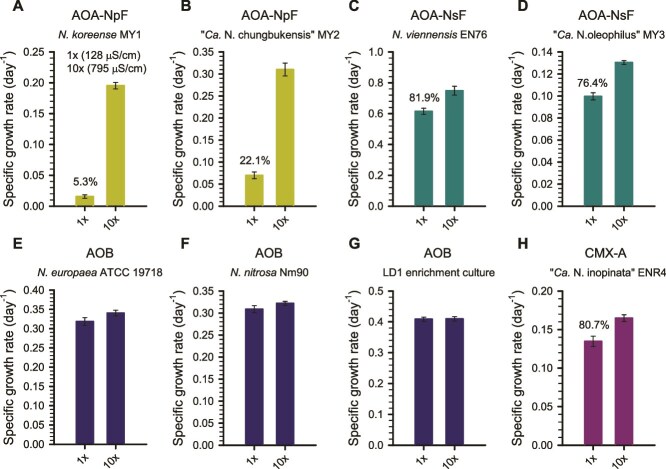 Figure 5
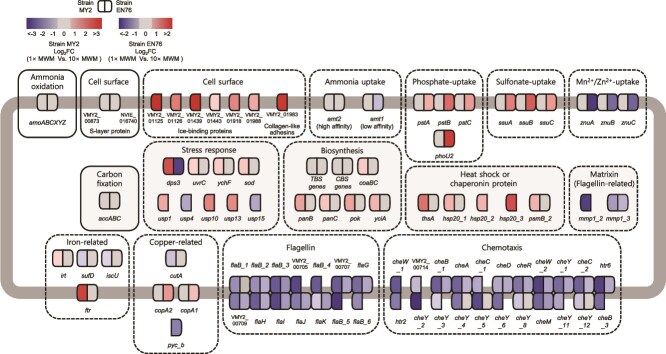 Figure 6
Peer Reviews
No public reviews on file for this paper yet. If you reviewed it on a platform where reviews are public (OpenReview, ICLR, NeurIPS, ICML), you can paste yours below so the community can read it here.
Videos
No videos yet. Explain this paper in a talk, walkthrough, or lecture? Add one.
Taxonomy
TopicsMicrobial Community Ecology and Physiology · Wastewater Treatment and Nitrogen Removal · Soil Carbon and Nitrogen Dynamics