Complex viral interactions revealed for the harmful bloom-forming dinoflagellate Karenia brevis
Anne E Booker, Cong Fei, Shady A Amin, James Custer, Kai Watkins, William Yaeger, So Hyun Ahn, Nayani K Vidyarathna, Alexandra Burns, Sarah Klass, Patricia M Glibert, Cynthia A Heil, Frederik Schulz, Joaquín Martínez Martínez

TL;DR
This study explores how viruses may influence the dynamics of harmful algal blooms caused by Karenia brevis, revealing complex viral interactions that could impact bloom termination.
Contribution
The study identifies multiple giant virus genomes and suggests complex viral interactions, including potential co-infection mechanisms, in K. brevis blooms.
Findings
Giant virus-like particles (VLPs) were detected in K. brevis cultures incubated with filtered bloom water.
Metagenomic analysis revealed 11 giant virus genomes and 7 viral operational taxonomic units (vOTUs) in the Imitervirales order.
Polinton-like virus (PLV) genomes were found, suggesting co-infection dynamics with Nucleocytoviricota viruses.
Abstract
Karenia brevis regularly forms harmful blooms along the West Florida Shelf that negatively affect marine and terrestrial organisms through toxin production. These blooms impose economic and environmental hardship, driving the need for research to understand the factors influencing their dynamics and to mitigate their impacts. A mostly unresolved issue is the potential role of viruses in bloom termination. We conducted an experiment incubating K. brevis cultures with size-fractionated bloom water samples. Flow cytometry revealed giant virus-like populations (VLPs) in replicate cultures with <1 μm-filtered and <0.2 μm-filtered bloom water. The VLPs’ abundance was paralleled by declines in photoefficiency and culture lysis. Metagenomic analyses of the lysates revealed 11 giant virus genomes (35%–100% complete) representing 7 viral operational taxonomic units (vOTUs) within the order…
Genes, proteins, chemicals, diseases, species, mutations and cell lines named across the full text — each resolved to its canonical identifier and authoritative record.
Click any figure to enlarge with its caption.
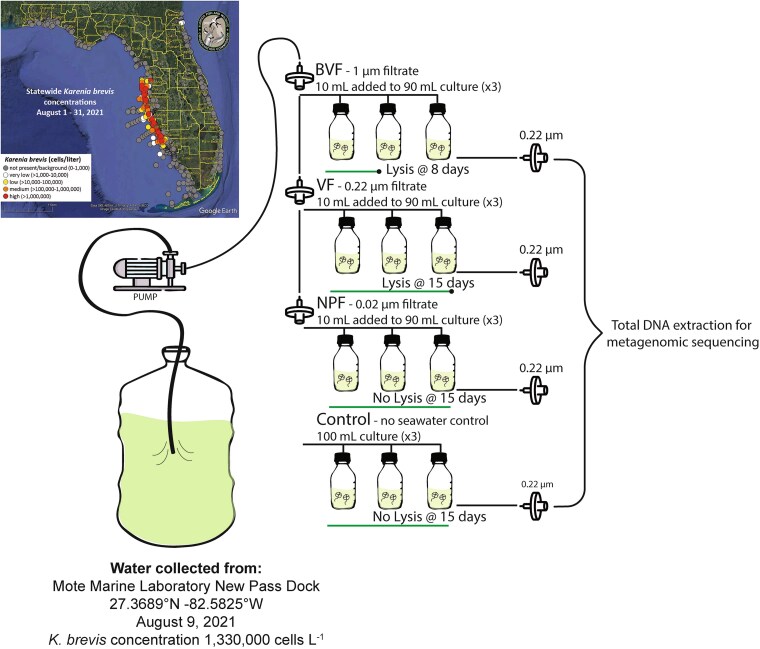 Figure 1
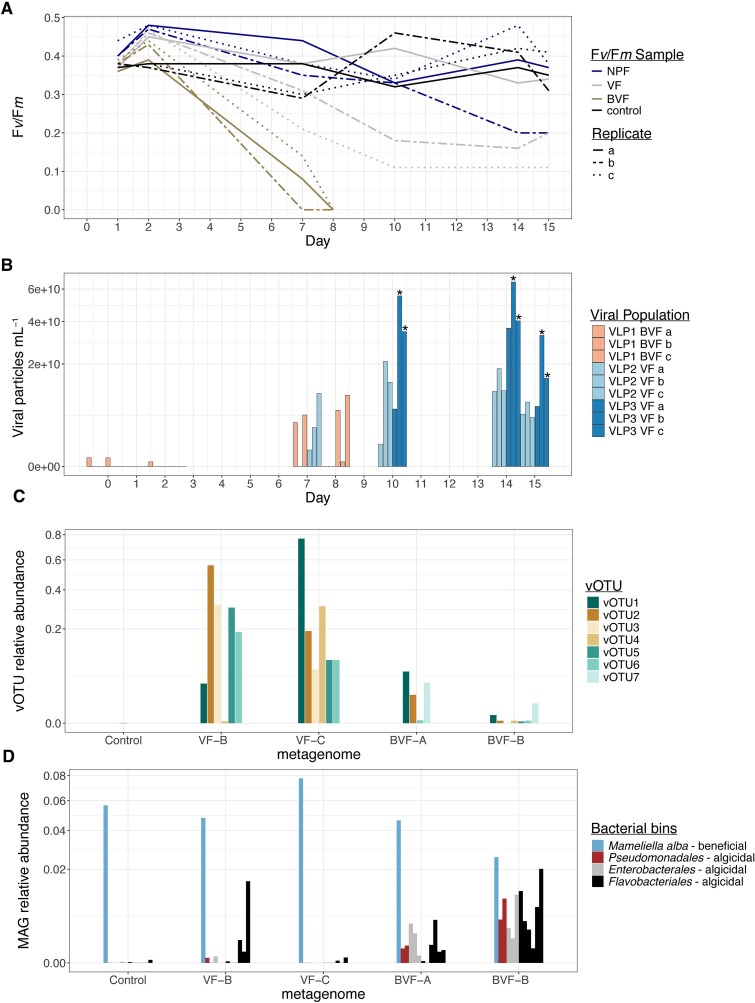 Figure 2
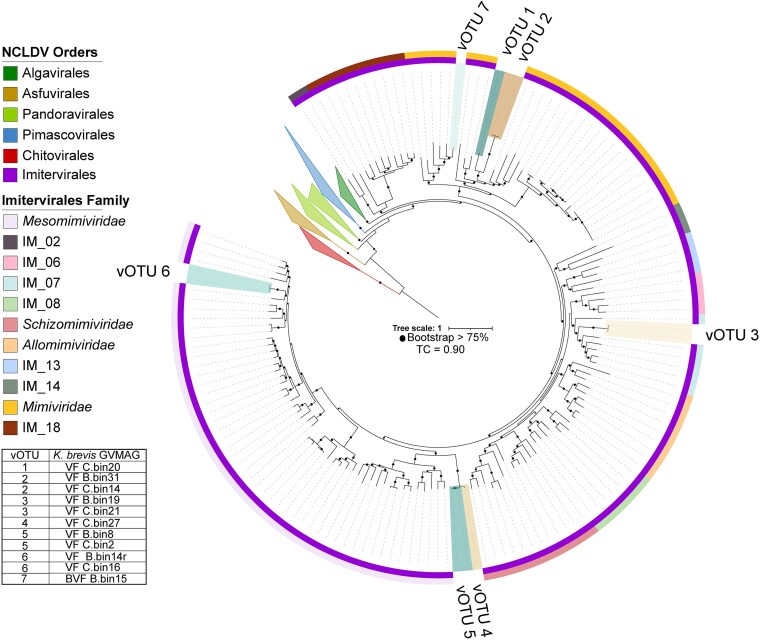 Figure 3
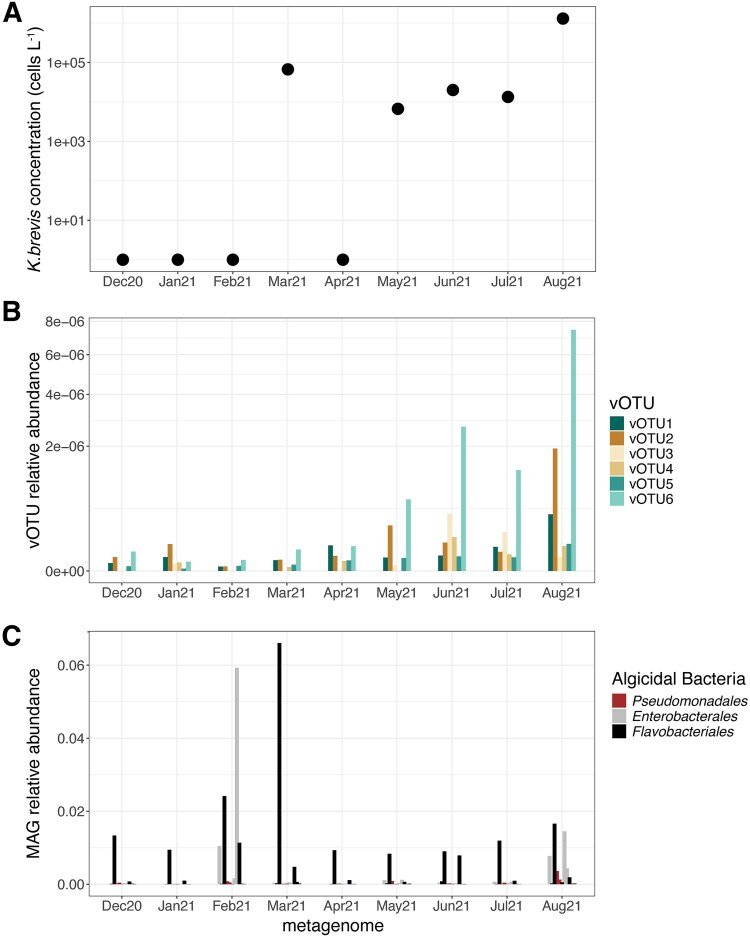 Figure 4
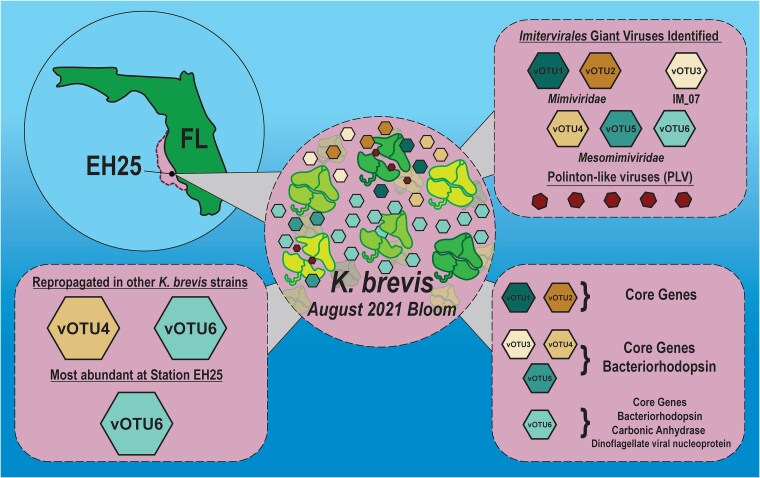 Figure 5
Peer Reviews
No public reviews on file for this paper yet. If you reviewed it on a platform where reviews are public (OpenReview, ICLR, NeurIPS, ICML), you can paste yours below so the community can read it here.
Videos
No videos yet. Explain this paper in a talk, walkthrough, or lecture? Add one.
Taxonomy
TopicsBacteriophages and microbial interactions · Marine Toxins and Detection Methods · Microbial Community Ecology and Physiology