DNA virus–host patterns in lake and marine environments over the last glacial cycle
Christiane Boeckel, Simeon Lisovski, Kathleen R Stoof-Leichsenring, Josefine Friederike Weiß, Sisi Liu, Lars Harms, Ulrike Herzschuh

TL;DR
This study uses ancient DNA from lake and marine sediments to explore how virus-host relationships have changed over thousands of years, revealing patterns in virus communities and their interactions with hosts.
Contribution
The study demonstrates the use of sedimentary ancient DNA to reconstruct ancient viral assemblages and their host interactions over glacial cycles.
Findings
Lake and marine virus communities differ, with lakes dominated by Caudoviricetes and marine sites including Algavirales.
Virus-host co-variation is stable in marine systems, especially for phytoplankton-infecting viruses.
Bacteriophages and hosts show antagonistic patterns, possibly linked to environmental shifts affecting viral cycles.
Abstract
Viruses are integral to population dynamics, biogeochemical cycling, and host evolution, making them essential for ecosystem function. We explore long-term virus–host interactions mainly within microbial ecosystems in lake and marine environments across the late Pleistocene and Holocene. Sedimentary ancient DNA (sedaDNA) from five Siberian lakes and three Subarctic/Antarctic marine cores were analysed to infer past DNA virus taxa from metagenomic sequences. Viruses accounted for 357 161 reads (0.089% of total mapped reads), distributed across 2084 unique viral taxa. Virus communities differ between lakes and marine sites, with lakes dominated by Caudoviricetes and marine environments featuring Caudoviricetes and Algavirales. Each time series shows compositional changes from the Pleistocene to the Holocene, supporting sedaDNA as a tool to reconstruct time-resolved ancient viral…
Genes, proteins, chemicals, diseases, species, mutations and cell lines named across the full text — each resolved to its canonical identifier and authoritative record.
Click any figure to enlarge with its caption.
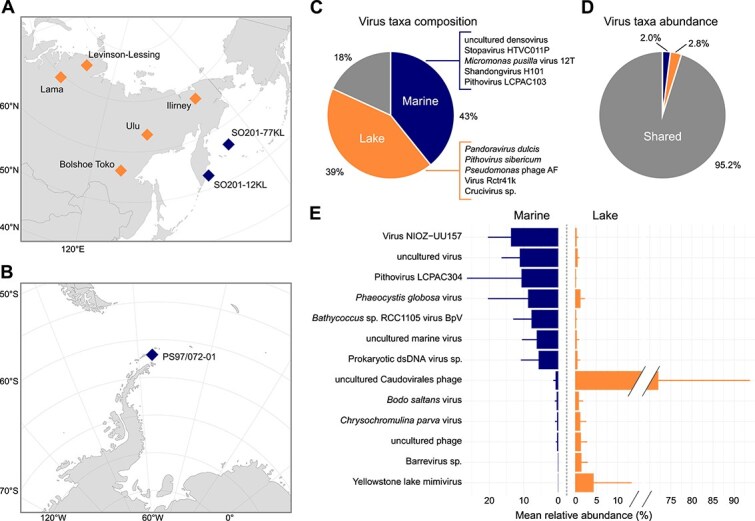 Figure 1
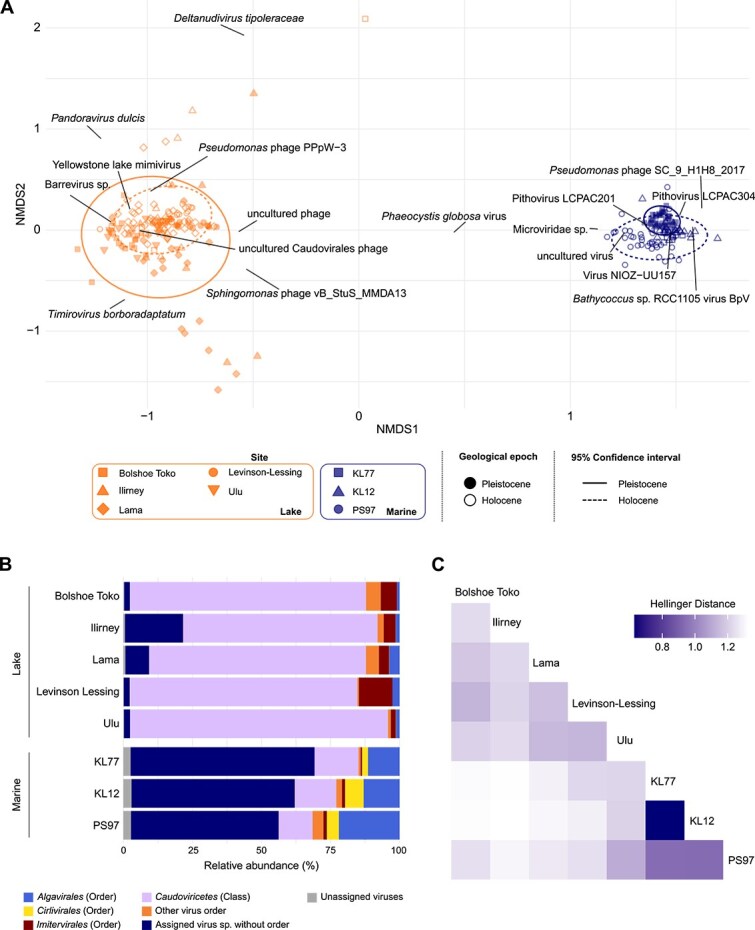 Figure 2
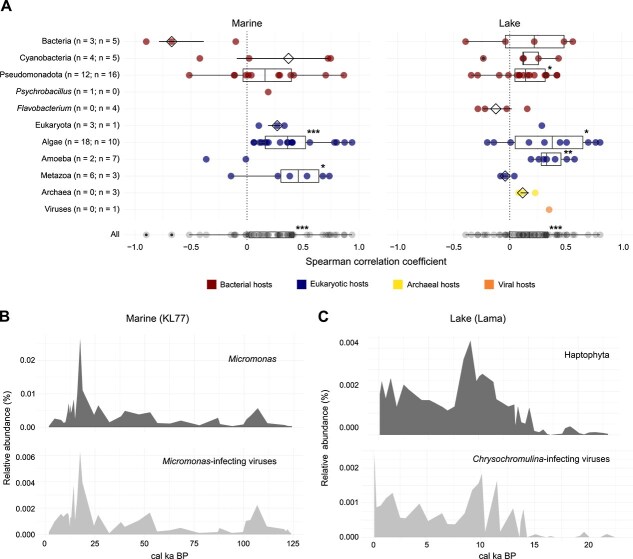 Figure 3
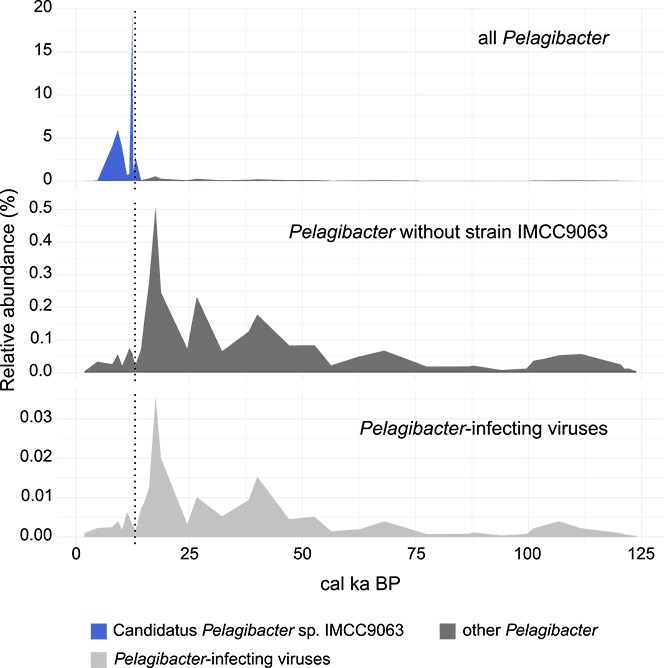 Figure 4
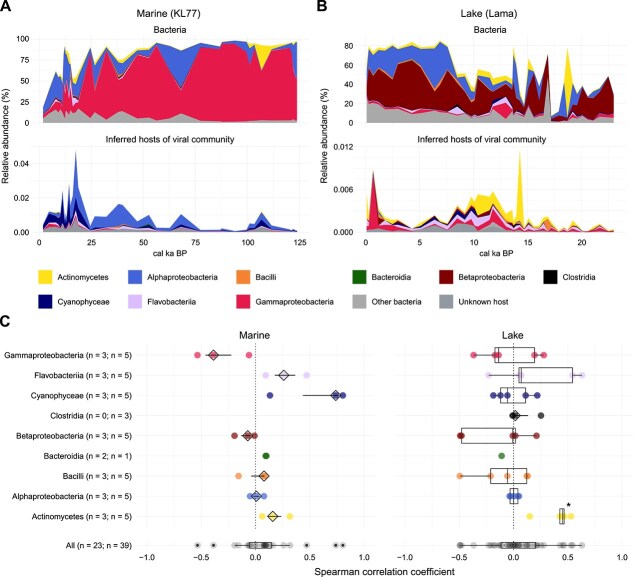 Figure 5
Peer Reviews
No public reviews on file for this paper yet. If you reviewed it on a platform where reviews are public (OpenReview, ICLR, NeurIPS, ICML), you can paste yours below so the community can read it here.
Videos
No videos yet. Explain this paper in a talk, walkthrough, or lecture? Add one.
Taxonomy
TopicsBacteriophages and microbial interactions · Fecal contamination and water quality · Microbial Community Ecology and Physiology