The role of artificial intelligence in advancing population-based cancer registration
Shuai Ding, Mingyuan Liu, Hao Wang, Cheng Song, Luyue Zhao, Zhihao Yang, Yue Wang, Yifan Wang, Haitao Cui, Zihao Liu, Dongrun Liu, Tomohiro Matsuda, Megumi Hori, Dimitris Katsimpokis, Gijs Geleijnse, Xavier Farré, David S Morrison, Yaogang Wang, Siwei Zhang, Meicen Liu

TL;DR
This paper explores how artificial intelligence can improve cancer registration by reducing workload and enhancing data analysis for better cancer control.
Contribution
The paper introduces a forward-looking AI-enhanced framework for cancer registration and discusses challenges in integrating AI into existing systems.
Findings
AI can reduce labor-intensive tasks in cancer registries by processing large datasets and extracting complex patterns.
AI integration faces challenges like computational constraints and potential biases in AI systems.
AI has the potential to optimize cancer registration efficiency and support cancer research and control.
Abstract
Cancer has become the second leading cause of death, the global cancer burden is rapidly increasing, and there are marked disparities between and within countries worldwide. Population-based cancer registries systematically collect data on cancer patients in defined populations, which play a crucial role in planning and assessing cancer prevention and control strategies. While the development of cancer registration has been marked by increasing standardization of definitions and methods and the electronic processing of data, the advent of artificial intelligence (AI) offers opportunities to further reduce the labor-intensive nature of registry operations, particularly where registry resources are scarce. These include enabling the processing of large datasets, extracting complex or unstructured data patterns to support cancer registration data abstraction, and facilitating data quality…
Genes, proteins, chemicals, diseases, species, mutations and cell lines named across the full text — each resolved to its canonical identifier and authoritative record.
Click any figure to enlarge with its caption.
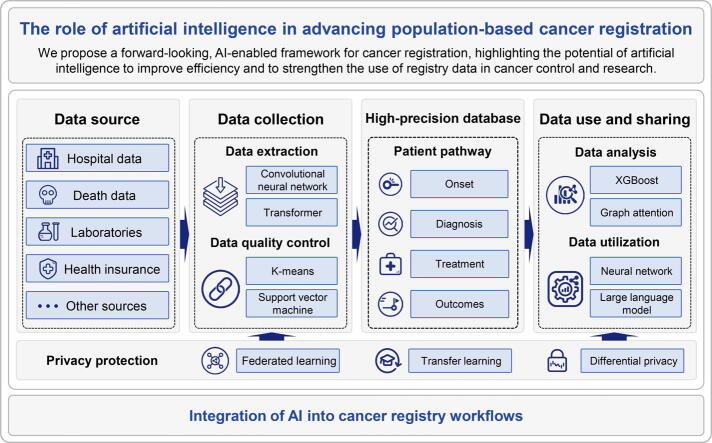 Figure 1
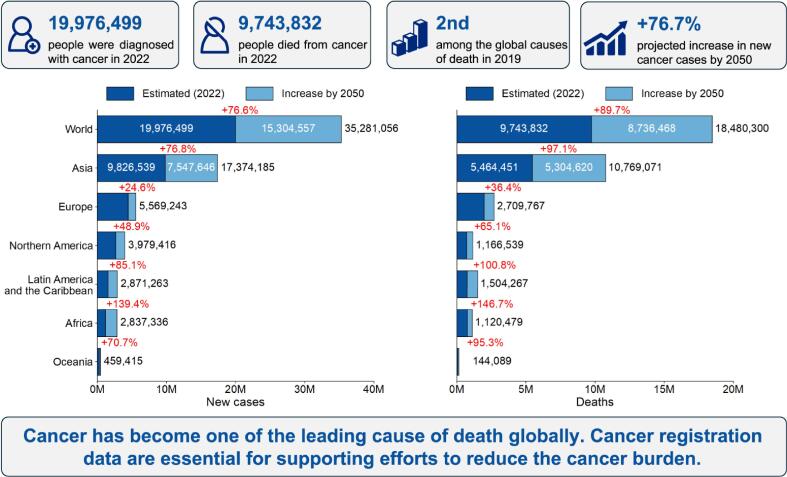 Figure 2
 Figure 3
 Figure 4
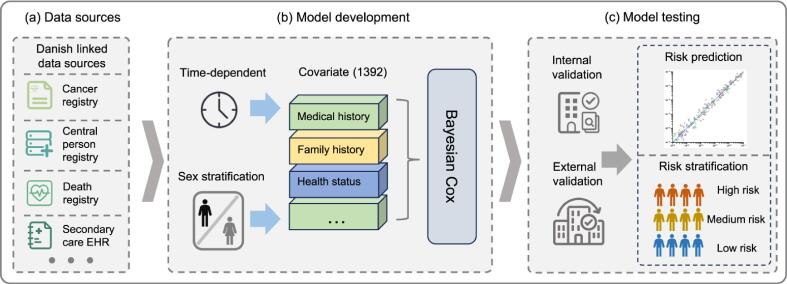 Figure 5
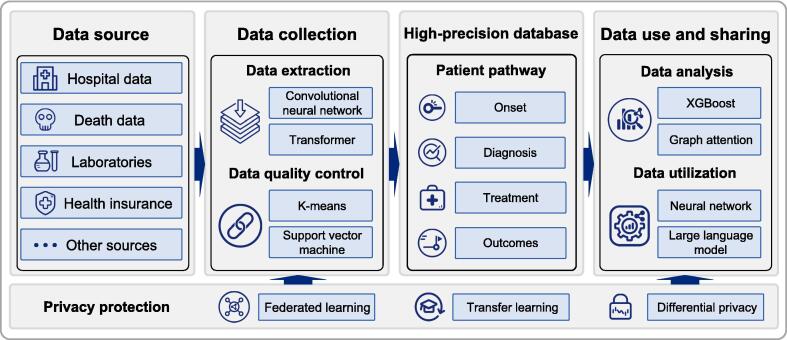 Figure 6
Peer Reviews
No public reviews on file for this paper yet. If you reviewed it on a platform where reviews are public (OpenReview, ICLR, NeurIPS, ICML), you can paste yours below so the community can read it here.
Videos
No videos yet. Explain this paper in a talk, walkthrough, or lecture? Add one.
Taxonomy
TopicsArtificial Intelligence in Healthcare and Education · AI in cancer detection · Cancer Genomics and Diagnostics