Deep learning of wrist accelerometry from UK Biobank data identifies early movement signatures of knee osteoarthritis up to 5 years before diagnosis
Ricardo Smits Serena, Michael T. Hirschmann, Georg Matziolis, Rüdiger von Eisenhart‐Rothe, Daniel Rueckert, Florian Hinterwimmer, Christina Valle

TL;DR
Wrist accelerometers and deep learning can detect early signs of knee osteoarthritis up to 5 years before diagnosis, offering a scalable and low-cost screening method.
Contribution
This study demonstrates the use of deep learning on wrist accelerometry data to identify early movement signatures of knee osteoarthritis.
Findings
Wrist accelerometry data can distinguish individuals with knee osteoarthritis from healthy individuals with moderate accuracy.
Altered movement patterns can be detected up to 5 years before a knee osteoarthritis diagnosis.
Prodromal and diagnosed knee osteoarthritis cannot be reliably distinguished using this method.
Abstract
This study aims to test whether week‐long wrist accelerometry combined with deep learning can (i) distinguish healthy individuals from people with knee osteoarthritis (KOA), (ii) separate prodromal KOA from established KOA, and (iii) identify individuals who will receive a KOA diagnosis within 5 years. We conducted a retrospective case–control study using the UK Biobank data set. After quality control, 102,120 participants with valid accelerometry were available; KOA was identified via ICD‐10 M17.x codes (n = 7262). To reduce adiposity confounding, analyses were restricted to body mass index (BMI) ≥ 29, with controls matched to KOA on age, sex and BMI distributions. We used preprocessed, orientation‐independent, hourly mean acceleration over a 24‐h cycle and included month, sex, age and weight as covariates. A 1D convolutional neural network modelled daily activity profiles with…
Genes, proteins, chemicals, diseases, species, mutations and cell lines named across the full text — each resolved to its canonical identifier and authoritative record.
Click any figure to enlarge with its caption.
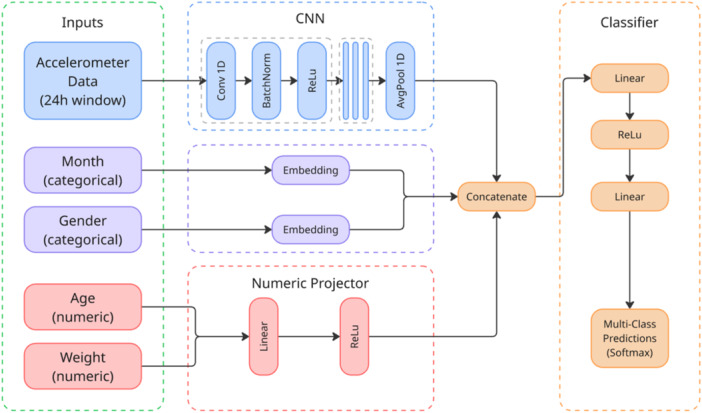 Figure 1
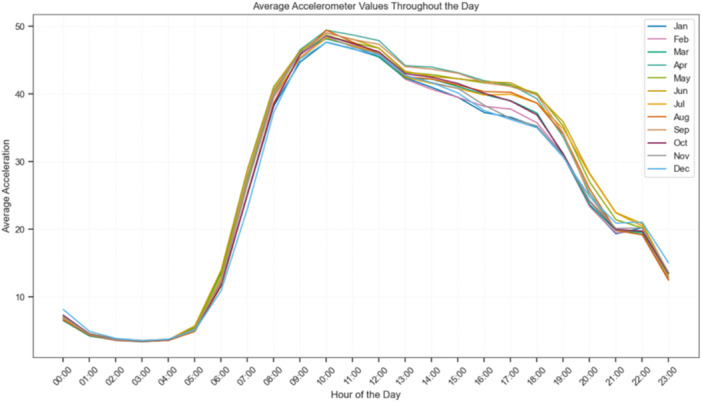 Figure 2
 Figure 3
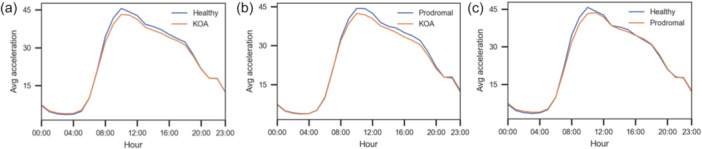 Figure 4
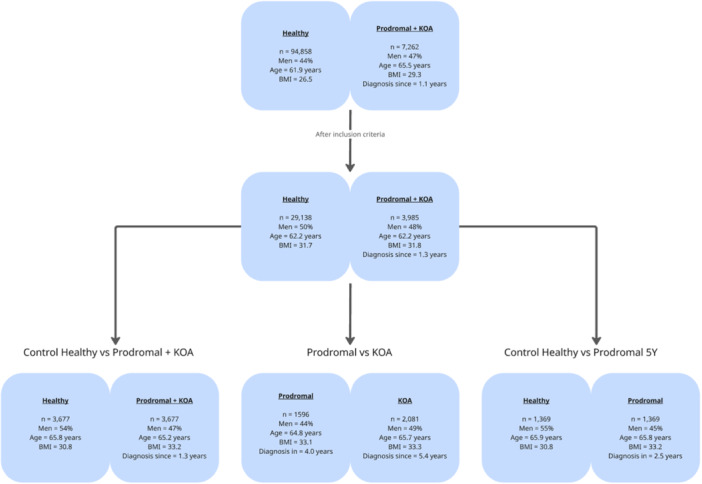 Figure 5
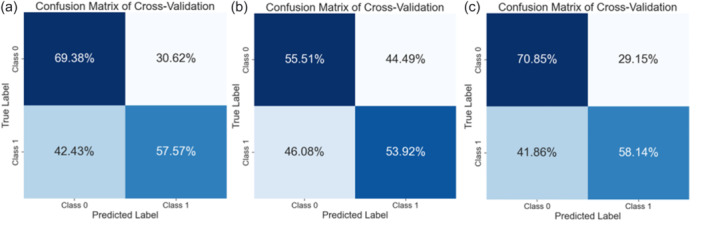 Figure 6
Peer Reviews
No public reviews on file for this paper yet. If you reviewed it on a platform where reviews are public (OpenReview, ICLR, NeurIPS, ICML), you can paste yours below so the community can read it here.
Videos
No videos yet. Explain this paper in a talk, walkthrough, or lecture? Add one.
Taxonomy
TopicsOsteoarthritis Treatment and Mechanisms · Total Knee Arthroplasty Outcomes · Balance, Gait, and Falls Prevention