Polydopamine‐Mediated Grafting of Cationic Polymer Brushes for Adsorption of Fluorinated Compounds
Agnes C. Morrissey, Federica Sbordone, Fred Pashley‐Johnson, Aaron S. Micallef, Bart van de Worp, Neomy Zaquen, Prasanna Egodawatta, Laura Delafresnaye, Lukas Michalek, Christopher Barner‐Kowollik

TL;DR
Researchers developed a method to create surfaces that can efficiently adsorb certain chemicals using a special polymer coating.
Contribution
A new grafting method using polydopamine enables tunable adsorption of anionic compounds on stonewool fibers.
Findings
PTMAEMA-functionalized fibers showed three times higher binding affinity for PFOA compared to unmodified surfaces.
Adsorption equilibrium was reached within 10 minutes, indicating rapid interaction.
XPS and TGA confirmed successful surface functionalization with distinct chemical signatures.
Abstract
Understanding the adsorption behavior of charged molecular species at functionalized polymer interfaces is critical for advancing surface science and material design. Building upon recent advances in polydopamine (PDA)‐mediated polymer grafting, we investigated electrostatic adsorption at cationic polymer brush surfaces. Using a grafting‐to approach, we covalently attached poly(2‐trimethylammonioethyl methacrylate chloride) (PTMAEMA) to PDA‐coated stonewool fibers and characterized the resulting charged interface via x‐ray photoelectron spectroscopy (XPS), scanning electron microscopy (SEM), and thermogravimetric analysis (TGA). We employed perfluorooctanoic acid (PFOA) as a model anionic adsorbate to investigate binding at a quaternary amine‐functionalized surface. Batch equilibrium sorption studies revealed concentration‐dependent adsorption kinetics, achieving three times higher…
Genes, proteins, chemicals, diseases, species, mutations and cell lines named across the full text — each resolved to its canonical identifier and authoritative record.
Click any figure to enlarge with its caption.
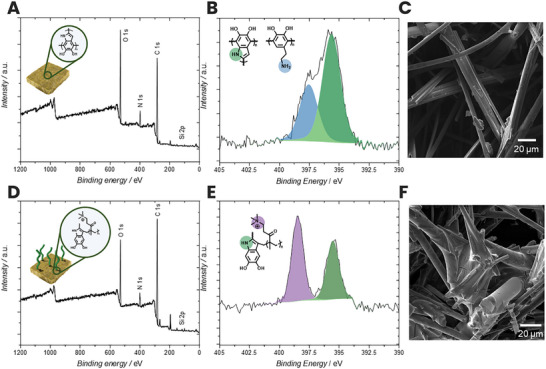 Figure 1
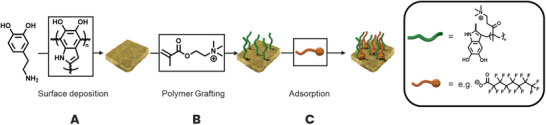 Figure 2
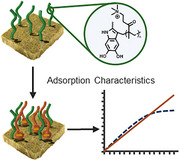 Figure 3
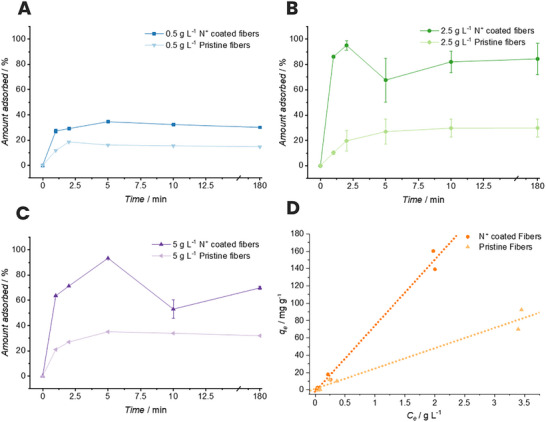 Figure 4
Peer Reviews
No public reviews on file for this paper yet. If you reviewed it on a platform where reviews are public (OpenReview, ICLR, NeurIPS, ICML), you can paste yours below so the community can read it here.
Videos
No videos yet. Explain this paper in a talk, walkthrough, or lecture? Add one.
Taxonomy
TopicsPolymer Surface Interaction Studies · Surface Modification and Superhydrophobicity · Minerals Flotation and Separation Techniques