SmI2/Sm‐Induced Reductive Silacyclization of Alkene/Diene Derivatives Using Dichlorosilanes or 1,2‐Dichlorodisilanes via Reductive Radical‐Polar Crossover
Zhengwei Chen, Daigo Kondo, Tsutomu Mizota, Leo Onishi, Huiying Mu, Koji Miki, Akiya Ogawa, Kouichi Ohe

TL;DR
This paper introduces a new method using samarium reagents to efficiently create silicon-containing cyclic compounds from simple starting materials.
Contribution
A SmI2/Sm-mediated reductive radical-polar crossover pathway for constructing diverse silacycles is presented.
Findings
The method enables the synthesis of 4–7-membered silacyclic compounds from unsaturated substrates and dichlorosilanes/disilanes.
Mechanistic studies reveal the involvement of silyl radical intermediates and a reductive radical-polar crossover pathway.
The approach demonstrates the versatility of Sm reagents in forming multiple Si─C bonds efficiently.
Abstract
The development of efficient strategies for constructing cyclic organosilicon frameworks is considered of great importance because of their structural diversity and synthetic utility. Herein, we report a SmI2/Sm‐mediated silacyclization of unsaturated organic compounds with readily available dichlorosilanes and ‐disilanes, enabling convenient access to 4−7‐membered silacyclic compounds. Mechanistic investigations indicate that the reaction involves silyl radical intermediates and proceeds via a reductive radical‐polar crossover (RRPCO) pathway. The present findings showcase the broad potential of Sm reagents in Si─C bond formation, providing a versatile strategy for constructing diverse silicon‐containing frameworks. A SmI2/Sm‐mediated silacyclization unlocks a concise route to 4–7‐membered silacycles from simple unsaturated substrates and dichlorosilanes/disilanes. The complementary…
Genes, proteins, chemicals, diseases, species, mutations and cell lines named across the full text — each resolved to its canonical identifier and authoritative record.
Click any figure to enlarge with its caption.
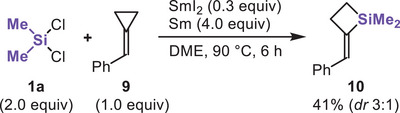 Figure 1
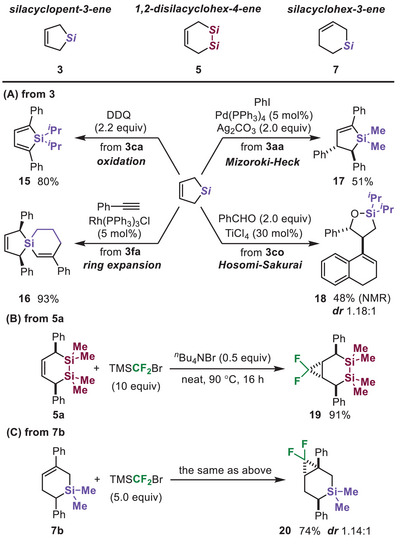 Figure 2
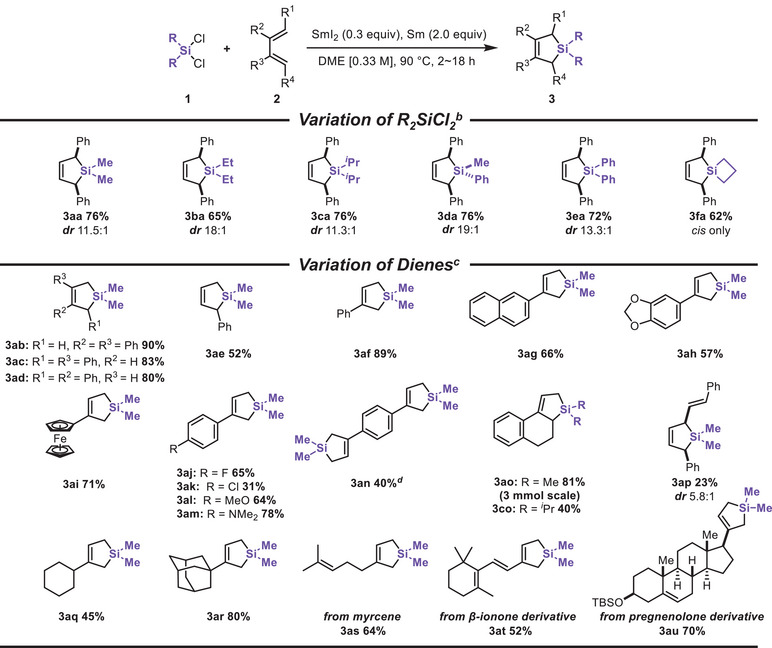 Figure 3
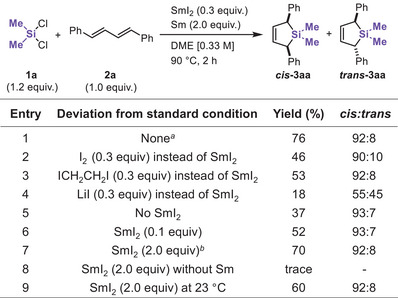 Figure 4
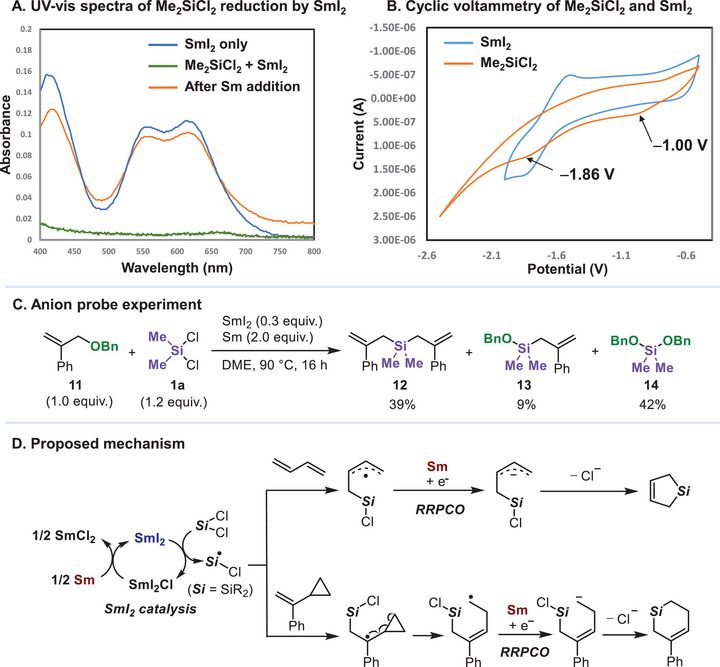 Figure 5
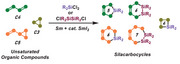 Figure 6
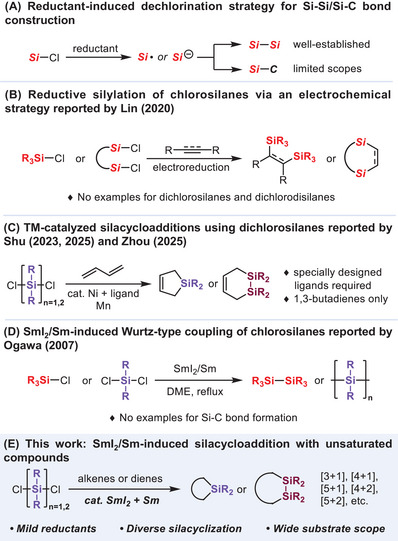 Figure 7
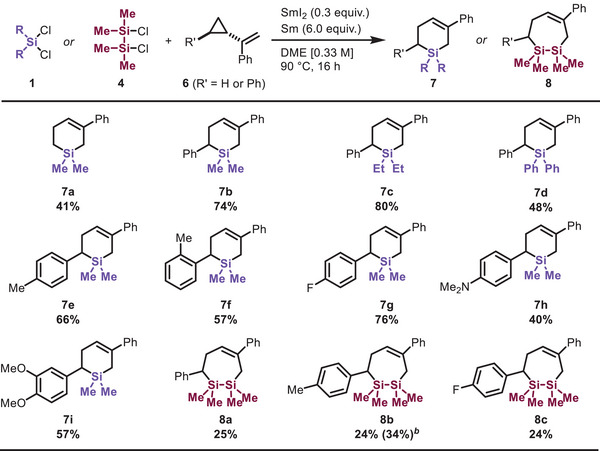 Figure 8
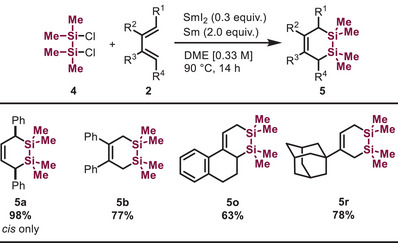 Figure 9
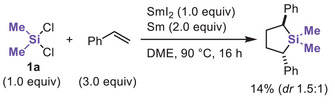 Figure 10
Peer Reviews
No public reviews on file for this paper yet. If you reviewed it on a platform where reviews are public (OpenReview, ICLR, NeurIPS, ICML), you can paste yours below so the community can read it here.
Videos
No videos yet. Explain this paper in a talk, walkthrough, or lecture? Add one.
Taxonomy
TopicsRadical Photochemical Reactions · Organoboron and organosilicon chemistry · Catalytic C–H Functionalization Methods