Late‐Stage Phenylation From [13C6] and [2H5]Benzene: A Versatile Tool for Stable Isotope Labeled MS Standards
Alexandre Labiche, Bouchaib Mouhsine, Dorian Dupommier, Louise Fogel, Frédéric Robert, David‐Alexandre Buisson, Frédéric Taran, Davide Audisio

TL;DR
This paper introduces a new method to incorporate isotopes into benzene for creating stable isotope-labeled molecules used in chemical and biological studies.
Contribution
A novel method for late-stage phenylation using sulfonium salts and palladium catalysis to produce isotopically labeled benzene derivatives.
Findings
Sulfonium salts effectively serve as sources of [13C6] and [2H5]benzene under palladium catalysis.
The method enables efficient C─C and C─S bond formation with various substrates.
Poly-substituted [13C6]benzene derivatives were successfully synthesized using this approach.
Abstract
We explored aryl thianthrenation as a tool for directly incorporating multiple isotopes into molecular scaffolds starting from full isotopically labeled benzene. Stable isotope‐labeled (SIL) molecules are indispensable tools for investigating chemical and biological mechanisms and quantifying metabolites. However, the late‐stage incorporation of isotopically labeled benzene remains challenging and under‐investigated. This challenge stems from the direct functionalization of non‐substituted benzene, which remains a difficult task. The approach described in this work is based on sulfonium salts used as a source of [13C6] and [2H5]benzene under palladium catalysis conditions. This approach demonstrates its efficiency in C─C and C─S bond formation with different substrates. Additionally, this methodology was employed for the synthesis of poly‐substituted [13C6]benzene derivatives.
Genes, proteins, chemicals, diseases, species, mutations and cell lines named across the full text — each resolved to its canonical identifier and authoritative record.
Click any figure to enlarge with its caption.
 Figure 1
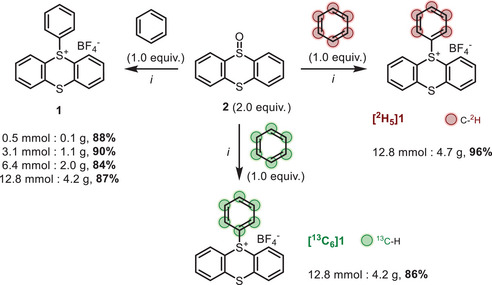 Figure 2
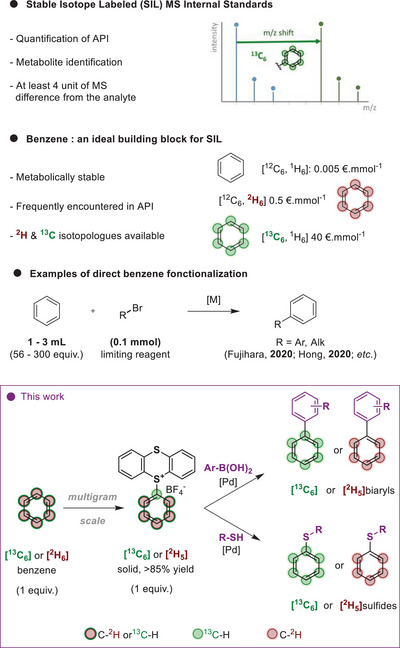 Figure 3
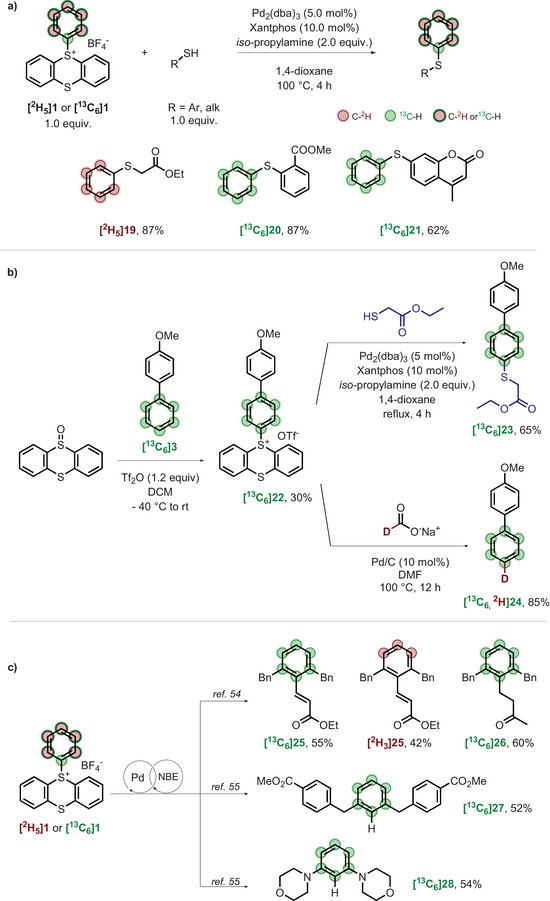 Figure 4
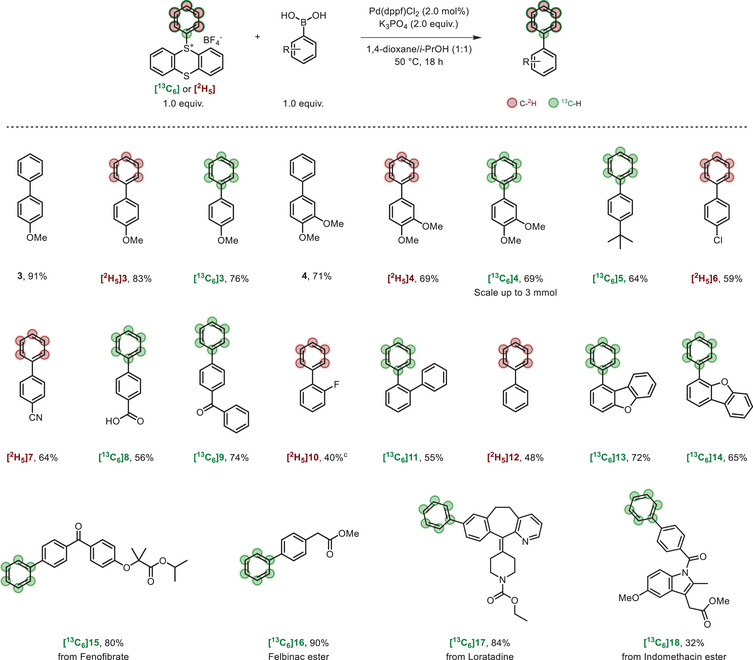 Figure 5
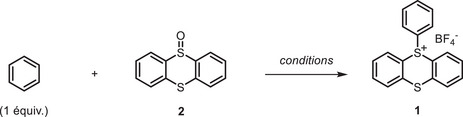 Figure 6
Peer Reviews
No public reviews on file for this paper yet. If you reviewed it on a platform where reviews are public (OpenReview, ICLR, NeurIPS, ICML), you can paste yours below so the community can read it here.
Videos
No videos yet. Explain this paper in a talk, walkthrough, or lecture? Add one.
Taxonomy
TopicsChemical Reactions and Isotopes · Fluorine in Organic Chemistry · Catalytic C–H Functionalization Methods