Diagnostic value of karyotyping, CMA/CNV-seq, and WES in fetuses with thickened nuchal translucency: perinatal and two-year follow-up outcomes
Mohan Wang, Yizhen Ji, Yasong Xu, Shiyu Sun, Xiaomei Yang, Li Sun, Qichang Wu

TL;DR
This study examines how prenatal diagnostic tests like karyotyping, CMA/CNV-seq, and WES help predict outcomes in fetuses with thickened nuchal translucency.
Contribution
The study demonstrates that CMA/CNV-seq improves detection of chromosomal abnormalities beyond karyotyping, and WES is highly effective in selected cases.
Findings
Karyotype abnormalities were detected in 32.86% of cases, with trisomy 21 being most common.
CMA/CNV-seq increased detection rates by 10.72%, identifying pCNVs and lpCNVs like 22q11.2 and 15q11.2 syndromes.
WES had a 72.7% detection rate in 11 cases, highlighting its value in selected cases.
Abstract
This study aimed to analyze the perinatal and pediatric outcomes of fetuses with thickened nuchal translucency (NT ≥ 2.5 mm) to enhance prenatal diagnostic strategies. A total of 720 pregnant women with NT ≥ 2.5 mm in the first trimester underwent interventional prenatal diagnosis. These participants were followed up during the perinatal and pediatric periods (2 years after birth). The detection rate of fetal chromosomal karyotype abnormalities was 32.86%, with trisomy 21 being the most common abnormality. Chromosomal microarray analysis (CMA) and copy number variation sequencing (CNV-seq) increased the detection rate by 10.72%. The most prevalent pathogenic copy number variations (pCNVs) and likely pathogenic copy number variations (lpCNVs) were associated with 22q11.21 microdeletion/duplication syndrome and 15q11.2 microdeletion syndrome, respectively. Excluding pathogenic karyotype…
Genes, proteins, chemicals, diseases, species, mutations and cell lines named across the full text — each resolved to its canonical identifier and authoritative record.
Click any figure to enlarge with its caption.
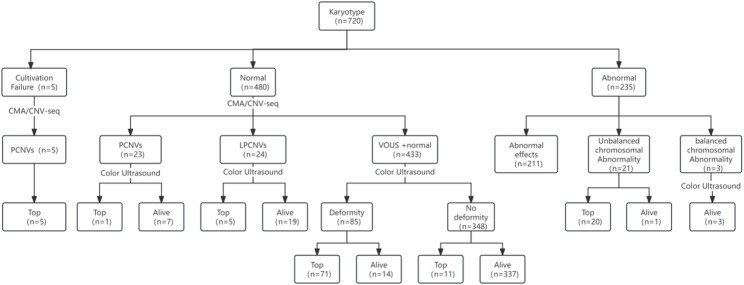 Figure 1
Peer Reviews
No public reviews on file for this paper yet. If you reviewed it on a platform where reviews are public (OpenReview, ICLR, NeurIPS, ICML), you can paste yours below so the community can read it here.
Videos
No videos yet. Explain this paper in a talk, walkthrough, or lecture? Add one.
Taxonomy
TopicsPrenatal Screening and Diagnostics · Fetal and Pediatric Neurological Disorders · Genomic variations and chromosomal abnormalities