The decision-making process for sedation in specialist palliative care: a qualitative interview study with team members, relatives, and patients
Violet Handtke, Sophie Meesters, Jeremias Bazata, Jan Schildmann, Claudia Bozzaro, Christoph Ostgathe, Claudia Bausewein, Carsten Klein, Eva Schildmann

TL;DR
This study explores how decisions about sedation in palliative care are made, emphasizing the need for better communication and shared decision-making among patients, families, and healthcare teams.
Contribution
The study introduces a five-phase decision-making model for sedation in palliative care, emphasizing re-evaluation as a critical phase.
Findings
Early discussions about sedation were limited, with some physicians avoiding them due to fears of pressure.
Informed consent was more common for deep sedation, but documentation was often inadequate.
Re-evaluation of sedation decisions was challenging due to concerns about reintroducing suffering.
Abstract
The decision-making process for sedation in palliative care remains under-researched, with evidence of limited involvement of patients and their relatives despite guidelines. The aim of this study was to explore the decision-making process for sedation in specialist palliative care in Germany, including all types of sedation (light to deep, temporary or continuous (until death)). Qualitative semi-structured interviews with 26 physicians, 22 nurses, eleven other members of the multiprofessional care team, eight relatives, and six patients. Recruitment took place via contact person in ten palliative care units and seven specialist palliative home care services in Germany. We analysed the transcripts by Framework Analysis and applied the shared treatment decision-making model by Charles et al. Findings could be assigned to the adapted 5-phase decision-making process: (1) In the…
Genes, proteins, chemicals, diseases, species, mutations and cell lines named across the full text — each resolved to its canonical identifier and authoritative record.
Click any figure to enlarge with its caption.
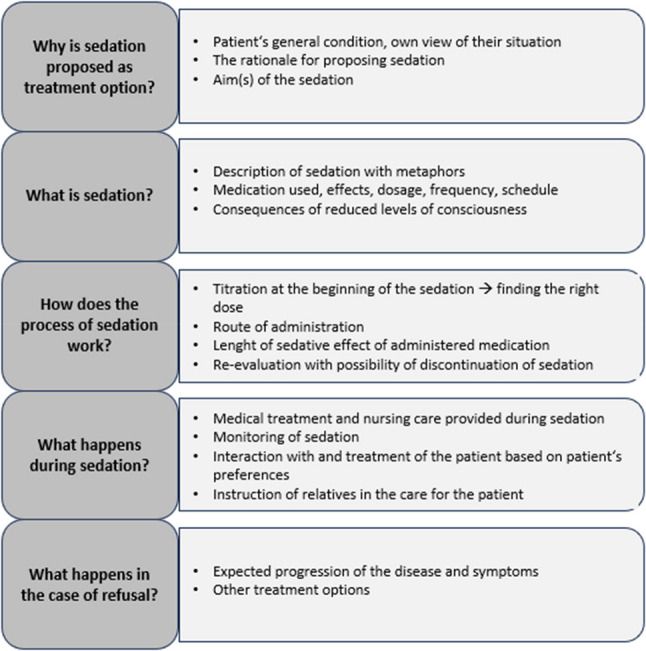 Figure 1
Peer Reviews
No public reviews on file for this paper yet. If you reviewed it on a platform where reviews are public (OpenReview, ICLR, NeurIPS, ICML), you can paste yours below so the community can read it here.
Videos
No videos yet. Explain this paper in a talk, walkthrough, or lecture? Add one.
Taxonomy
TopicsPalliative Care and End-of-Life Issues · Healthcare Decision-Making and Restraints · Patient-Provider Communication in Healthcare