Adaptive ensemble sizing with reinforcement learning for real-time ankle injury detection in wearable sensor systems
Abdulmohsen S. Alanazi, Abdulelah F. Alshehri, Rayan A. Almutairi, Emad N. Alzeanidi, Abdullah N. Alzeanidi, Saleh T. Alsuwaih, Moath A. Albukairi, Tariq S. Alotaibi, Albandari M. Alajlan, Moaath A. Alamir

TL;DR
This paper presents a real-time ankle injury detection system using wearable sensors and machine learning, achieving high accuracy and efficiency.
Contribution
The novel use of reinforcement learning to adaptively control an ensemble model for real-time injury detection in wearable systems.
Findings
The system achieved 87.4% overall detection accuracy with a 12.1% false alarm rate.
It predicted 76.3% of injury events at least 150 ms in advance with 17.2 ms latency.
The system reduced energy consumption by 35.4% and memory usage by 27.7% compared to baselines.
Abstract
Ankle injuries represent a leading cause of long-term impairment for athletes. Wearable inertial sensors have emerged for continuous joint monitoring yet implementing accurate real-time injury detection remains a challenge due to the latency, energy, and computational limitations. Effective solutions must therefore support fast, adaptive, and energy-efficient inference without compromising clinical relevance. We implemented an adaptive ankle injury detection framework using the Ankle Motion Kinematics Dataset (AMKD), which synchronized inertial sensor and video-labeled data from 87 athletes across 12 sports. The system integrates a quantized 1D convolutional neural network (1D-CNN) and a pruned long short-term memory (LSTM) model into a lightweight ensemble. A reinforcement learning (RL) agent dynamically adjusts model parameters based on motion context, informed by a Gaussian process…
Genes, proteins, chemicals, diseases, species, mutations and cell lines named across the full text — each resolved to its canonical identifier and authoritative record.
Click any figure to enlarge with its caption.
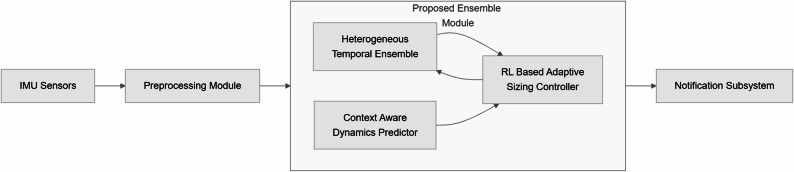 Figure 1
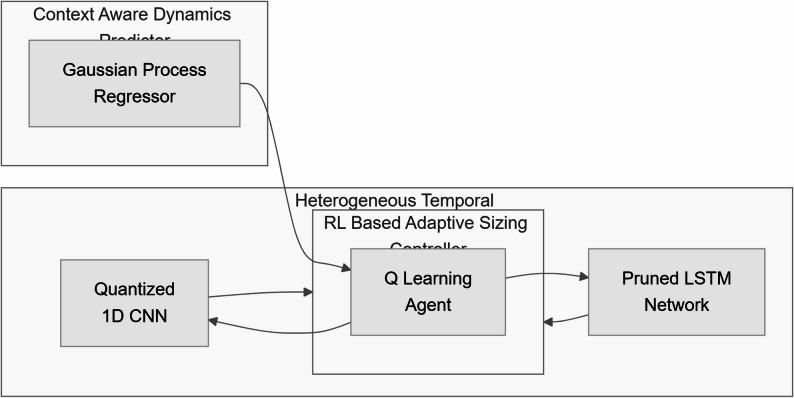 Figure 2
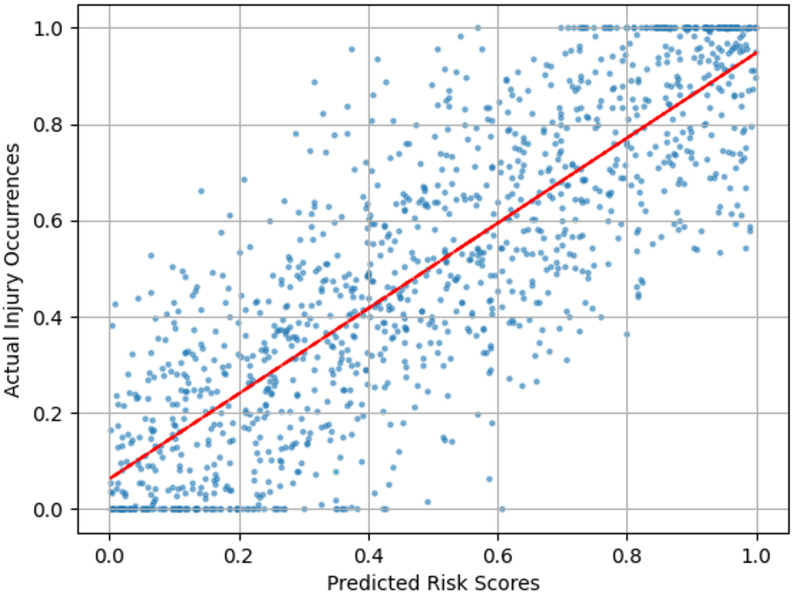 Figure 3
 Figure 4
Peer Reviews
No public reviews on file for this paper yet. If you reviewed it on a platform where reviews are public (OpenReview, ICLR, NeurIPS, ICML), you can paste yours below so the community can read it here.
Videos
No videos yet. Explain this paper in a talk, walkthrough, or lecture? Add one.
Taxonomy
TopicsProsthetics and Rehabilitation Robotics · Knee injuries and reconstruction techniques · Spinal Cord Injury Research