A general and scalable DNA nano-chip with a fully localized architecture enables biocomputing in living cells and precisely induces cell apoptosis
Jintao Yi, Tingting Chen, Jinghong Li

TL;DR
Researchers developed a DNA-based nano-chip that can perform complex computations in living cells and selectively kill tumor cells.
Contribution
A general and scalable DNA nano-chip with a fully localized architecture for efficient biocomputing in living cells.
Findings
Up to 11 addressable logic components were reconfigured in a single nano-chip for complex biocomputing tasks.
The nano-chip enabled precise identification and killing of tumor cells through multi-level logic cascading.
Compared to diffusible DNA circuits, the nano-chip improved biocomputing efficiency in both solution and living cells.
Abstract
DNA logic circuits have made important progress towards mimicking functions analogous to silicon-based electronic circuits. However, because of limitations in the orthogonality of free-floating DNA logic components and difficulty in controlling the intrinsically random collision of DNA molecules, the complexity, scalability, and information processing ability of DNA circuits are still constrained. Here, we demonstrate a general and scalable DNA nano-chip by integration of multilayer basic DNA logic gates on a DNA origami structure. We created basic DNA logic gates based on DNA localized strand displacement reactions. The basic logic gates were modularly combined into circuits by spatially arranging all of the reactive DNA components on a DNA origami structure according to the wiring instructions, establishing the generality and scalability of our DNA origami-based nano-chips. We showed…
Genes, proteins, chemicals, diseases, species, mutations and cell lines named across the full text — each resolved to its canonical identifier and authoritative record.
Click any figure to enlarge with its caption.
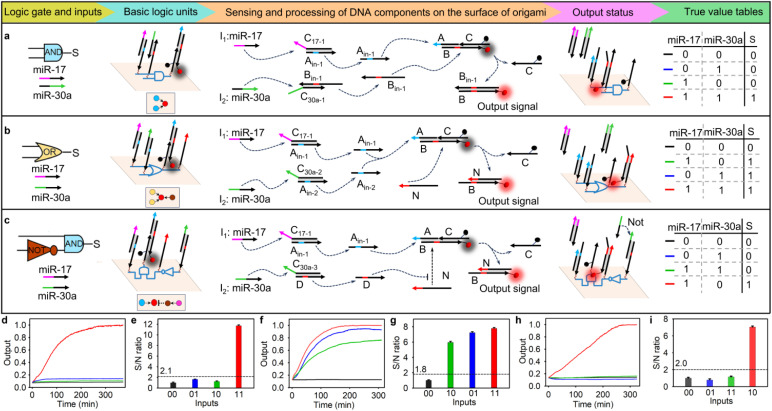 Figure 1
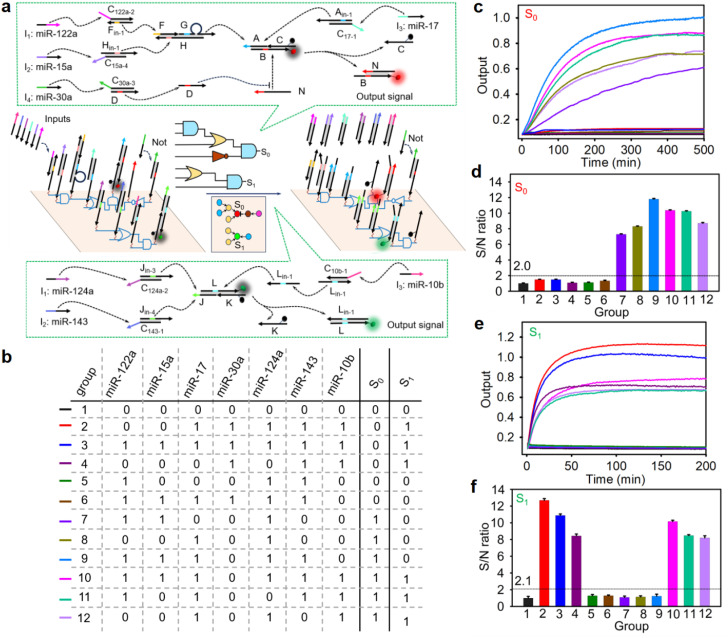 Figure 2
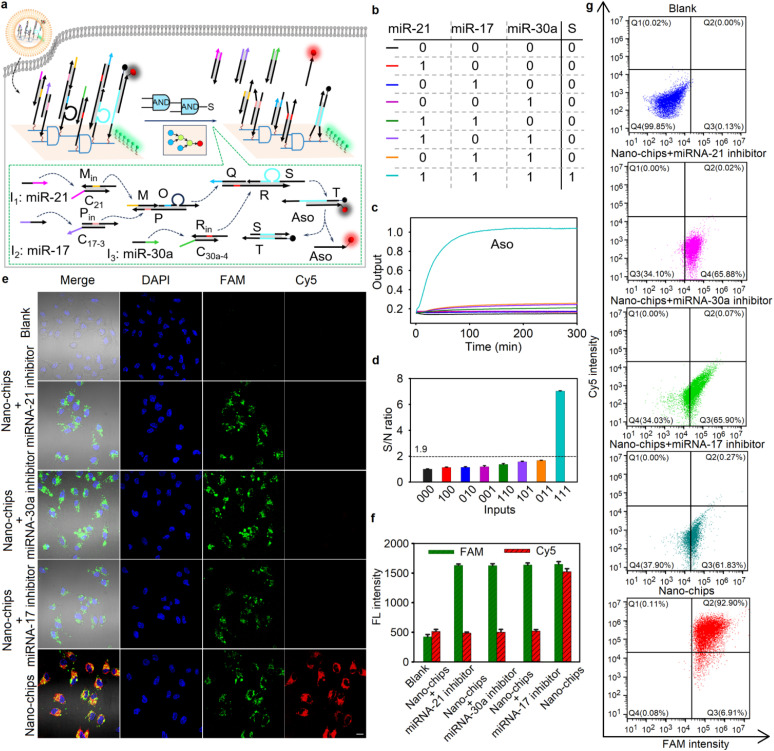 Figure 3
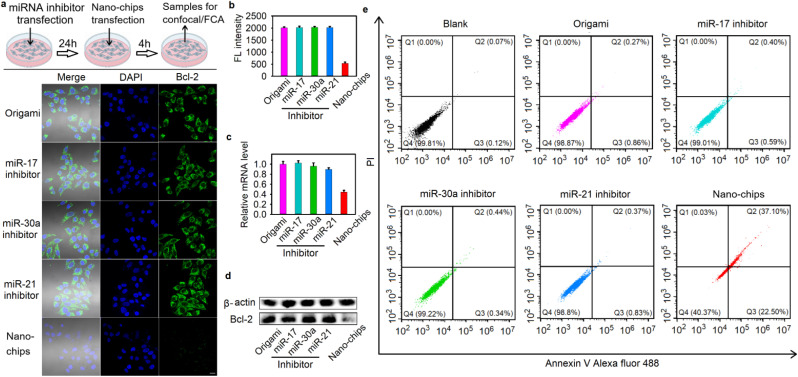 Figure 4
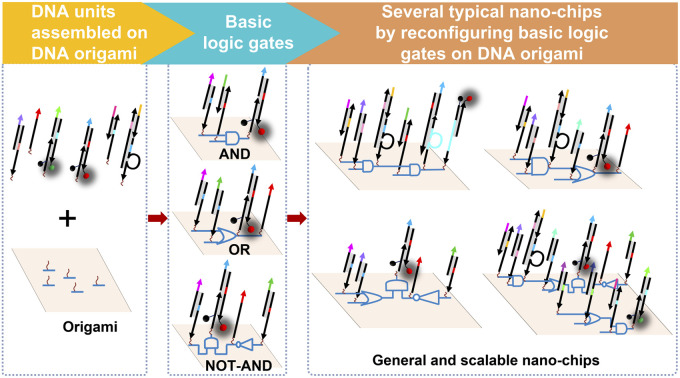 Figure 5
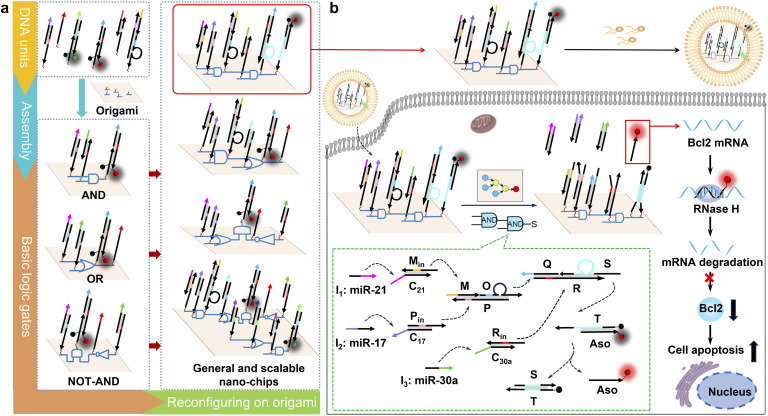 Figure 6
Peer Reviews
No public reviews on file for this paper yet. If you reviewed it on a platform where reviews are public (OpenReview, ICLR, NeurIPS, ICML), you can paste yours below so the community can read it here.
Videos
No videos yet. Explain this paper in a talk, walkthrough, or lecture? Add one.
Taxonomy
TopicsAdvanced biosensing and bioanalysis techniques · DNA and Biological Computing · Nanopore and Nanochannel Transport Studies