Regioselectivity of the Reaction between β‑Enamino Diketones and Methylhydrazine Explained
Vinicius Martinelli, Isaac F. Leach, Julia Poletto, Wagner E. Richter, Fernanda A. Rosa, Rodrigo M. Pontes

TL;DR
This paper explains how different reaction pathways and electronic effects determine the product distribution in the reaction between β-enamino diketones and methylhydrazine.
Contribution
The study provides a detailed quantum chemical explanation of the regioselectivity and mechanism in this organic reaction.
Findings
The reaction mechanism branches into multiple pathways based on nitrogen attack and electronic effects.
Three of four possible regioisomers are observed experimentally due to cyclization and proton transfer.
Proton transfer catalysts significantly influence the reaction in different solvents like acetonitrile.
Abstract
The complete mechanism for the reaction of β-enamino diketone (BED) with methylhydrazine in H2O/MeOH and acetonitrile is elucidated via state-of-the-art quantum chemical calculations. Our results show that the mechanism branches into multiple pathways with distinct energetic profiles, leading to a product distribution governed by a delicate balance of electronic effects. The initial branching point is determined by which the nitrogen atom of the asymmetric methylhydrazine (NH2 or NHMe) attacks the BED β-carbon. Following the elimination of HNMe2, a cyclization step occurs, where the remaining methylhydrazine nitrogen attacks one of two distinct carbonyl carbons, leading to a product distribution, where three of four possible regioisomers are observed experimentally. The activation energy for this cyclization is influenced by the electronic properties of the substituents on both the…
Genes, proteins, chemicals, diseases, species, mutations and cell lines named across the full text — each resolved to its canonical identifier and authoritative record.
Click any figure to enlarge with its caption.
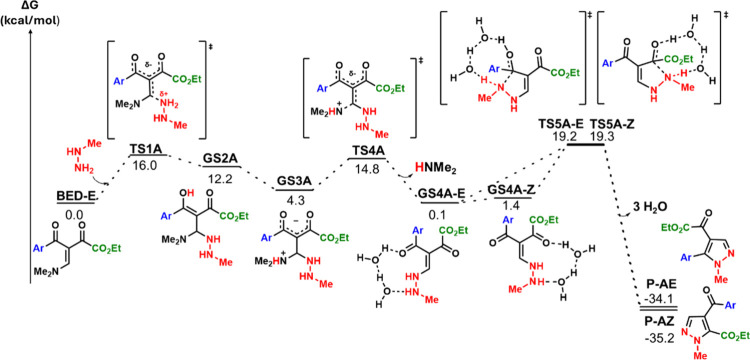 Figure 1
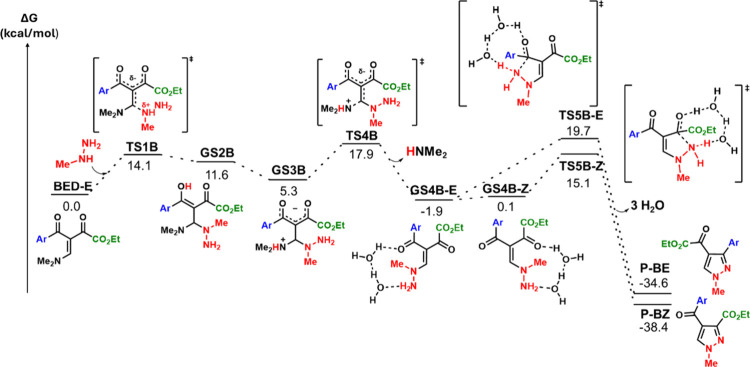 Figure 2
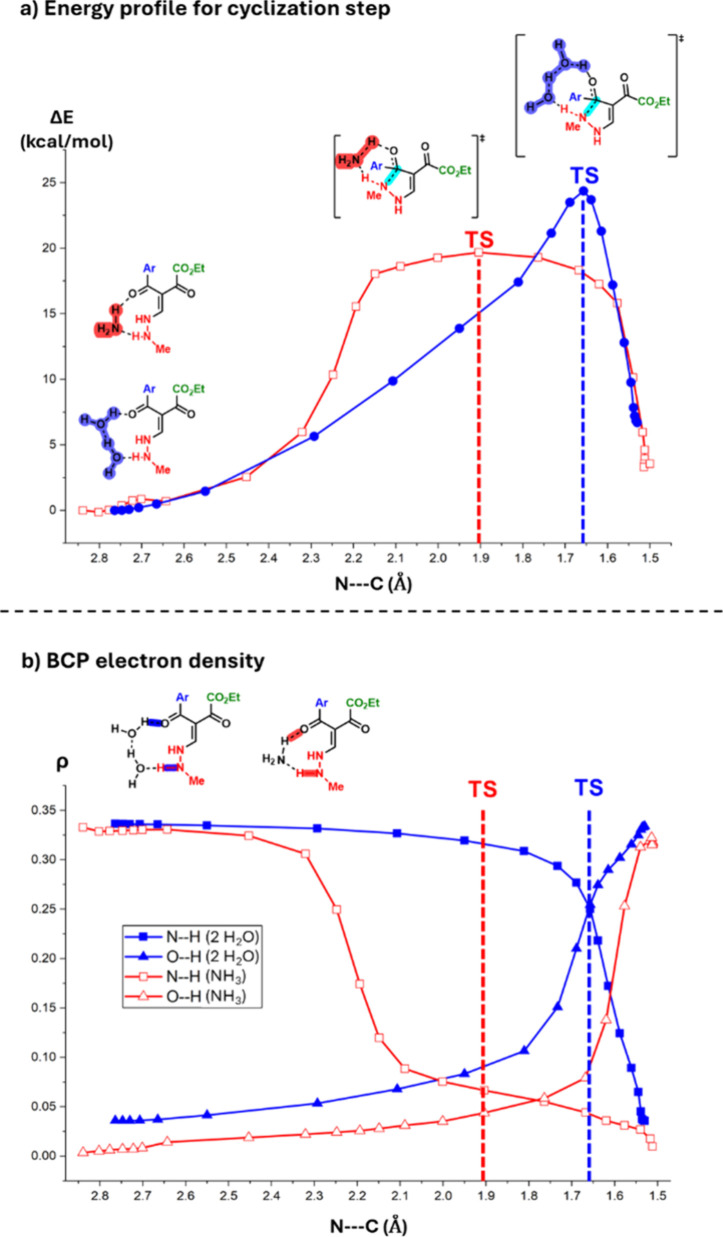 Figure 3
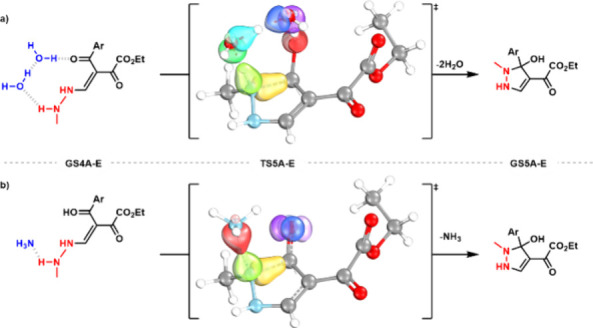 Figure 4
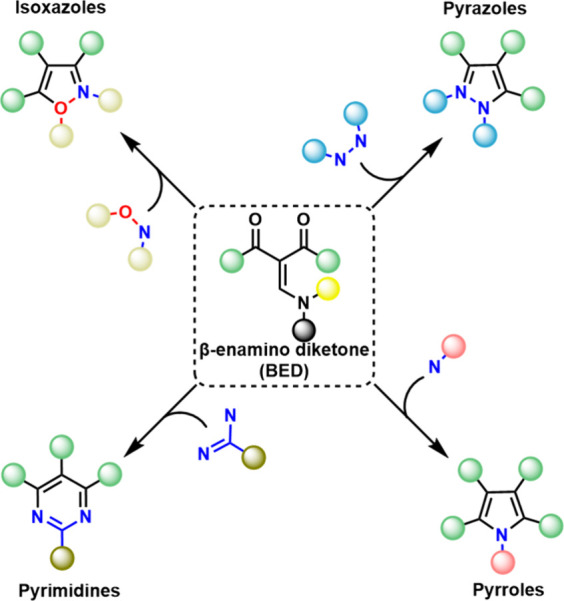 Figure 5
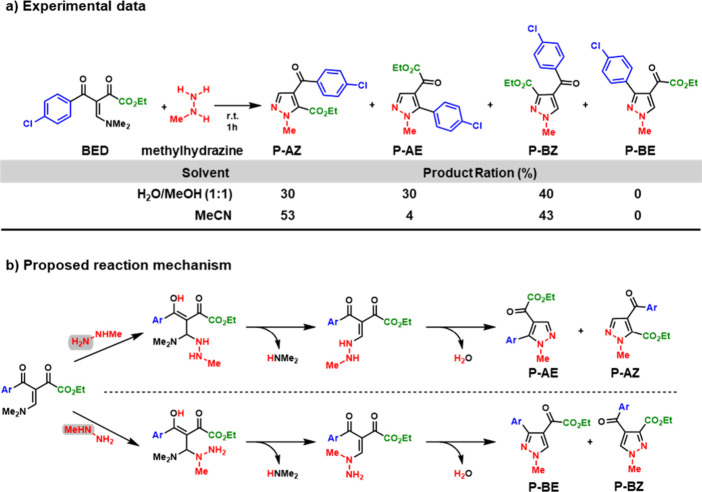 Figure 6
 Figure 7
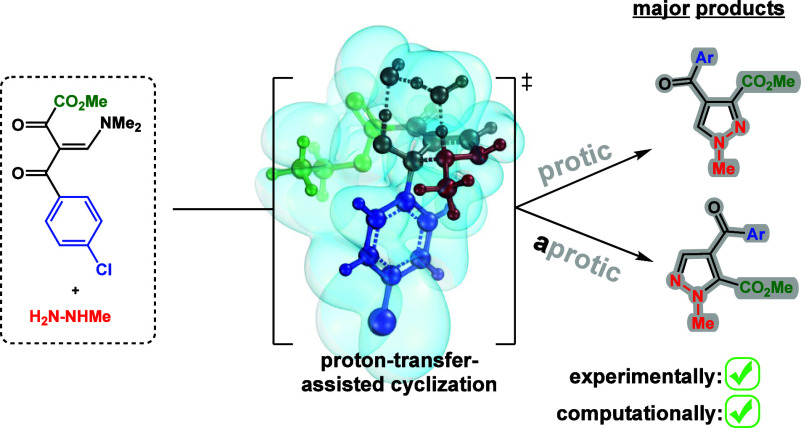 Figure 8
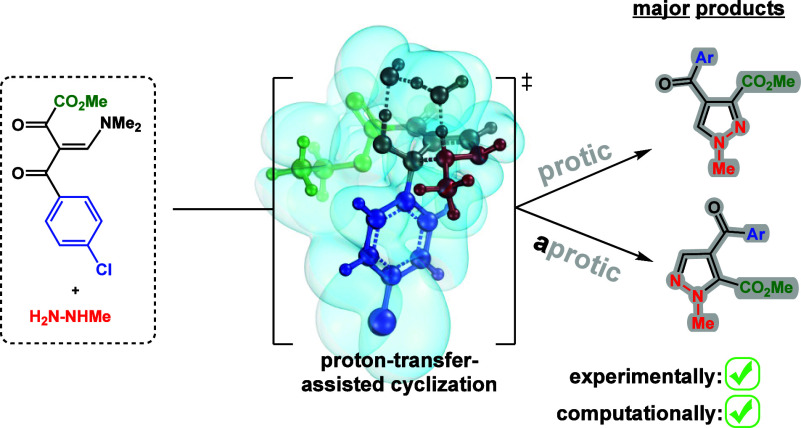 Figure 9
Peer Reviews
No public reviews on file for this paper yet. If you reviewed it on a platform where reviews are public (OpenReview, ICLR, NeurIPS, ICML), you can paste yours below so the community can read it here.
Videos
No videos yet. Explain this paper in a talk, walkthrough, or lecture? Add one.
Taxonomy
TopicsSynthesis and Reactions of Organic Compounds · Organic Chemistry Synthesis Methods · Chemical synthesis and pharmacological studies