The important role of palpation in the examination of solitary skin lesions: mnemonic of three T’s
Alexander Salava

TL;DR
This paper introduces a teaching method called the 'three T’s' to improve how students learn to examine skin lesions through palpation.
Contribution
The novel contribution is a simple, stepwise mnemonic for teaching palpation of skin lesions in dermatology.
Findings
The three T’s method simplifies teaching palpation techniques for solitary skin lesions.
The method enhances student learning outcomes and communication in dermatology education.
Abstract
The author describes an easy applicable three-step teaching method to increase learning outcomes in dermatology education and physical examination: the mnemonic of three T’s. It summarizes the three most important aspects of palpation in a methodologically simple to learn and stepwise manner and can be used to systematize teachings, indicating the important role of palpation, and to enhance communication and student motivation.
Genes, proteins, chemicals, diseases, species, mutations and cell lines named across the full text — each resolved to its canonical identifier and authoritative record.
Click any figure to enlarge with its caption.
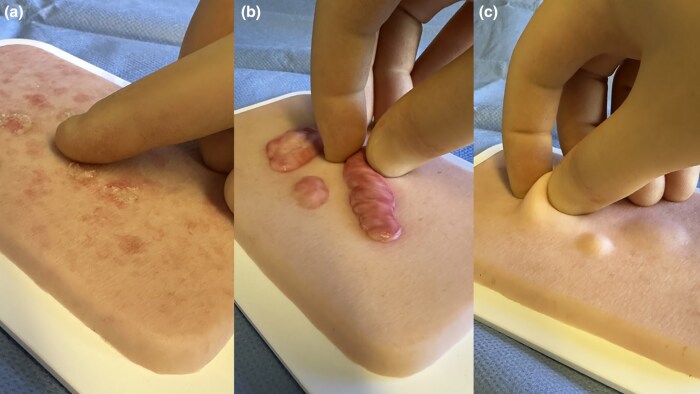 Figure 1
Peer Reviews
No public reviews on file for this paper yet. If you reviewed it on a platform where reviews are public (OpenReview, ICLR, NeurIPS, ICML), you can paste yours below so the community can read it here.
Videos
No videos yet. Explain this paper in a talk, walkthrough, or lecture? Add one.
Taxonomy
TopicsInnovations in Medical Education · Cutaneous Melanoma Detection and Management · Clinical Reasoning and Diagnostic Skills