RanGAP1 accumulates in stress-induced cytoplasmic compartments that are distinct from stress granules and P-bodies
Justin Mezzanotte, Jessica Shi, Ursula Stochaj

TL;DR
This study shows that the protein RanGAP1 gathers in new cytoplasmic structures when exposed to a drug, separate from known stress-related compartments.
Contribution
The discovery of a new type of cytoplasmic compartment where RanGAP1 accumulates, distinct from stress granules and P-bodies.
Findings
RanGAP1 accumulates in cytoplasmic compartments after PFT-µ treatment.
These compartments do not overlap with stress granules or P-bodies.
PFT-µ induces stress granule formation in human cancer cells.
Abstract
Stress granules (SGs) and P-bodies are dynamic compartments in the cytoplasm of eukaryotic cells. SGs assemble in response to stress. The nuclear transport factor RanGAP1 is linked to the pathologies of several human diseases. RanGAP1 concentrates at nuclear pore complexes, but can also associate with cytoplasmic biomolecular condensates. The small molecule pifithrin-µ (PFT-µ) inhibits Hsp70 family members and has potential as a therapeutic agent. PFT-µ triggers SG formation in human cancer cells. This prompted us to evaluate the subcellular localization of RanGAP1 upon exposure to PFT-µ. We show that RanGAP1 accumulates in unique cytoplasmic compartments that do not colocalize with SGs or P-bodies.
Genes, proteins, chemicals, diseases, species, mutations and cell lines named across the full text — each resolved to its canonical identifier and authoritative record.
Click any figure to enlarge with its caption.
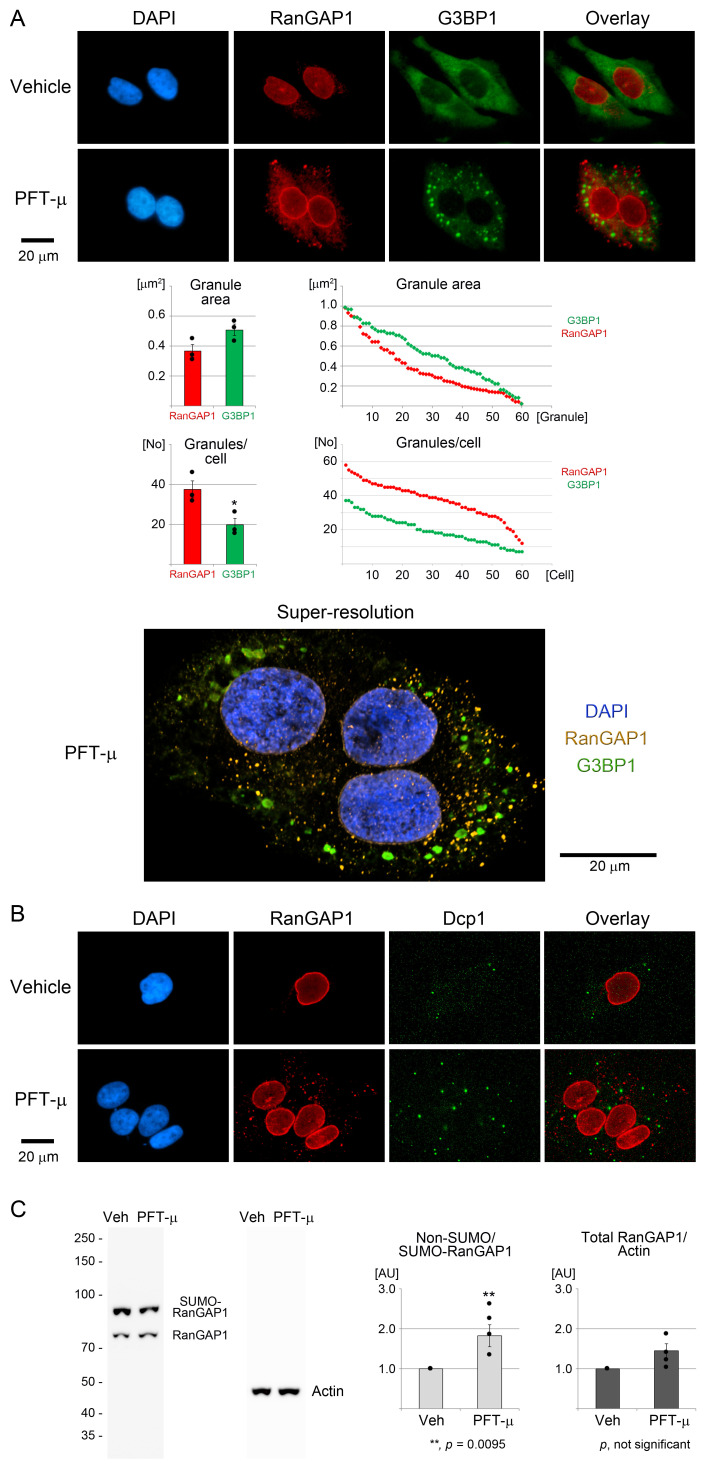 Figure 1
Peer Reviews
No public reviews on file for this paper yet. If you reviewed it on a platform where reviews are public (OpenReview, ICLR, NeurIPS, ICML), you can paste yours below so the community can read it here.
Videos
No videos yet. Explain this paper in a talk, walkthrough, or lecture? Add one.
Taxonomy
TopicsHeat shock proteins research · Nuclear Structure and Function · RNA Research and Splicing