Genotype and injury severity modulate the effects of traumatic brain injury on sleep in Drosophila
Leah Pisano, Michael P. Shahandeh

TL;DR
This study shows that both injury severity and genetic background affect how traumatic brain injuries impact sleep in fruit flies.
Contribution
The study demonstrates for the first time how injury severity and genetic background modulate TBI effects on sleep in Drosophila.
Findings
TBI effects on sleep increase with injury severity in both genetic backgrounds.
Genetic differences between Drosophila strains influence susceptibility to TBI-induced sleep changes.
Abstract
Traumatic brain injuries (TBIs) have many negative impacts in humans (i.e. lifespan, cognitive function, sleep). Recently, Drosophila emerged as a model for studying these impacts in a controlled environment. Previous studies have described effects of TBIs on sleep in Drosophila , but how these effects are modulated by injury severity or genetic background has not been explicitly investigated. Here, we exposed male Drosophila melanogaster from two genetic backgrounds to two TBI severity treatments and measured effects on sleep. We document significantly increasing effects with injury severity in both genetic backgrounds and describe differences between genotypes, demonstrating a genetic basis to susceptibility.
Genes, proteins, chemicals, diseases, species, mutations and cell lines named across the full text — each resolved to its canonical identifier and authoritative record.
Click any figure to enlarge with its caption.
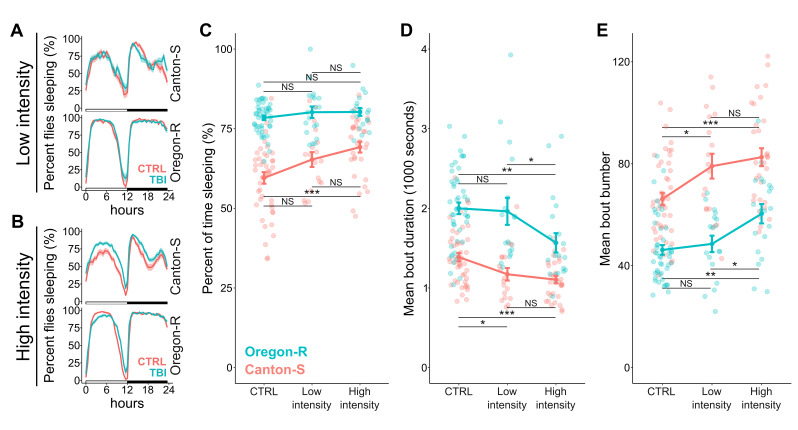 Figure 1
Peer Reviews
No public reviews on file for this paper yet. If you reviewed it on a platform where reviews are public (OpenReview, ICLR, NeurIPS, ICML), you can paste yours below so the community can read it here.
Videos
No videos yet. Explain this paper in a talk, walkthrough, or lecture? Add one.
Taxonomy
TopicsTraumatic Brain Injury Research · Sleep and Wakefulness Research · Traumatic Brain Injury and Neurovascular Disturbances