Intolerance of uncertainty and suicidal ideation among Chinese college students: the mediating role of non-suicidal self-injury and the stage-specific moderating roles of perceived social support
Xuefei Li, Shilei Zhang, Danrui Chen

TL;DR
This study explores how intolerance of uncertainty relates to suicidal thoughts in Chinese college students, with non-suicidal self-injury and social support playing key roles.
Contribution
The study identifies stage-specific protective roles of family and friend support in mitigating the link between intolerance of uncertainty and suicidal ideation.
Findings
Intolerance of uncertainty is positively linked to both non-suicidal self-injury and suicidal ideation.
Non-suicidal self-injury partially mediates the relationship between intolerance of uncertainty and suicidal ideation.
Friend and family support moderate different stages of the pathway from intolerance of uncertainty to suicidal ideation.
Abstract
Intolerance of uncertainty (IU) is increasingly recognized as a transdiagnostic risk factor for suicide-related outcomes. However, the mechanisms linking IU to suicidal ideation remain insufficiently understood. This study aimed to examine the association between IU and suicidal ideation, particularly regarding the role of non-suicidal self-injury (NSSI) and the protective roles of perceived social support from different sources, including family and friend support. A cross-sectional survey was conducted among 2, 167 Chinese college students (68.6% females; Mage = 18.91years, SD = 1.31). Participants completed measures of IU, NSSI, suicidal ideation, and perceived family and friend support. Results indicated: (1) IU was positively associated with both NSSI and suicidal ideation. (2) NSSI partially mediated the association between IU and suicidal ideation. (3) Perceived family support…
Genes, proteins, chemicals, diseases, species, mutations and cell lines named across the full text — each resolved to its canonical identifier and authoritative record.
Click any figure to enlarge with its caption.
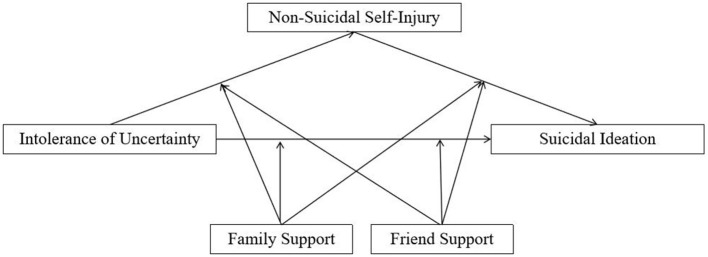 Figure 1
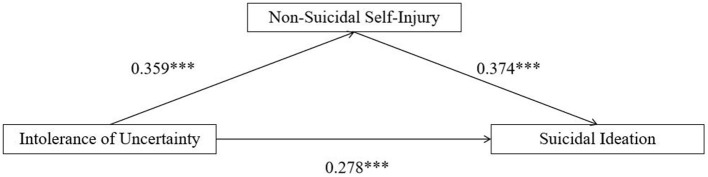 Figure 2
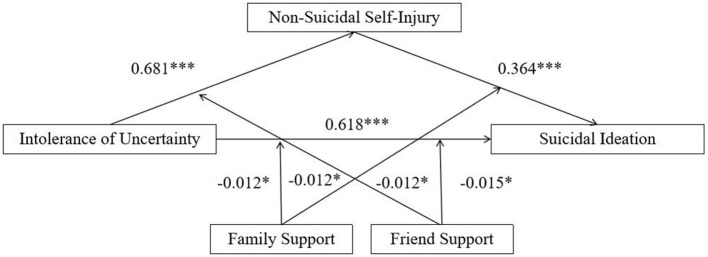 Figure 3
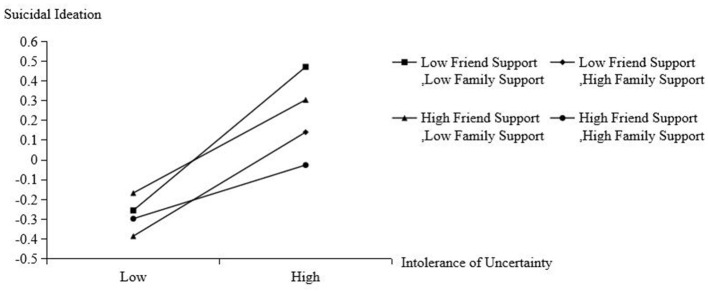 Figure 4
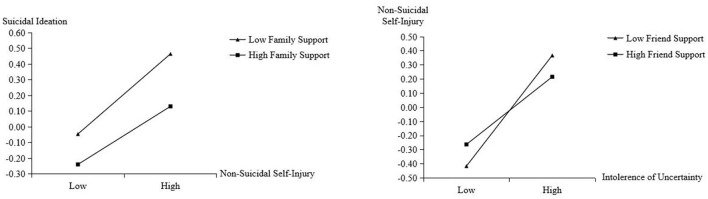 Figure 5
Peer Reviews
No public reviews on file for this paper yet. If you reviewed it on a platform where reviews are public (OpenReview, ICLR, NeurIPS, ICML), you can paste yours below so the community can read it here.
Videos
No videos yet. Explain this paper in a talk, walkthrough, or lecture? Add one.
Taxonomy
TopicsSuicide and Self-Harm Studies · Anxiety, Depression, Psychometrics, Treatment, Cognitive Processes · COVID-19 and Mental Health