Hobbyist preferences for pet freshwater turtles
Jingjing Zhao, Zhan Chen, Beilu Duan, Wuji Zheng, Anita Kar Yan Wan, Xiaoxi Zhang, Lishu Li, Tien Ming Lee

TL;DR
This study explores what pet turtle hobbyists in China prefer, aiming to help protect wild turtle populations.
Contribution
The study provides empirical insights into turtle hobbyist preferences and identifies distinct consumer types.
Findings
Hobbyists prefer inexpensive and captive-bred turtles with legal documentation.
Three distinct consumer types were identified based on preferences for price and captive breeding.
Social influence can affect willingness to pay higher prices for turtles.
Abstract
The burgeoning pet trade is a primary threat to wild freshwater turtles worldwide. Although the risks from commercial exploitation of turtles have been discussed widely, there is little empirical research on preferences for pet turtles from a hobbyists’ perspective. We conducted an online survey of nearly 2000 turtle hobbyists recruited via discussion forums in China. We collected information on turtle‐keeping experiences, past purchase behaviors, knowledge about the protection status of certain endangered species, and awareness of legality in the trade. We framed discrete choice experiments around different hypothetical scenarios about wild population statuses and captive‐breeding market conditions. We then used a random parameter logit model and a latent class logit model to identify key influencing factors and to explore the level of heterogeneity among turtle hobbyists. Consumers…
Click any figure to enlarge with its caption.
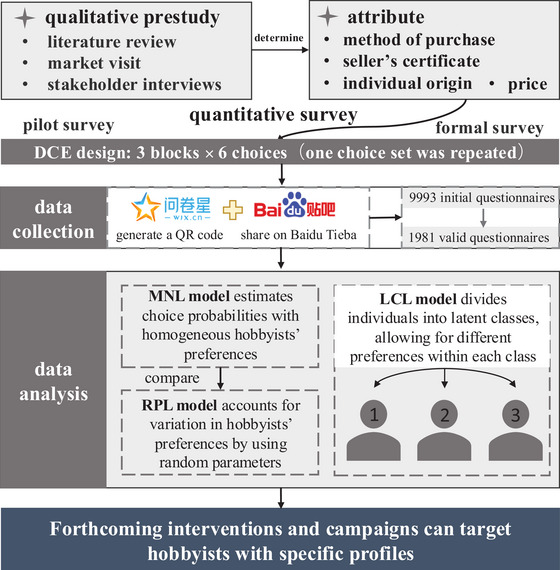 Figure 1
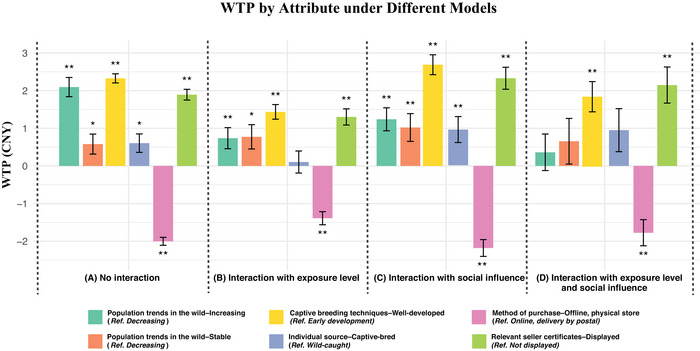 Figure 2
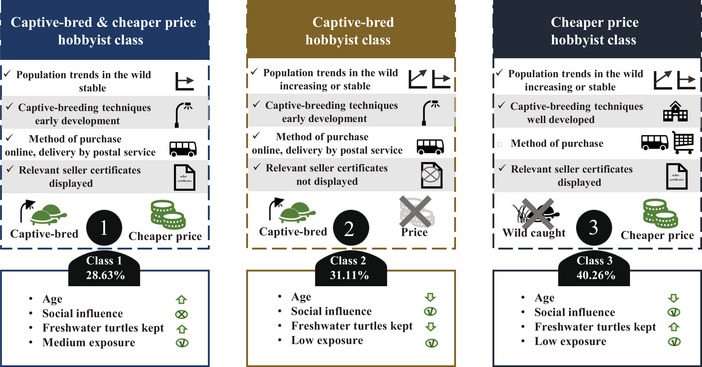 Figure 3
Peer Reviews
No public reviews on file for this paper yet. If you reviewed it on a platform where reviews are public (OpenReview, ICLR, NeurIPS, ICML), you can paste yours below so the community can read it here.
Videos
No videos yet. Explain this paper in a talk, walkthrough, or lecture? Add one.
Taxonomy
TopicsTurtle Biology and Conservation · Economic and Environmental Valuation · Wildlife-Road Interactions and Conservation