Automating the analysis of public saliency and attitudes toward biodiversity from digital media
Noah Giebink, Amrita Gupta, Diogo Veríssimo, Charlotte H. Chang, Tony Chang, Angela Brennan, Brett G. Dickson, Alex Bowmer, Jonathan Baillie

TL;DR
This paper introduces a method to automatically analyze public attitudes toward wildlife from digital media, using natural language processing tools to filter and interpret large volumes of data.
Contribution
The paper introduces a novel two-stage relevance filter combining unsupervised learning and zero-shot LLMs to analyze biodiversity-related public discourse in digital media.
Findings
Up to 62% of articles with bat-related search terms were irrelevant, highlighting the need for robust filtering.
News and X posts about horseshoe bats increased significantly in early 2020, with sentiment shifts later in the year.
The method effectively applies modern NLP tools to analyze public perceptions of biodiversity.
Abstract
Measuring public attitudes toward wildlife provides crucial insights into human relationships with nature and helps monitor progress toward Global Biodiversity Framework targets. Yet, conducting such assessments at a global scale presents challenges. Digital news and social media offer a rich record of public discourse, but extracting information about attitudes toward wildlife from these sources is not straightforward. Selecting effective search terms is complicated by differences between everyday names for taxa and their scientific or formal common names, and raw news and social media data are often cluttered with irrelevant content and syndicated articles. To address search term selection, we used a folk taxonomy approach that derives recognizable species groupings from shared common name endings. We identified syndicated articles by using cosine similarity on term frequency‐inverse…
Genes, proteins, chemicals, diseases, species, mutations and cell lines named across the full text — each resolved to its canonical identifier and authoritative record.
Click any figure to enlarge with its caption.
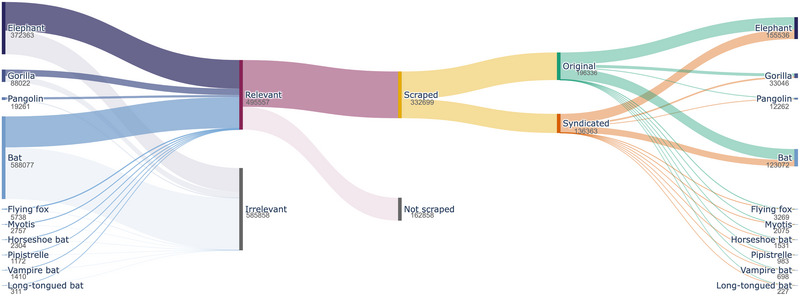 Figure 1
 Figure 2
 Figure 3
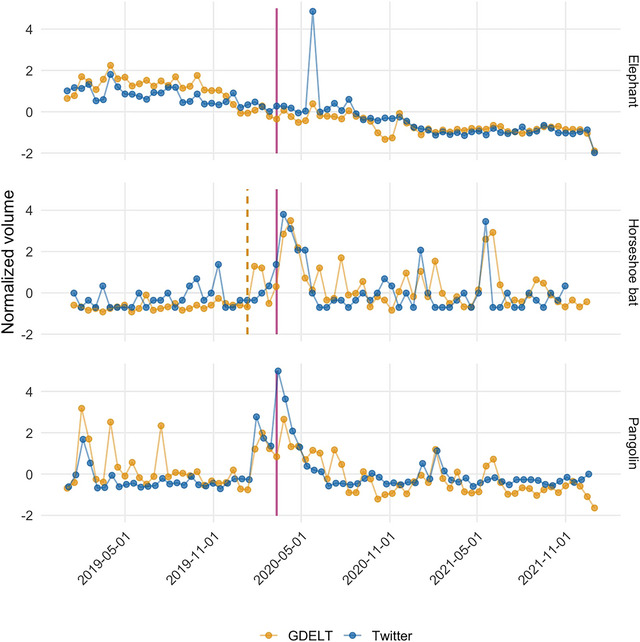 Figure 4
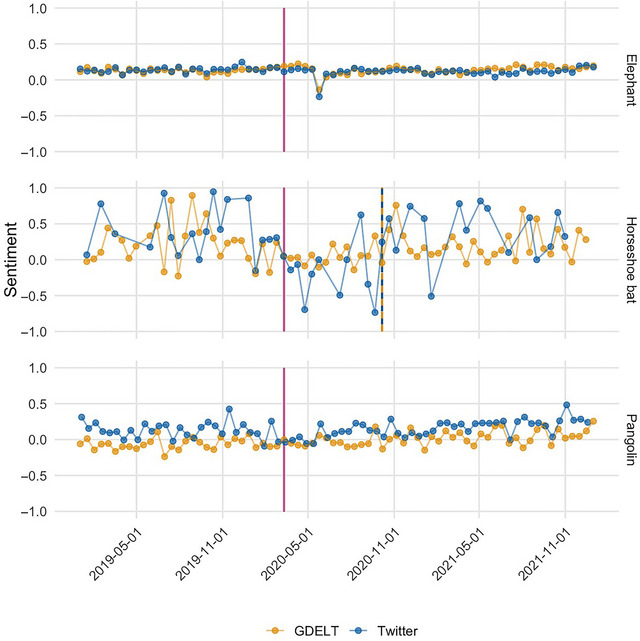 Figure 5
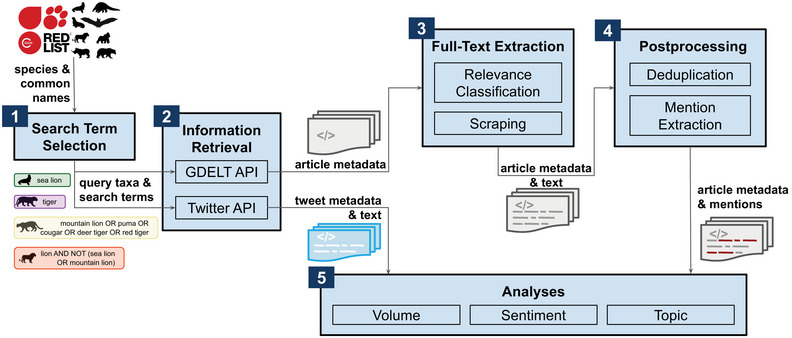 Figure 6
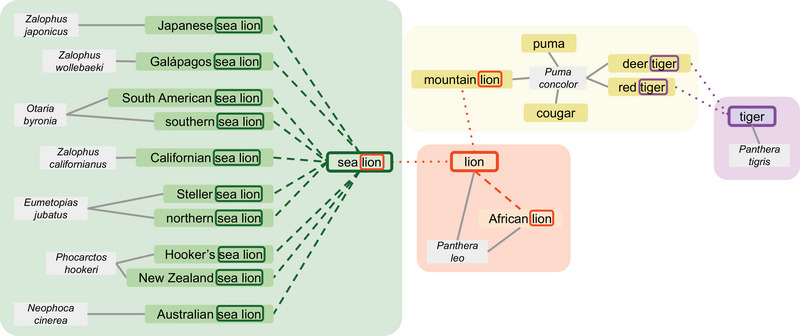 Figure 7
Peer Reviews
No public reviews on file for this paper yet. If you reviewed it on a platform where reviews are public (OpenReview, ICLR, NeurIPS, ICML), you can paste yours below so the community can read it here.
Videos
No videos yet. Explain this paper in a talk, walkthrough, or lecture? Add one.
Taxonomy
TopicsAnimal and Plant Science Education · Species Distribution and Climate Change · Zoonotic diseases and public health