Renewed coexistence as a conceptual reframing of animal reintroductions to foster sustainable human–wildlife coexistence
Roger Edward Auster, Alan Puttock, Stewart Barr, Richard Brazier

TL;DR
This paper reframes animal reintroductions as a process of renewed coexistence, emphasizing long-term human-wildlife interactions and social integration.
Contribution
The paper introduces a novel conceptual framework for reintroductions as renewed coexistence, emphasizing coadaptive processes and human involvement.
Findings
Renewed coexistence emphasizes long-term human-wildlife interactions beyond mere animal return.
A transition phase is identified where humans and reintroduced animals continue to coadapt.
Meaningful human involvement is crucial from the project's outset through to implementation.
Abstract
Wildlife reintroductions are socioecological processes entailing the intentional movement of organisms by people. In animal reintroductions, there is growing recognition of the importance of human dimensions and efforts to integrate these into reintroduction projects. To conceptually reframe reintroductions as processes of renewed coexistence (a coadaptive process through which sustainable human–wildlife interactions [HWIs] are fostered), we build upon existing understanding of HWIs and coexistence. Our conceptual framing acknowledges historical HWIs and recognizes that the reintroduced species may be new for people to coexist with today. This provides a long‐term, futures‐oriented perspective on reintroductions that goes beyond the return of an animal to fostering long‐term coexistence between humans and the reintroduced animal. This requires integration of social understandings and…
Genes, proteins, chemicals, diseases, species, mutations and cell lines named across the full text — each resolved to its canonical identifier and authoritative record.
Click any figure to enlarge with its caption.
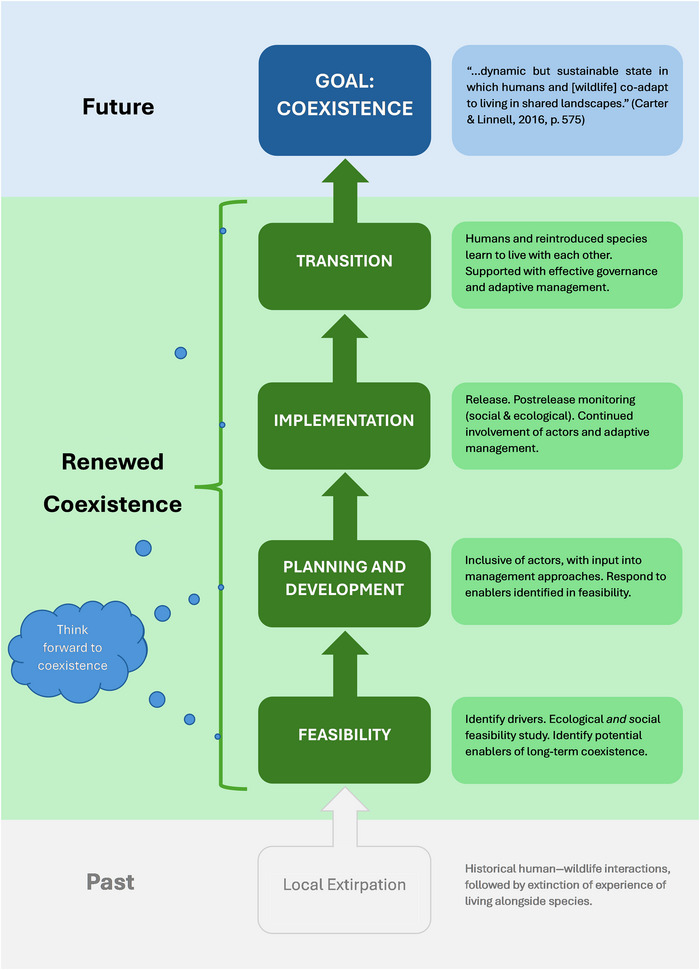 Figure 1
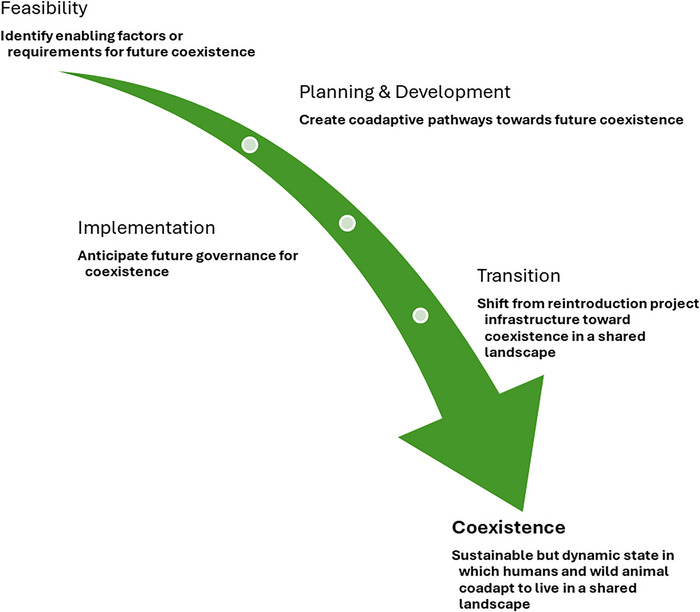 Figure 2
Peer Reviews
No public reviews on file for this paper yet. If you reviewed it on a platform where reviews are public (OpenReview, ICLR, NeurIPS, ICML), you can paste yours below so the community can read it here.
Videos
No videos yet. Explain this paper in a talk, walkthrough, or lecture? Add one.
Taxonomy
TopicsWildlife Ecology and Conservation · Geographies of human-animal interactions · Environmental Philosophy and Ethics