Diminishing returns of disease-modifying treatment in older participants of multiple sclerosis clinical trials
Eva Strijbis, Jop Mostert, Miguel D’Haeseleer, Ester Moral, Luis Brieva Ruiz, Jacynthe Comtois, Joep Killestein, Pavle Repovic, Tarrant McPherson, Gary Cutter, Marcus Koch

TL;DR
This study shows that disease-modifying treatments for multiple sclerosis become less effective as patients age, based on clinical trial data.
Contribution
The novel use of Number Needed to Treat (NNT) to quantify diminishing treatment efficacy with age in multiple sclerosis trials.
Findings
Inflammatory disease activity decreases with age, leading to higher NNTs in older patients.
NNTs to prevent T2 lesions or relapses increase significantly in older age groups.
NNTs offer a practical framework for balancing treatment benefits and harms in clinical decision-making.
Abstract
It remains uncertain whether the relative benefit of disease-modifying treatments (DMTs) diminish as patients age because of a natural decline of inflammatory disease activity. To better capture the balance of benefit and harm, the statistical concept of the Number Needed to Treat (NNT) provides a useful and easily interpretable metric. We examined the relationship between treatment efficacy and age by applying the NNT concept to three pivotal randomized clinical trials of high-efficacy DMTs: AFFIRM, SENTINEL, and DECIDE (3,954 participants together). NNTs were calculated to determine how many individuals within each age group would need to be treated to prevent one additional inflammatory event (by different definitions of significant inflammation). Inflammatory disease activity decreased with advancing age, resulting in progressively higher NNTs in older participants. For instance,…
Genes, proteins, chemicals, diseases, species, mutations and cell lines named across the full text — each resolved to its canonical identifier and authoritative record.
Click any figure to enlarge with its caption.
 Figure 1
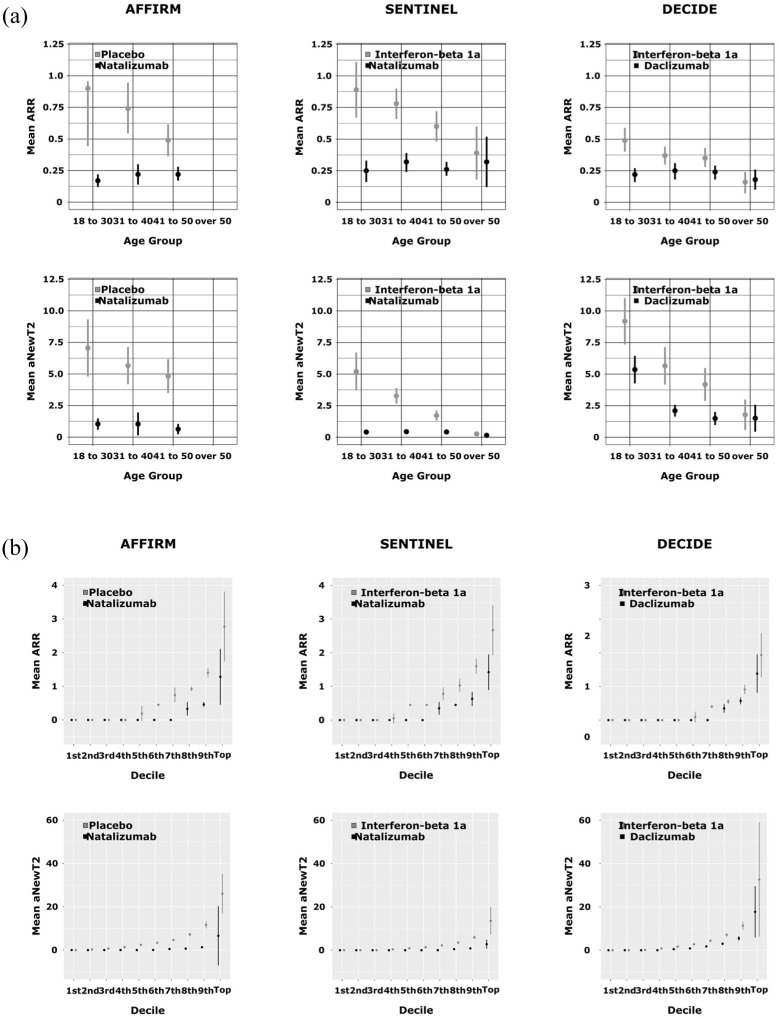 Figure 1
 Figure 3
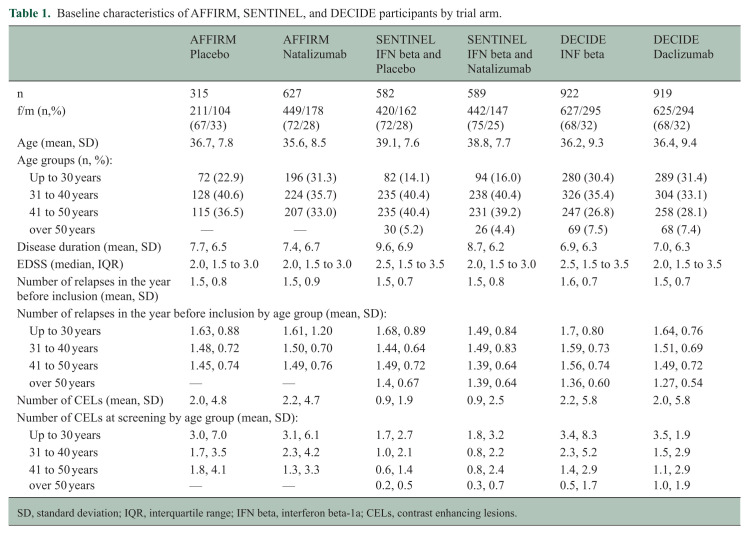 Figure 4
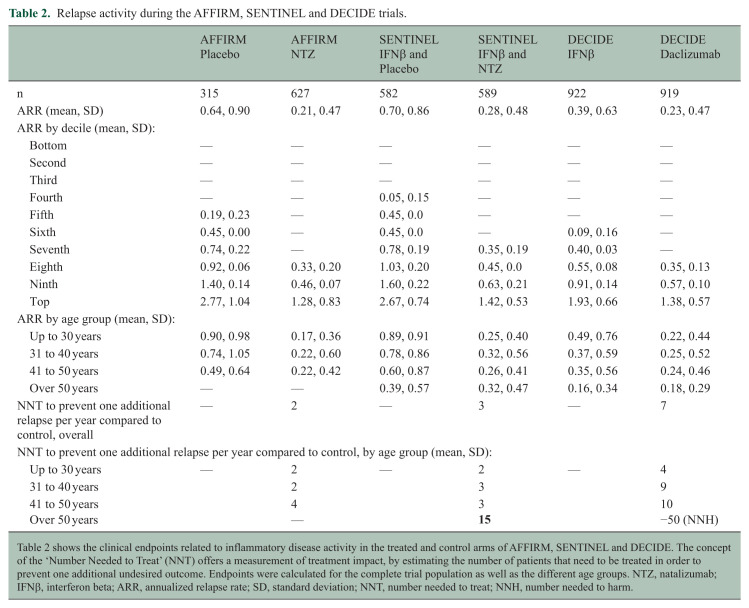 Figure 5
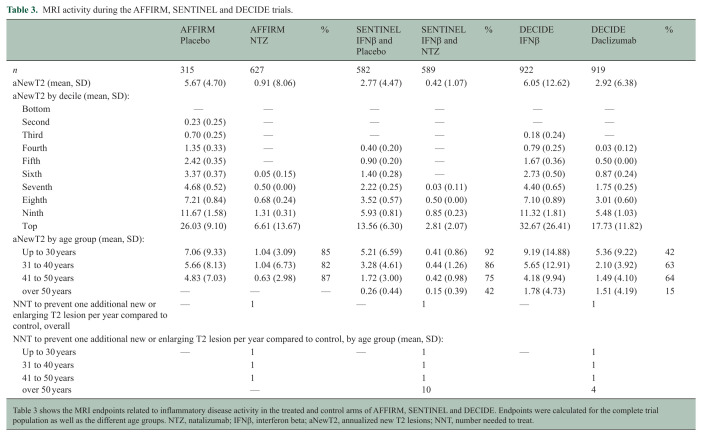 Figure 6
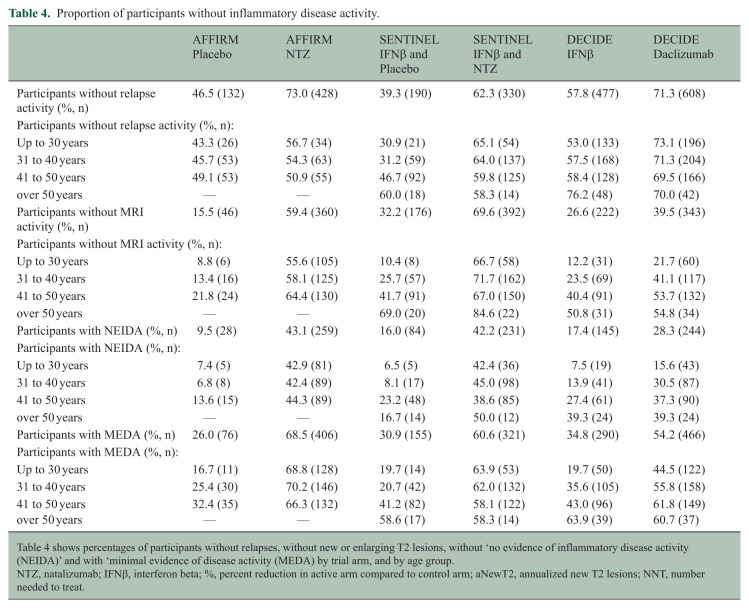 Figure 7
Peer Reviews
No public reviews on file for this paper yet. If you reviewed it on a platform where reviews are public (OpenReview, ICLR, NeurIPS, ICML), you can paste yours below so the community can read it here.
Videos
No videos yet. Explain this paper in a talk, walkthrough, or lecture? Add one.
Taxonomy
TopicsMultiple Sclerosis Research Studies · Immune responses and vaccinations · Rheumatoid Arthritis Research and Therapies