Analyzing and supporting mental representations and strategies in solving Bayesian problems
Julia Sirock, Markus Vogel, Tina Seufert

TL;DR
This study shows that visualizing Bayesian problems improves learning success and reduces cognitive load compared to using formulas.
Contribution
The study compares the effectiveness of different visualization methods for solving Bayesian problems and their impact on cognitive load.
Findings
Learning success is significantly higher with the unit square and 2 × 2 table than with the formula.
No significant differences were found between the unit square and 2 × 2 table in learning success or cognitive load.
Creating and explaining visualizations improves solution performance and reduces effort.
Abstract
Solving Bayesian problems poses many challenges, such as identifying relevant numerical information, classifying and translating it into mathematical formula language, and forming a mental representation. This triggers research on how to support the solving of Bayesian problems. The facilitating effect of using numerical data in frequency format instead of probabilities is well documented, as is the facilitating effect of given visualizations of statistical data. Accordingly, this study examines the differences, in learning success and cognitive load, between the formula, the 2 × 2 table, and the unit square. The visualizations are additionally explained in a descriptive way and created by the participants themselves. The results confirm the hypothesis of the study that learning success is significantly higher when using the unit square and the 2 × 2 table than when using the formula. A…
Click any figure to enlarge with its caption.
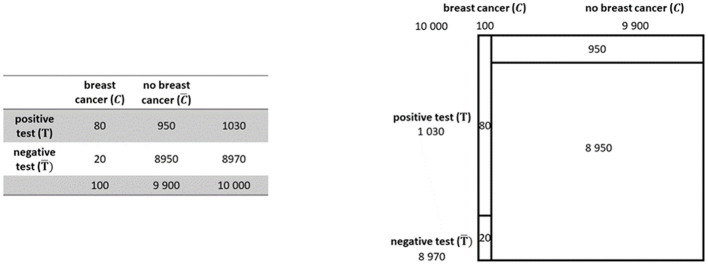 Figure 1
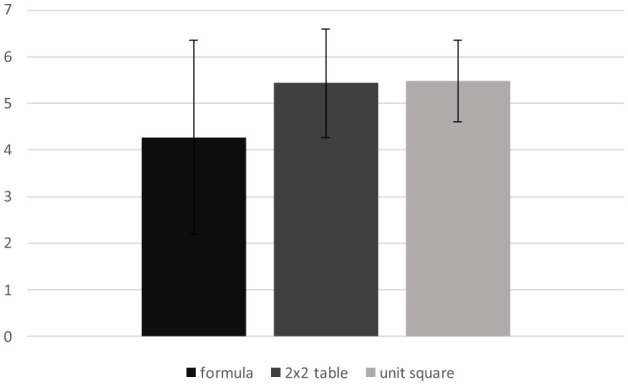 Figure 2
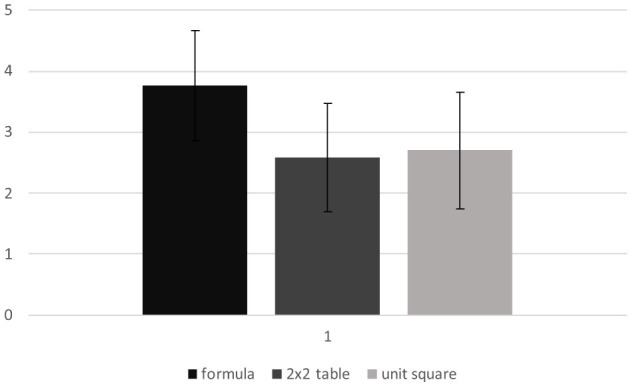 Figure 3
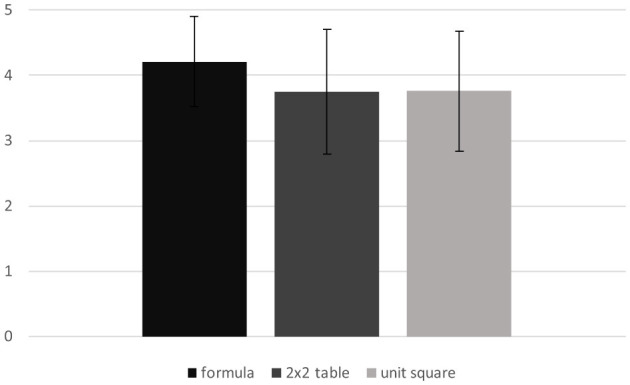 Figure 4
Peer Reviews
No public reviews on file for this paper yet. If you reviewed it on a platform where reviews are public (OpenReview, ICLR, NeurIPS, ICML), you can paste yours below so the community can read it here.
Videos
No videos yet. Explain this paper in a talk, walkthrough, or lecture? Add one.
Taxonomy
TopicsVisual and Cognitive Learning Processes · Cognitive and developmental aspects of mathematical skills · Statistics Education and Methodologies