The AMP–antibiotic–microbiota triad in IBD: a mechanistic framework for dysregulated antimicrobial defense
Yuyuan Hu, Yan Li, Qiang Zhang, Qiaobo Tan, Haoze Liu, Yuhang Yang, Chenfei Jin, Wei Zhang, Jinghan Jia, Jinxi Wang

TL;DR
This paper explores how imbalances in antimicrobial peptides, antibiotics, and gut microbes contribute to inflammatory bowel disease and suggests new treatment strategies.
Contribution
The paper introduces a novel mechanistic framework called the AMP–antibiotic–microbiota triad to explain dysregulated antimicrobial defense in IBD.
Findings
AMP expression is altered in different IBD subtypes, such as reduced α-defensins in Crohn’s disease.
Antibiotic exposure disrupts microbial communities and AMP regulation, worsening dysbiosis.
Therapeutic strategies like AMP enhancement and microbiota-sparing antibiotics are proposed for IBD treatment.
Abstract
Inflammatory bowel disease (IBD) represents a chronic relapsing disorder driven by a loss of homeostatic balance between the host immune system and the intestinal microbiota. Endogenous antimicrobial peptides (AMPs), produced primarily by epithelial and immune cells, function in concert with commensal microorganisms to preserve mucosal integrity and barrier function. Disruption of this antimicrobial equilibrium—through genetic susceptibility such as NOD2 mutations or environmental perturbations including antibiotic overuse—can impair antimicrobial defense, distort microbial composition, and initiate chronic inflammation. Recent investigations have revealed distinct alterations in AMP expression across IBD subtypes. In Crohn’s disease, Paneth cell–derived α-defensins (HD5 and HD6) are markedly diminished in the ileal mucosa, whereas colonic, segmental IBD exhibits inadequate induction of…
Genes, proteins, chemicals, diseases, species, mutations and cell lines named across the full text — each resolved to its canonical identifier and authoritative record.
Click any figure to enlarge with its caption.
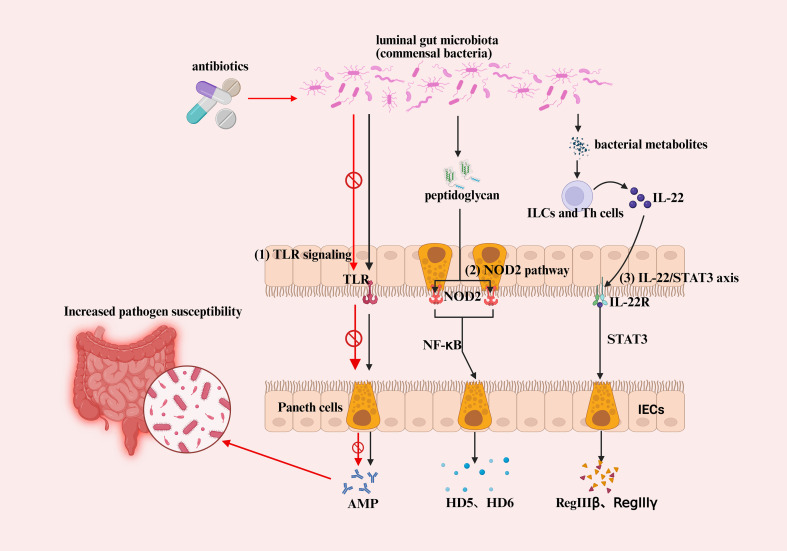 Figure 1
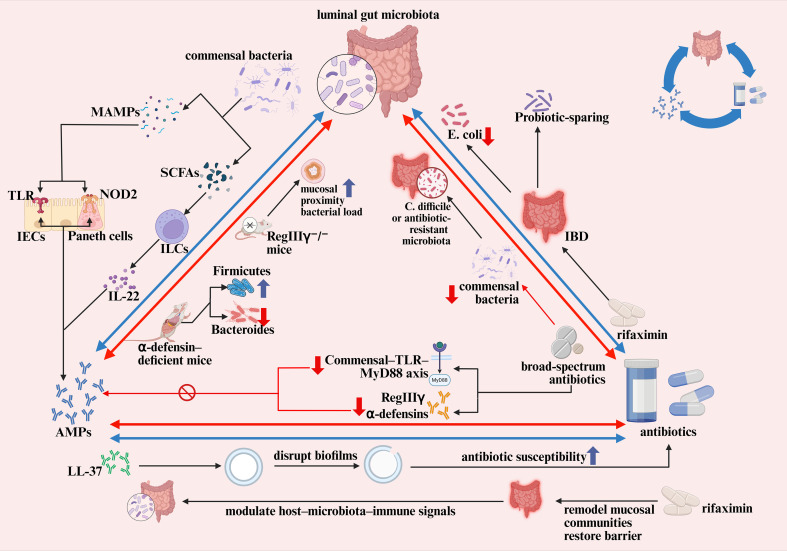 Figure 2
Peer Reviews
No public reviews on file for this paper yet. If you reviewed it on a platform where reviews are public (OpenReview, ICLR, NeurIPS, ICML), you can paste yours below so the community can read it here.
Videos
No videos yet. Explain this paper in a talk, walkthrough, or lecture? Add one.
Taxonomy
TopicsAntimicrobial Peptides and Activities · Gut microbiota and health · Dermatology and Skin Diseases