Lower-body strength and power profiles and their relationships with shot velocity and accuracy in elite arena soccer players
Minh N. Q. Nguyen, Caleb Bean, Angeleau Scott, Quincy Johnson, Thayne A. Munce, Andrew C. Fry

TL;DR
This study explores how lower-body strength and power relate to shot velocity and accuracy in elite arena soccer players.
Contribution
It identifies distinct neuromuscular profiles for powerful and accurate shooting in professional arena soccer.
Findings
Faster shots are linked to eccentric braking capacity during countermovement jumps.
Shooting accuracy is best explained by maximal strength and reactive strength index.
Combined shooting proficiency relates to relative peak force and reactive strength.
Abstract
Soccer goals depend on the ability to strike the ball both fast and accurately, yet it is unclear which lower-body neuromuscular qualities best underpin these outcomes in professional arena soccer. This study examined how force plate–derived strength and power characteristics relate to shot velocity, accuracy, and a combined shooting proficiency score in elite arena players. Thirty-two male Major Arena Soccer League players completed a battery of lower-body tests on dual force plates [isometric mid-thigh pull [IMTP], countermovement jump [CMJ], drop jump, and 10/5 repeated ankle hops], followed 24–48 h later by a standardized Rosch Soccer Shooting Test. Shooting outcomes were dominant-foot shot velocity (VEL; radar-derived), shooting accuracy (ACC; summed target-grid score of the best three shots), and a composite proficiency index (PROF = VEL × ACC). Pearson correlations were used to…
Click any figure to enlarge with its caption.
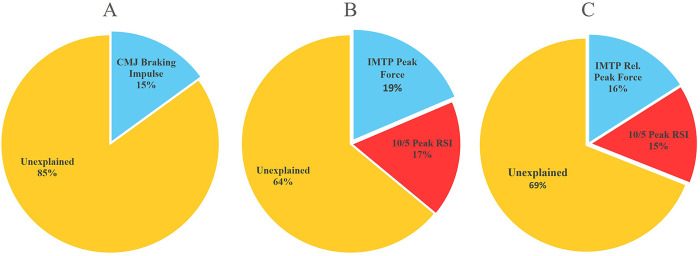 Figure 1
Peer Reviews
No public reviews on file for this paper yet. If you reviewed it on a platform where reviews are public (OpenReview, ICLR, NeurIPS, ICML), you can paste yours below so the community can read it here.
Videos
No videos yet. Explain this paper in a talk, walkthrough, or lecture? Add one.
Taxonomy
TopicsSports Performance and Training · Knee injuries and reconstruction techniques · Sports Dynamics and Biomechanics