Mediation analysis investigating the mechanisms of two school-based smoking prevention interventions in adolescents from Northern Ireland and Bogotá
Jennifer M. Murray, Sharon C. Sánchez-Franco, Olga L. Sarmiento, Erik O. Kimbrough, Christopher Tate, Shannon C. Montgomery, Rajnish Kumar, Laura Dunne, Allen Thurston, Aideen Gildea, Abhijit Ramalingam, Erin L. Krupka, Felipe Montes, Huiyu Zhou, Laurence Moore, Linda Bauld

TL;DR
This study compared two school-based smoking prevention programs in Northern Ireland and Bogotá to understand how they work and if they can be adapted for low-middle income countries.
Contribution
The study provides novel mediation analysis of smoking prevention interventions in different economic settings, focusing on low-middle income countries.
Findings
Dead Cool showed more anti-smoking outcomes compared to ASSIST, but ASSIST had lower exposure to tobacco advertising.
Setting effects showed more anti-smoking outcomes in Northern Ireland versus Bogotá, but Bogotá had stronger support for anti-smoking norms.
Suppressive mediation effects suggest unmeasured factors influence smoking prevention outcomes.
Abstract
Reviews have highlighted a lack of evidence on how successful intervention strategies for adolescent smoking prevention can be effectively adapted for low-middle income countries (LMICs). The MECHANISMS study compared behavioral mechanisms between two school-based smoking prevention programs for adolescents in Northern Ireland (NI; a high-income setting) and Bogotá, Colombia (middle-income). ASSIST works via peer education and diffusion. Dead Cool uses conventional classroom pedagogy. Both interventions were previously trialed in the UK and were culturally adapted for Bogotá. We investigated whether changes in smoking/vaping outcomes differed by intervention or setting. Mediation analyses were conducted to test the hypothesized intervention mechanisms. Full school year groups in 12 secondary schools participated during one semester (n = 1,344, target age 12–13 years). Outcomes included…
Genes, proteins, chemicals, diseases, species, mutations and cell lines named across the full text — each resolved to its canonical identifier and authoritative record.
Click any figure to enlarge with its caption.
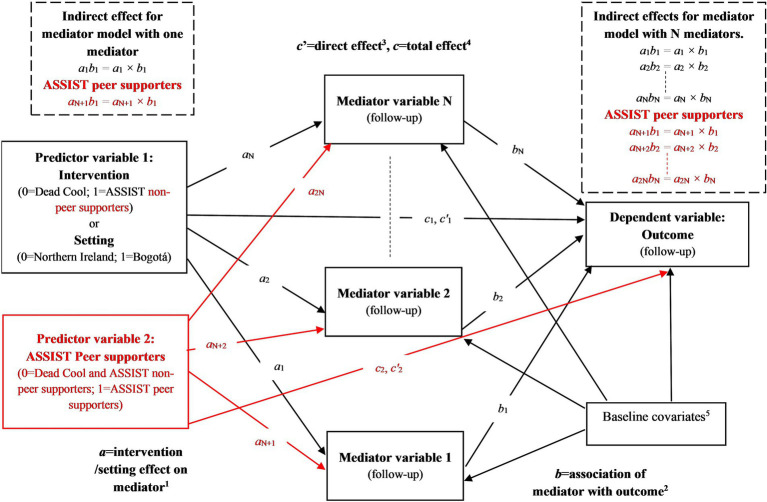 Figure 1
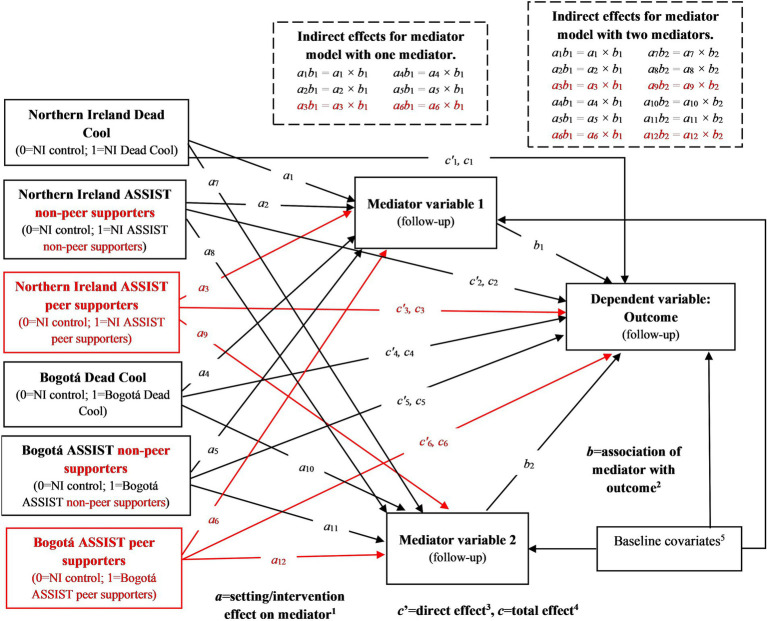 Figure 2
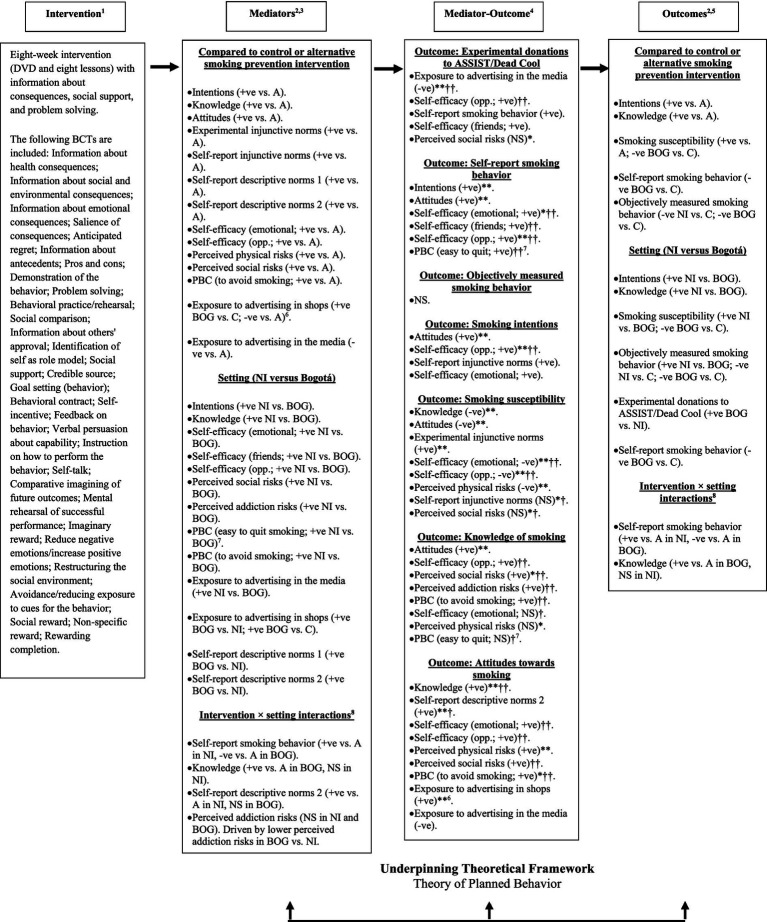 Figure 3
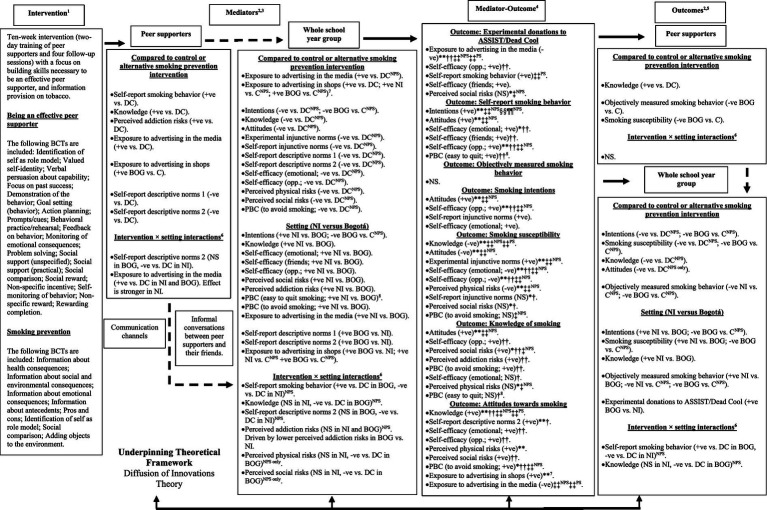 Figure 4
Peer Reviews
No public reviews on file for this paper yet. If you reviewed it on a platform where reviews are public (OpenReview, ICLR, NeurIPS, ICML), you can paste yours below so the community can read it here.
Videos
No videos yet. Explain this paper in a talk, walkthrough, or lecture? Add one.
Taxonomy
TopicsSmoking Behavior and Cessation · Behavioral Health and Interventions · Obesity, Physical Activity, Diet