Exploratory biomarkers for oxaliplatin-induced nivolumab responsiveness in metastatic microsatellite-stable colorectal cancer
Anne Hansen Ree, Paula A. Bousquet, Tina Visnovska, Torben Lüders, Benjamin P. Geisler, Shixiong Wang, Diana L. Bordin, Hilde L. Nilsen, Hanne M. Hamre, Christian Kersten, Eva Hofsli, Marianne G. Guren, Halfdan Sorbye, Jens P. Berg, Kjersti Flatmark, Sebastian Meltzer

TL;DR
The study explores how tumor mutations and inflammation levels may predict response to a treatment combining chemotherapy and immunotherapy in a specific type of colorectal cancer.
Contribution
The study identifies TMB ≥9, BRAF-V600E mutation, and low C-reactive protein as potential biomarkers for better treatment outcomes in metastatic colorectal cancer.
Findings
Patients with TMB ≥9 or BRAF-V600E mutation had significantly longer progression-free survival.
Those with TMB ≥9, BRAF-V600E, and normal C-reactive protein levels had even longer survival.
TMB, BRAF status, and systemic inflammation are proposed as practical biomarkers for treatment prediction.
Abstract
The randomised METIMMOX trial evaluated short-course oxaliplatin-based chemotherapy alternating with nivolumab for metastatic microsatellite-stable/mismatch repair-proficient colorectal cancer. In a post hoc analysis, we investigated whether tumour mutations or patients’ systemic inflammation might provide insights into responsiveness to the METIMMOX regimen. Patients received either oxaliplatin-based chemotherapy (control group) or alternating two cycles each of chemotherapy and nivolumab (experimental group), with progression-free survival (PFS) as the primary endpoint. Tumour biopsies were sequenced with the TruSight Oncology 500 assay. The median tumour mutational burden (TMB; in mutations/megabase) was 8 (range, 1–13). The experimental-arm patients with TMB ≥9 or BRAF-V600E mutation (n = 17) achieved median PFS of 19.8 months (95% confidence interval, 11.3–28.3), longer (p =…
Genes, proteins, chemicals, diseases, species, mutations and cell lines named across the full text — each resolved to its canonical identifier and authoritative record.
Click any figure to enlarge with its caption.
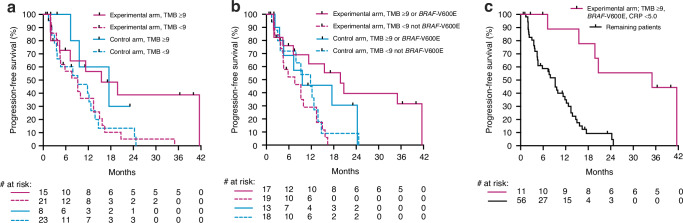 Figure 1
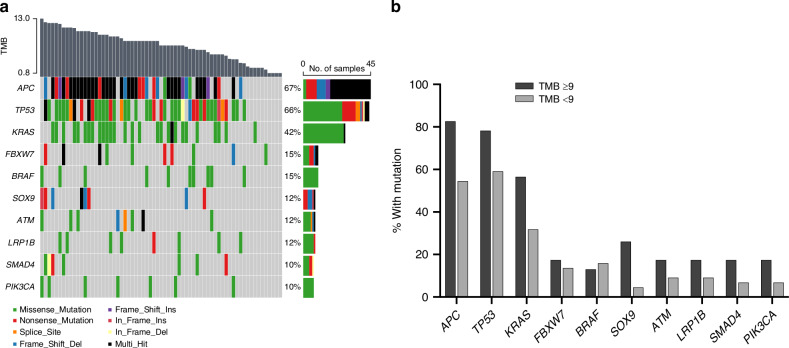 Figure 2
Peer Reviews
No public reviews on file for this paper yet. If you reviewed it on a platform where reviews are public (OpenReview, ICLR, NeurIPS, ICML), you can paste yours below so the community can read it here.
Videos
No videos yet. Explain this paper in a talk, walkthrough, or lecture? Add one.
Taxonomy
TopicsColorectal Cancer Treatments and Studies · Cancer Immunotherapy and Biomarkers · Genetic factors in colorectal cancer