Dosimetric analysis reveals rapid clearance and low absorbed dose of [¹⁷⁷Lu]Lu-PSMA-617 in non-prostate cancers with high PSMA expression
Fadi Khreish, Florian Rosar, Caroline Burgard, Sven Petto, Stephan Maus, Tobias Stemler, Mark Bartholomä, Amir Sabet, Andrea Schaefer-Schuler, Samer Ezziddin

TL;DR
A study found that [¹⁷⁷Lu]Lu-PSMA-617 delivers low radiation doses to non-prostate cancers with high PSMA uptake, making it less effective for these tumors.
Contribution
The study provides new dosimetric evidence that [¹⁷⁷Lu]Lu-PSMA-617 is not effective for non-prostate cancers despite high PSMA expression.
Findings
Non-prostate cancer tumors had a significantly shorter effective half-life of [¹⁷⁷Lu]Lu-PSMA-617 compared to prostate cancer tumors.
The absorbed radiation dose in non-prostate cancer tumors was significantly lower than in prostate cancer tumors.
Despite high PSMA uptake, [¹⁷⁷Lu]Lu-PSMA-617 therapy is not effective for non-prostate cancers due to low tumor-absorbed dose.
Abstract
The aim of this study was to evaluate the dosimetry for [177Lu]Lu-PSMA-617 in advanced non-prostate cancer (non-PCa) patients with previous intense radiotracer uptake of the tumor lesions on PET/CT using [68Ga]Ga-PSMA-11. Dosimetry data of 5 patients with non-prostate cancer (non-PCa group) were assessed and compared; Non-PCa tumors were breast cancer (BC), renal cell carcinoma (RCC), hepatocellular carcinoma (HCC) and anaplastic astrocytoma (AA). Five patients with metastatic castration-resistant prostate cancer (PCa group) were used as control-group. All patients were given [177Lu]Lu-PSMA-617 after proven sufficient PSMA uptake of tumor lesions by [68Ga]Ga-PSMA-11 PET/CT. Post-therapeutic dosimetry with serial whole-body scans (24, 48 and 72–120 h post-injection) included calculation of effective half-life and absorbed doses for tumor and non-tumor lesions and comparison between…
Genes, proteins, chemicals, diseases, species, mutations and cell lines named across the full text — each resolved to its canonical identifier and authoritative record.
Click any figure to enlarge with its caption.
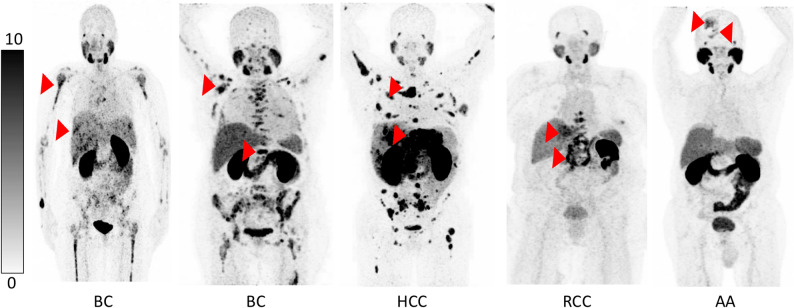 Figure 1
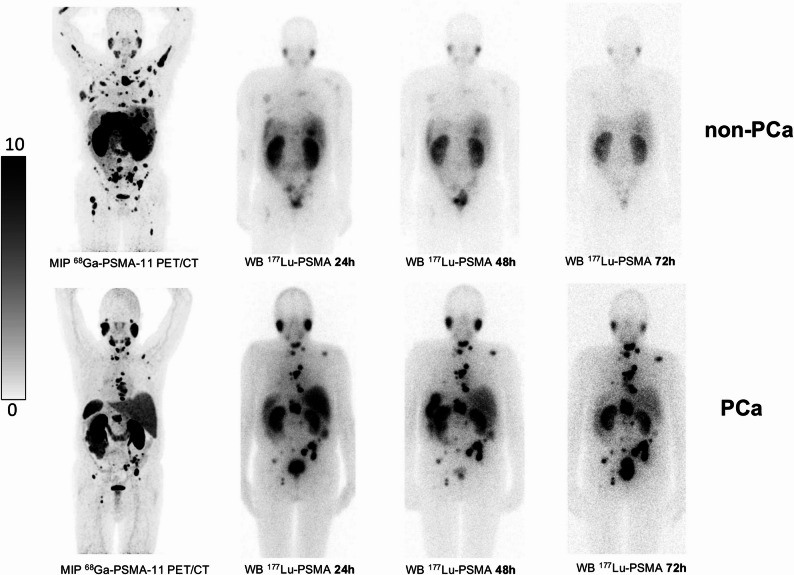 Figure 2
Peer Reviews
No public reviews on file for this paper yet. If you reviewed it on a platform where reviews are public (OpenReview, ICLR, NeurIPS, ICML), you can paste yours below so the community can read it here.
Videos
No videos yet. Explain this paper in a talk, walkthrough, or lecture? Add one.
Taxonomy
TopicsProstate Cancer Treatment and Research · Radiopharmaceutical Chemistry and Applications · Peptidase Inhibition and Analysis