Individual differences in musical melody perception moderate the speech-to-song illusion in Mandarin Chinese listeners
Tamara V. Rathcke, Massimiliano Canzi

TL;DR
This study shows how Mandarin speakers experience a speech-to-song illusion differently, possibly due to their language's tonal nature affecting how they perceive melody in speech.
Contribution
The study reveals that Mandarin Chinese listeners' weaker melody perception abilities facilitate the speech-to-song illusion, suggesting a link to perceptual pitch distortion.
Findings
Mandarin listeners showed a modest speech-to-song illusion effect, independent of sentence acoustics.
Weaker melody perception abilities were associated with stronger speech-to-song illusion effects.
Linguistic background influences how speech is perceived as song, linking language experience to music cognition.
Abstract
Repeated exposure to a spoken phrase can give rise to the perception of the speech-to-song illusion (STS), whereby speech gains musical qualities and begins to sound like singing. STS is known to rely on acoustic cues and may depend on an individual’s ability to extract musical qualities (such as melody and rhythm) from speech acoustics. So far, most research has examined listeners of non-tonal languages, with preliminary evidence indicating that tonal-language listeners experience STS differently, if at all. This study investigated STS in Mandarin Chinese listeners who rated song-likeness of Mandarin sentences before and after repetition and completed the Musical Ear Test. Test sentences were designed to promote the acoustic transmission of either melody or rhythm. Results demonstrated a modest STS effect in Mandarin listeners at the group level, which was independent of sentence…
Genes, proteins, chemicals, diseases, species, mutations and cell lines named across the full text — each resolved to its canonical identifier and authoritative record.
Click any figure to enlarge with its caption.
 Figure 1
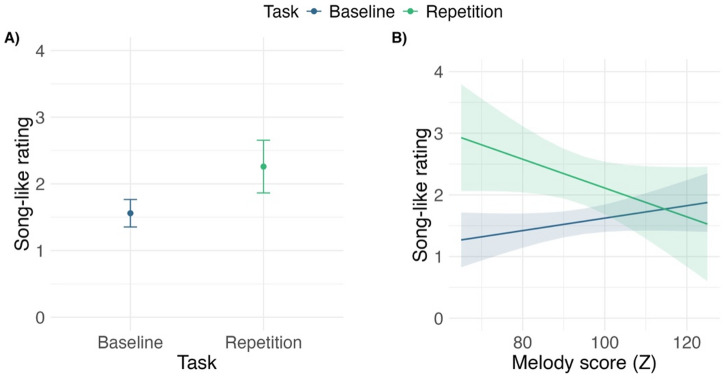 Figure 2
 Figure 3
Peer Reviews
No public reviews on file for this paper yet. If you reviewed it on a platform where reviews are public (OpenReview, ICLR, NeurIPS, ICML), you can paste yours below so the community can read it here.
Videos
No videos yet. Explain this paper in a talk, walkthrough, or lecture? Add one.
Taxonomy
TopicsPhonetics and Phonology Research · Neuroscience and Music Perception · Hearing Loss and Rehabilitation