Integrating clinical proxies and metabolic data identifies and distinguishes high-risk depression subtypes in a real-world first-hospitalization cohort
Huizeng Yang, Pinfan Gu, Di Liu, Xinxu Wang, Minghui Li, Xinyu Xu, Nannan Liu

TL;DR
The study identifies high-risk depression subtypes using clinical and metabolic data in first-hospitalized patients, helping to improve early risk stratification.
Contribution
The novel integration of clinical proxies and metabolic data enables distinguishing between recurrent and treatment-resistant depression subtypes in real-world settings.
Findings
Recurrent depression is linked to older age, longer hospital stays, and worse metabolic profiles like higher triglycerides and glucose.
Treatment-resistant depression is marked by higher rates of treatment observation completion and elevated suicide risk documentation.
Prolonged illness duration in first-episode patients is a strong indicator of a misdiagnosed first episode due to treatment delay.
Abstract
Early identification of high-risk depression subtypes, specifically, recurrent (RD) and treatment-resistant (TRD) depression, is critical for improving long-term outcomes, yet practical stratification tools based on routinely available clinical and metabolic data remain limited. This study aimed to characterize these subtypes within a real-world, first-hospitalization cohort by integrating clinical proxy indicators with metabolic biomarkers. In a cross-sectional analysis of 1,436 first-hospitalized patients with first-episode depression (FED) and RD, we compared demographic, clinical, and metabolic characteristics. TRD was operationally defined by electroconvulsive therapy (ECT) exposure. Multivariable logistic regression identified factors associated with RD (vs. FED) and TRD (within RD). Compared to FED patients, RD patients were older (47.1 vs. 42.4 years, p<0.001), had longer…
Genes, proteins, chemicals, diseases, species, mutations and cell lines named across the full text — each resolved to its canonical identifier and authoritative record.
Click any figure to enlarge with its caption.
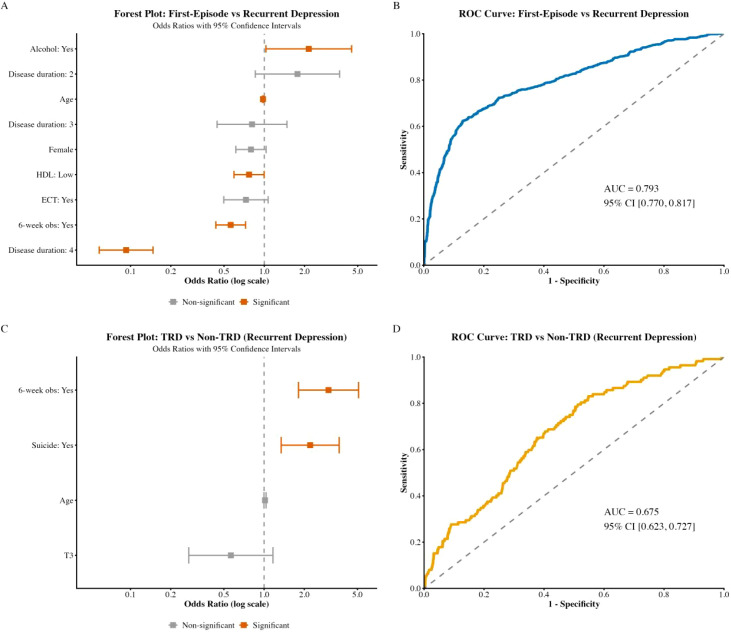 Figure 1
Peer Reviews
No public reviews on file for this paper yet. If you reviewed it on a platform where reviews are public (OpenReview, ICLR, NeurIPS, ICML), you can paste yours below so the community can read it here.
Videos
No videos yet. Explain this paper in a talk, walkthrough, or lecture? Add one.
Taxonomy
TopicsTreatment of Major Depression · Electroconvulsive Therapy Studies · Tryptophan and brain disorders