Promises and challenges of applying large language models in the healthcare domain
Qingyu Wang, Ziheng Gong, Zou Lai, Lina Bu, Fried-Michael Dahlweid, Hong Sun

TL;DR
This paper reviews how large language models are being used in healthcare, comparing general and specialized models and discussing their benefits and challenges.
Contribution
The paper contrasts general-purpose and domain-specific models in healthcare and outlines future directions like retrieval-augmented generation.
Findings
General-purpose models adapt to healthcare via prompt engineering, while domain-specific models align with medical knowledge graphs.
Challenges include hallucination, privacy issues, and unclear evaluation metrics.
Future routes include retrieval-augmented generation and agentic architectures.
Abstract
Large language models are rapidly moving from theoretical concepts to active clinical pilots. Current approaches diverge between general-purpose models, which adapt to healthcare via prompt engineering, and domain-specific models, which prioritize deep alignment with medical knowledge graphs to ensure safety. Despite reported benefits in documentation efficiency and diagnostic reasoning, significant challenges remain regarding hallucination, privacy, and the validity of evaluation metrics. This Mini Review synthesizes current evidence, contrasts these two modeling paradigms, highlights key controversies, and maps out future development routes including retrieval-augmented generation and agentic architectures.
Genes, proteins, chemicals, diseases, species, mutations and cell lines named across the full text — each resolved to its canonical identifier and authoritative record.
Click any figure to enlarge with its caption.
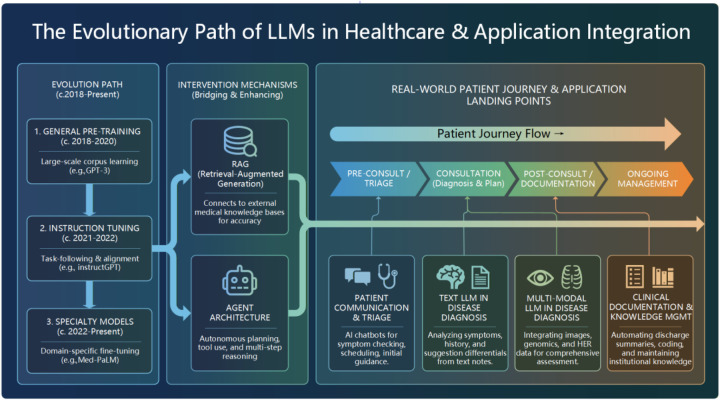 Figure 1
Peer Reviews
No public reviews on file for this paper yet. If you reviewed it on a platform where reviews are public (OpenReview, ICLR, NeurIPS, ICML), you can paste yours below so the community can read it here.
Videos
No videos yet. Explain this paper in a talk, walkthrough, or lecture? Add one.
Taxonomy
TopicsMachine Learning in Healthcare · Artificial Intelligence in Healthcare and Education · Topic Modeling