Sex-specific psychological mechanisms of cyber reactive aggression: evidence from Chinese college students
Qian-Nan Ruan, Fei-Rui Ni, Ru-Ying Yu, Yongjian Lin

TL;DR
This study explores how male and female Chinese college students differ in their online aggressive behaviors, revealing distinct psychological patterns and suggesting the need for gender-specific interventions.
Contribution
The study identifies sex-specific psychological mechanisms linking trait anger, hostile attribution bias, and revenge motivation to cyber reactive aggression in Chinese college students.
Findings
Male students showed strong associations between trait anger and hostile attribution bias, and between revenge motivation and cyber reactive aggression.
Female students exhibited prominent relationships between hostile attribution bias and cyber reactive aggression.
Maternal education levels were positively linked to aggression in both sexes, while left-behind experiences uniquely increased hostile attribution bias in males.
Abstract
This study investigated sex-specific psychological mechanisms underlying cyber reactive aggression (CRA) among Chinese college students, addressing a critical gap in understanding how trait anger (TA), hostile attribution bias (HAB), and revenge motivation (RM) differently influence male and female online aggressive behaviors. Using convenience sampling, we collected data from 926 students (371 males, 555 females) across 12 universities in China. Network analysis with mgm package revealed distinct sex-specific patterns: male participants showed strong TA-HAB and RM-CRA associations, while female participants exhibited prominent HAB-CRA relationships. Notably, maternal education levels were positively associated with aggressive behavior in both sexes (males: weight = 0.22; females: weight = 0.14), while left-behind experiences uniquely was associated with higher HAB in males (weight =…
Genes, proteins, chemicals, diseases, species, mutations and cell lines named across the full text — each resolved to its canonical identifier and authoritative record.
Click any figure to enlarge with its caption.
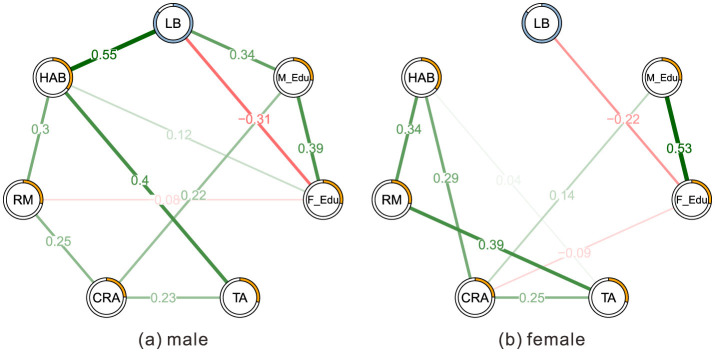 Figure 1
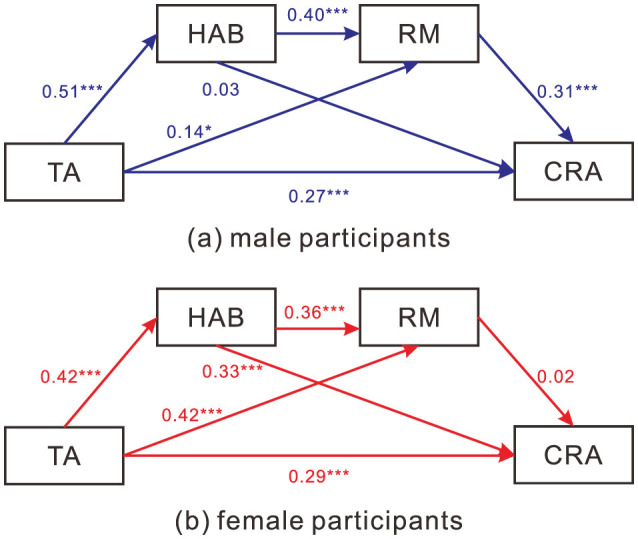 Figure 2
Peer Reviews
No public reviews on file for this paper yet. If you reviewed it on a platform where reviews are public (OpenReview, ICLR, NeurIPS, ICML), you can paste yours below so the community can read it here.
Videos
No videos yet. Explain this paper in a talk, walkthrough, or lecture? Add one.
Taxonomy
TopicsBullying, Victimization, and Aggression · Impact of Technology on Adolescents · Personality Traits and Psychology