Systematic review of AI-based models in pharmacoepidemiology for adverse drug event prediction and detection
Apostolia Karampatea, Konstantinos Kassandros, Theodoros Constantinides, Christos Kontogiorgis

TL;DR
This paper reviews how AI models are used to detect and predict adverse drug events in real-world clinical data.
Contribution
The study systematically characterizes AI-based methods for adverse drug event prediction and highlights gaps in validation and model transparency.
Findings
Most studies used structured EHRs or claims data, with limited use of natural language processing.
Tree-based models were most common, while deep learning was less frequently applied.
External validation and explainability methods were rarely used, limiting generalizability.
Abstract
Artificial intelligence (AI) has increasingly been applied in pharmacoepidemiology, yet the methodological landscape of adverse drug event (ADE) prediction remains heterogeneous and insufficiently mapped. This systematic review aimed to characterize contemporary AI-based approaches used to detect or predict ADEs in real-world clinical data. Following PRISMA 2020 guidelines and a registered protocol (PROSPERO: CRD420251159394), 281 records were screened and 15 studies met the inclusion criteria. All included studies relied primarily on structured electronic health records (EHRs) or administrative claims, while only a minority incorporated natural language processing (NLP) components, and none used spontaneous reporting systems as the primary analytic datasets. Tree-based ensemble models (e.g., Random Forests, XGBoost) and regularized regression were the most commonly adopted…
Click any figure to enlarge with its caption.
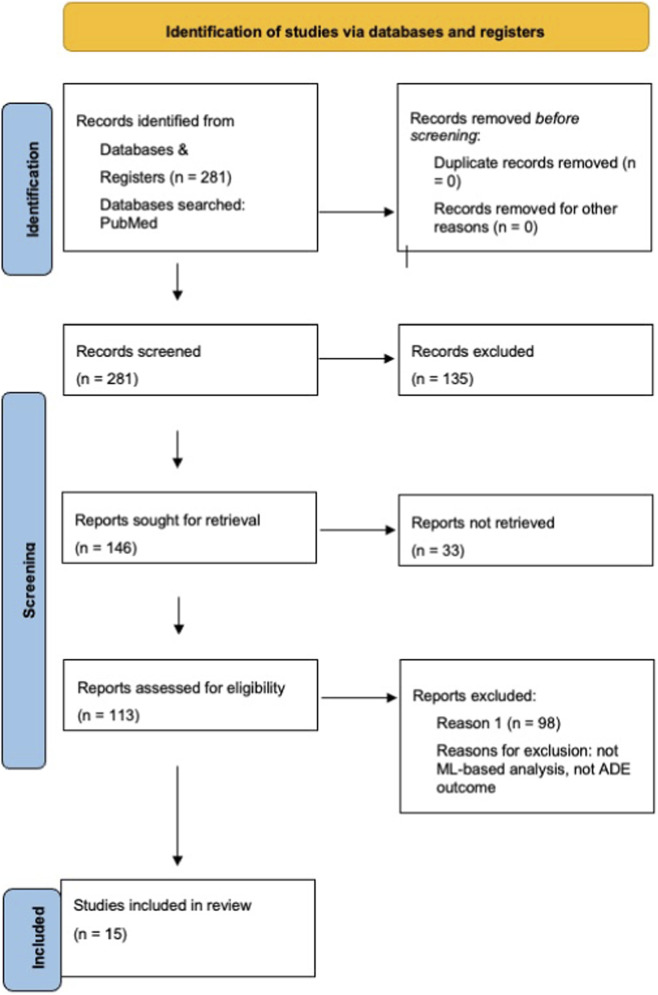 Figure 1
Peer Reviews
No public reviews on file for this paper yet. If you reviewed it on a platform where reviews are public (OpenReview, ICLR, NeurIPS, ICML), you can paste yours below so the community can read it here.
Videos
No videos yet. Explain this paper in a talk, walkthrough, or lecture? Add one.
Taxonomy
TopicsPharmacovigilance and Adverse Drug Reactions · Machine Learning in Healthcare · Artificial Intelligence in Healthcare and Education