Superior extraconal orbital fat hyperintensityin pediatric population: a potential diagnostic pitfall
Ariel Kerpel, Tamer Sobeh, Eyal Atia, Israel Cohen, Chen Hoffmann, Shai Shrot

TL;DR
This study identifies a common MRI finding in children's orbital fat that can be mistaken for disease but is likely harmless, especially in younger kids.
Contribution
The study characterizes a previously underrecognized MRI finding in pediatric patients and clarifies its benign nature.
Findings
Symmetric T2-hyperintense bands in superior extraconal orbital fat were observed in 45.5% of pediatric patients.
The finding was more common in younger children and showed a significant negative correlation with age.
Clinical follow-up showed no subsequent orbital pathology in most patients.
Abstract
With the increasing use of magnetic resonance imaging (MRI) in children, radiologists frequently encounter incidental findings that may mimic pathology. One such underrecognized finding is T2-weighted hyperintensity in the superior extraconal orbital fat, which is occasionally mistaken for an infiltrative or neoplastic process. Our objective was to characterize the imaging appearance, prevalence, and clinical associations of superior extraconal orbital fat T2 hyperintensity in pediatric MRI. We conducted a retrospective study of 143 pediatric patients (mean age 7.2±5.1 years) who underwent brain MRI with an orbit-specific protocol between 2015 and 2022. Patients were grouped based on the presence or absence of bilateral papilledema and whether imaging was performed under general anesthesia. Clinical data were extracted from the electronic medical records. Three neuroradiologists…
Genes, proteins, chemicals, diseases, species, mutations and cell lines named across the full text — each resolved to its canonical identifier and authoritative record.
Click any figure to enlarge with its caption.
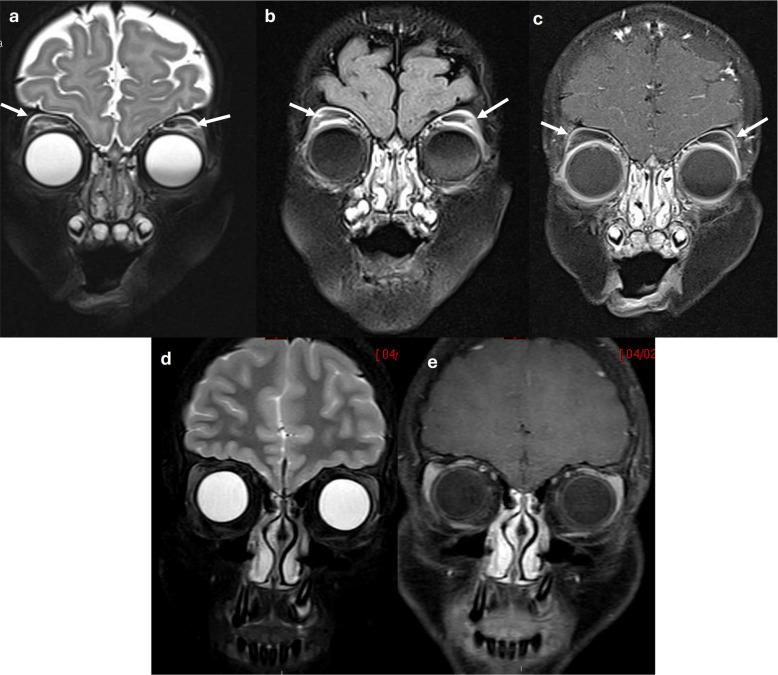 Figure 1
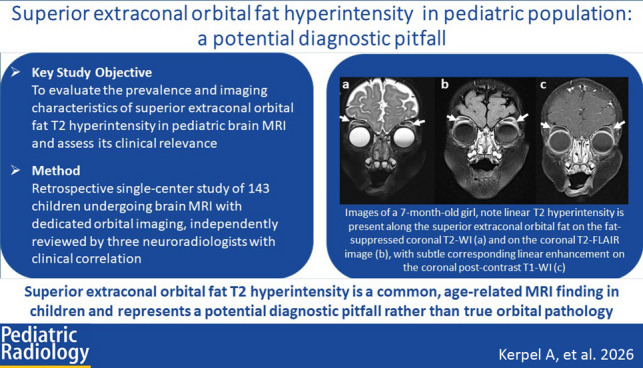 Figure 2
Peer Reviews
No public reviews on file for this paper yet. If you reviewed it on a platform where reviews are public (OpenReview, ICLR, NeurIPS, ICML), you can paste yours below so the community can read it here.
Videos
No videos yet. Explain this paper in a talk, walkthrough, or lecture? Add one.
Taxonomy
TopicsIgG4-Related and Inflammatory Diseases · Congenital Ear and Nasal Anomalies · Teratomas and Epidermoid Cysts