Artificial intelligence for traumatic brain injury imaging: a translational review from algorithm development to clinical implementation
Yansong Xu, Cuiqing Huang

TL;DR
This review explores how AI, especially deep learning, can improve the diagnosis and prognosis of traumatic brain injury through imaging, but highlights the need for more clinical validation.
Contribution
The paper provides a translational review of AI in TBI imaging, emphasizing the pathway from algorithm development to clinical implementation.
Findings
AI models, like convolutional neural networks, show high sensitivity (up to 96%) in detecting intracranial hemorrhage and segmenting lesions.
Multimodal AI approaches can predict patient outcomes, including mortality and functional recovery.
Despite improved diagnostic metrics, robust trials showing direct patient benefit are still lacking.
Abstract
Traumatic brain injury (TBI) remains a major global health burden, with computed tomography (CT) serving as the frontline imaging modality for acute assessment. However, CT interpretation is hampered by subjectivity, oversight in busy emergency settings, and limited prognostic accuracy of traditional scoring systems. Artificial intelligence (AI), particularly deep learning, offers transformative potential to automate and enhance TBI neuroimaging analysis. This review systematically synthesizes the translational pathway of AI in TBI imaging, from algorithm development to clinical implementation. AI models, especially convolutional neural networks, demonstrate high performance (sensitivity up to 96%) in detecting and classifying intracranial hemorrhage, segmenting lesions, and automating radiological scoring. Through multimodal data fusion, AI further shows promise in predicting patient…
Genes, proteins, chemicals, diseases, species, mutations and cell lines named across the full text — each resolved to its canonical identifier and authoritative record.
Click any figure to enlarge with its caption.
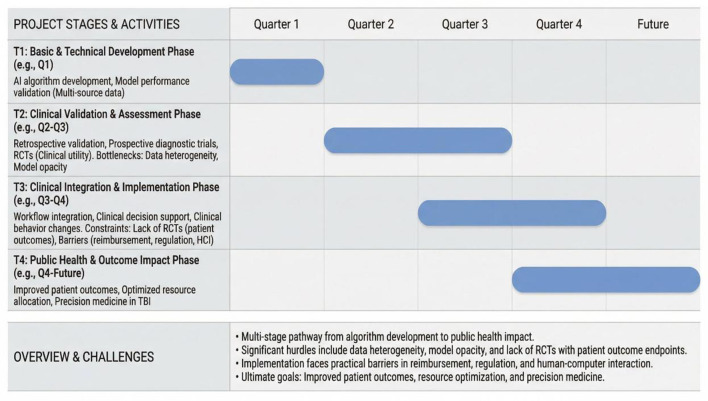 Figure 1
Peer Reviews
No public reviews on file for this paper yet. If you reviewed it on a platform where reviews are public (OpenReview, ICLR, NeurIPS, ICML), you can paste yours below so the community can read it here.
Videos
No videos yet. Explain this paper in a talk, walkthrough, or lecture? Add one.
Taxonomy
TopicsTraumatic Brain Injury and Neurovascular Disturbances · Traumatic Brain Injury Research · Artificial Intelligence in Healthcare and Education