Not all babies are the same: an examination of temperament profiles during infancy
Catherine Meloche, Magdalena A. Zdebik, Jean-Pascal Lemelin, Jessica Pearson

TL;DR
This study identifies four distinct temperament profiles in 6-month-old infants, showing that individual differences in temperament emerge early and could influence future development.
Contribution
The study applies latent profile analysis to Rothbart’s model to identify distinct infant temperament profiles in a general population sample.
Findings
Four distinct temperament profiles were identified in 6-month-old infants.
The profiles include combinations of reactivity, regulation, positivity, and negativity.
These profiles suggest that individual temperament configurations are present at a very young age.
Abstract
Early temperament plays an essential role in shaping children’s reactions to their environment and can therefore have important implications for socioemotional and cognitive development throughout childhood. Investigating how different temperament characteristics group together in infancy can identify how distinct temperamental profiles are represented in the general population and potentially offer valuable insights into long-term developmental outcomes. However, few studies have identified temperament profiles in infants. The objective of this study was to identify temperament profiles using the 14 dimensions described in the Rothbart’s model of infant temperament in a general population sample of 6-month-old infants. Participants were 433 French-speaking mothers of low-risk socioeconomic background who assessed their child’s temperament at 6 months of age using the Infant Behavior…
Click any figure to enlarge with its caption.
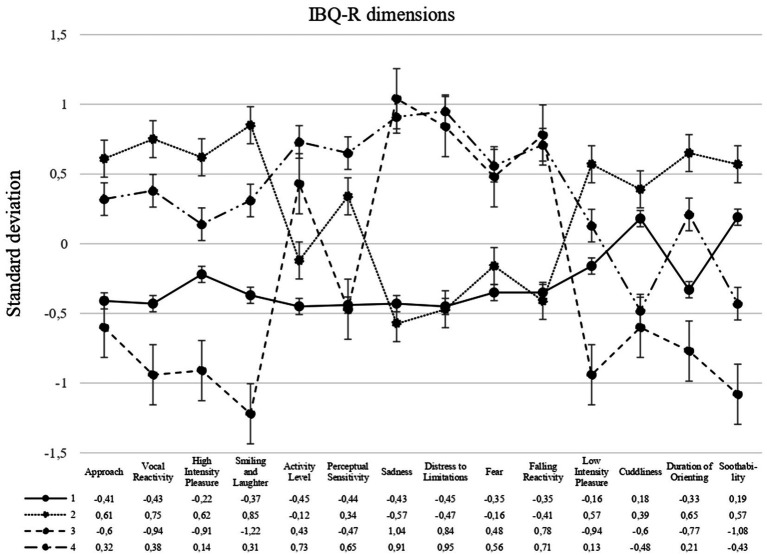 Figure 1
Peer Reviews
No public reviews on file for this paper yet. If you reviewed it on a platform where reviews are public (OpenReview, ICLR, NeurIPS, ICML), you can paste yours below so the community can read it here.
Videos
No videos yet. Explain this paper in a talk, walkthrough, or lecture? Add one.
Taxonomy
TopicsChild and Adolescent Psychosocial and Emotional Development · Infant Health and Development · Child and Animal Learning Development