Giant pituitary adenomas: an institutional experience with 289 surgically treated patients
Victoria Antonia Binder, Yining Zhao, Julia Sandra Breu, Moritz Repschläger, Rudolf Fahlbusch, Michael Buchfelder

TL;DR
This study examines surgical outcomes in 289 patients with giant pituitary adenomas, highlighting treatment challenges and complication rates.
Contribution
The paper provides a large, single-center retrospective analysis of surgical strategies and outcomes for giant pituitary adenomas.
Findings
Transsphenoidal surgery was used in 69.6% of cases, but combined approaches were needed in 18%.
Gross-total resection was achieved in only 18% of patients, influenced by tumor size and extension.
Severe complications occurred in 5.9% to 3.5% of cases, with a 2.4% early mortality rate.
Abstract
Giant pituitary adenomas (GPA) are considered difficult to treat and the operative procedures are associated with more complications. This study aimed to assess treatment strategies of GPAs in a large consecutive and uniformly documented series in a single specialized center. A total of 289 patients with GPA who underwent primary surgery in our department between December 1982 and December 2022 were analyzed in this retrospective study. GPAs were defined by a maximum diameter of ≥ 4 cm in at least one plane. Patients were reviewed for endocrine, radiological and ophthalmological outcomes as well as complication and mortality rates. The mean maximum tumor diameter was 4.6 ± 0.7 cm. 201 patients (69.6%) underwent transsphenoidal and 36 patients (12.4%) underwent transcranial surgery only. 52 patients (18.0%) underwent a combined approach within a few weeks. Gross-total resection (GTR)…
Genes, proteins, chemicals, diseases, species, mutations and cell lines named across the full text — each resolved to its canonical identifier and authoritative record.
Click any figure to enlarge with its caption.
 Figure 1
 Figure 2
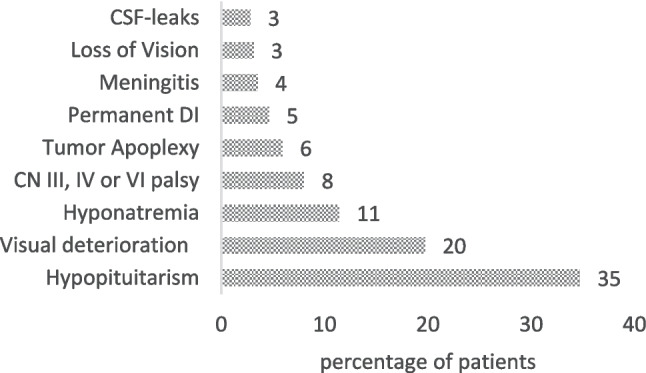 Figure 3
Peer Reviews
No public reviews on file for this paper yet. If you reviewed it on a platform where reviews are public (OpenReview, ICLR, NeurIPS, ICML), you can paste yours below so the community can read it here.
Videos
No videos yet. Explain this paper in a talk, walkthrough, or lecture? Add one.
Taxonomy
TopicsPituitary Gland Disorders and Treatments · Head and Neck Surgical Oncology · Meningioma and schwannoma management