Machine learning-based treatment outcome prediction in head and neck cancer using integrated noninvasive diagnostics
Melda Yeghaian, Stefano Trebeschi, Marina Herrero-Huertas, Francisco Javier Mendoza Ferradás, Paula Bos, Maarten J. A. van Alphen, Marcel A. J. van Gerven, Regina G. H. Beets-Tan, Zuhir Bodalal, Lilly-Ann van der Velden

TL;DR
This study uses machine learning to predict survival and feeding tube dependence in head and neck cancer patients, finding that clinical data is most effective for survival prediction.
Contribution
The study introduces a machine learning approach to predict both one-year survival and feeding tube dependence in head and neck cancer patients using noninvasive data.
Findings
Clinical data showed the highest predictive performance for one-year survival (AUC = 0.75).
Postsurgical treatment information was most effective for predicting feeding tube dependence (AUC = 0.67).
Multimodal integration did not improve overall model performance but showed modest gains for weaker modalities.
Abstract
Accurate prediction of treatment outcomes is crucial for personalized treatment in head and neck squamous cell carcinoma (HNSCC). Beyond one-year survival, assessing long-term enteral nutrition dependence is essential for optimizing patient counseling and resource allocation. This preliminary study aimed to predict one-year survival and feeding tube dependence in surgically treated HNSCC patients using classical machine learning. This proof-of-principle retrospective study included 558 surgically treated HNSCC patients. Baseline clinical data, routine blood markers, and MRI-based radiomic features were collected before treatment. Additional postsurgical treatments within one year were also recorded. Random forest classifiers were trained to predict one-year survival and feeding tube dependence. Model explainability was assessed using Shapley Additive exPlanation (SHAP) values. Using…
Genes, proteins, chemicals, diseases, species, mutations and cell lines named across the full text — each resolved to its canonical identifier and authoritative record.
Click any figure to enlarge with its caption.
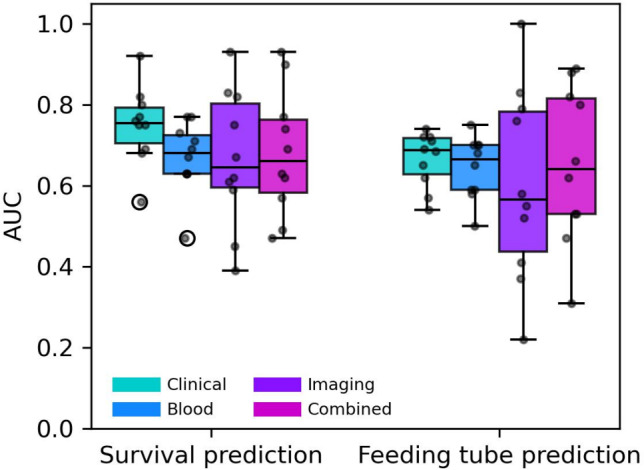 Figure 1
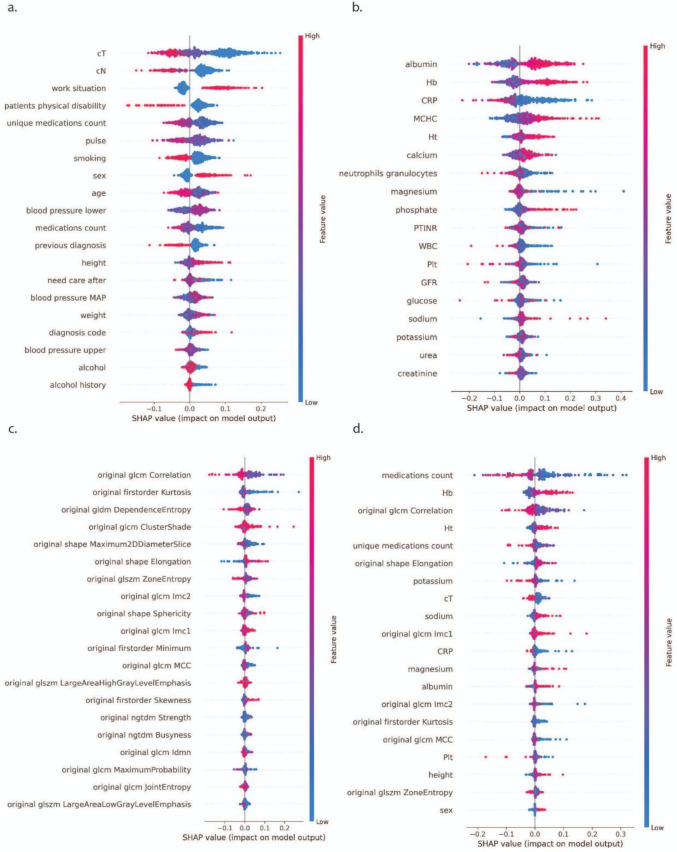 Figure 2
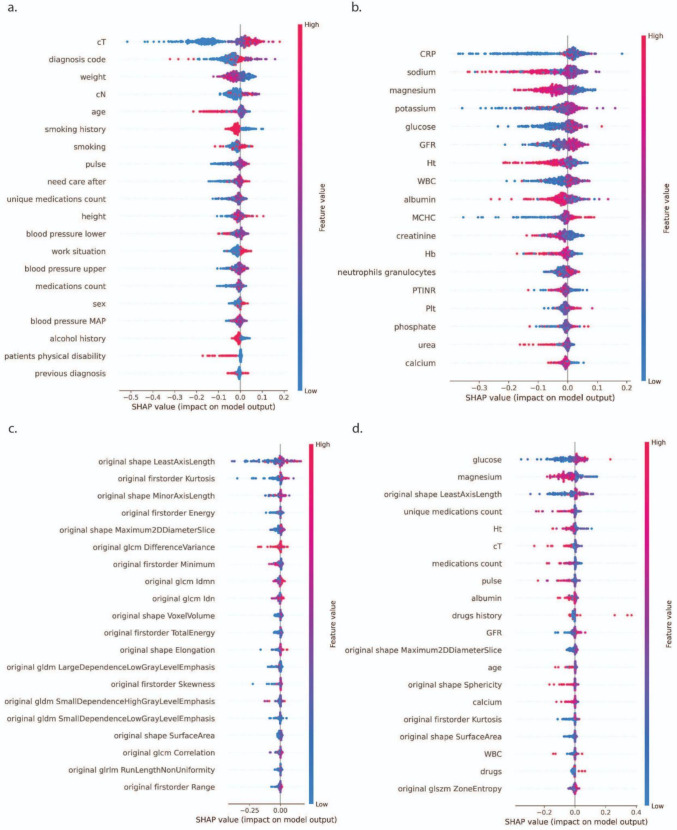 Figure 3
Peer Reviews
No public reviews on file for this paper yet. If you reviewed it on a platform where reviews are public (OpenReview, ICLR, NeurIPS, ICML), you can paste yours below so the community can read it here.
Videos
No videos yet. Explain this paper in a talk, walkthrough, or lecture? Add one.
Taxonomy
TopicsHead and Neck Cancer Studies · Radiomics and Machine Learning in Medical Imaging · Voice and Speech Disorders