Workplace harassment and violence in the public sector: an integrative literature review
Luana Gonçalves De Vito, Marli Aparecida Reis Coimbra, Rafaela Cristina Sanfelice

TL;DR
This paper reviews studies on workplace harassment and violence in the public sector, finding high prevalence and significant mental health impacts.
Contribution
The study provides a synthesized overview of recent evidence on harassment and violence in public sector workplaces.
Findings
Verbal violence prevalence ranged from 19.4% to 63.5% among public sector workers.
Public sector workers faced harassment and violence about three times more than private sector workers.
Managerial support was identified as a protective factor against workplace violence.
Abstract
Workplace violence is associated with workers’ mental health impairment. This study aimed to characterize the scientific production on workplace harassment and/or violence in the public sector and to synthesize the main available evidence. An integrative literature review was conducted, with a protocol registered on the Open Science Framework platform (https://osf.io/phq4z/). Searches were performed in the VHL, PubMed, and APA PsycInfo®. The search strategy included the descriptors “public sector,” “harassment, non-sexual,” and “workplace violence.” Inclusion criteria were original articles published within the last 10 years, available in full text, written in Portuguese, English, or Spanish, whose study population included public sector workers and addressed workplace harassment and/or violence. After the selection process, 10 articles were included. Verbal violence showed a prevalence…
Genes, proteins, chemicals, diseases, species, mutations and cell lines named across the full text — each resolved to its canonical identifier and authoritative record.
Click any figure to enlarge with its caption.
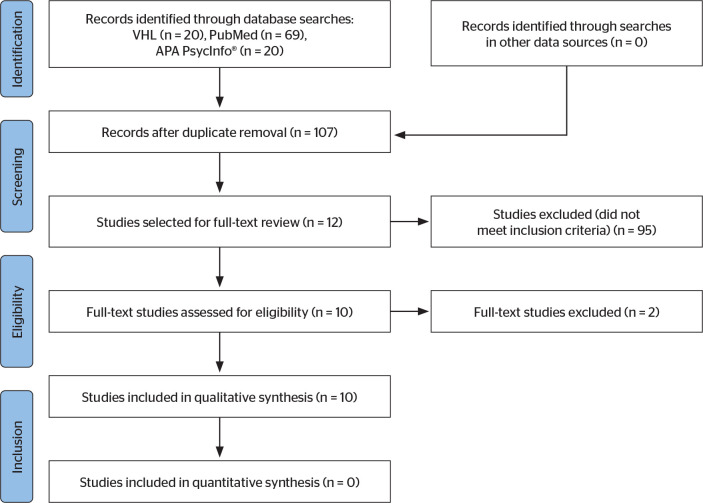 Figure 1
| Database | Search string |
|---|---|
| VHL | |
| PubMed | |
| APA PsycInfo® |
| Title, authors, year, and country | Objective | Results/recommendations |
|---|---|---|
| Acoso laboral y factores asociados en
trabajadores de servicios de emergencias | To determine workplace harassment and associated factors among workers in emergency services of public and private health facilities. | Workplace harassment prevalence was three times higher in the public sector than in the private sector, particularly among women and single workers. Perpetrators were most often coworkers, followed by supervisors. The study highlights the need for measures to address workplace harassment. |
| Determinants of workplace violence against
clinical physicians in hospitals | To examine organizational determinants of workplace violence against clinical physicians. | Overall, 41.5% reported at least one threat of physical or verbal violence, and 9.8% reported sexual harassment in the previous 3 months. Higher rates were associated with greater work demands and perceived insecurity. |
| Prevalence of Psychological Workplace
Violence among Employees of a Public Tertiary Health Facility in
Enugu, Southeast Nigeria | To determine the prevalence of psychological workplace violence among employees in a tertiary health institution in Nigeria. | The study showed a high prevalence of psychological violence (49.7%). Verbal abuse (40.8%), bullying (7.0%), and sexual harassment (1.9%) were the most reported forms. Most perpetrators were patients’ relatives, while 23.4% were staff members. In 28.6% of cases, no action was taken, and only 1% were formally reported. Bullying was markedly higher among health professionals. |
| Sources, incidence and effects of
non-physical workplace violence against nurses in Ghana | To document the incidence, sources, and effects of verbal abuse and sexual harassment against Ghanaian nurses. | Results showed that 52.2% experienced verbal abuse, mostly perpetrated by patients’ relatives (45.5%), and 12% experienced at least one episode of sexual harassment, most frequently perpetrated by physicians (50%). Chi-square testing showed significant associations between gender, workplace violence, and intention to leave nursing. Reported consequences ranged from distressing memories to constant vigilance. The study recommended educational programs and clear policies to increase awareness of the problem. |
| Violência no trabalho: um estudo
com servidores públicos da saúde | To investigate workplace violence as a factor influencing the health of public health workers. | The study found that 25.9% experienced at least 1 form of workplace violence, with verbal aggression being the most common (19.4%). Workplace harassment prevalence was 10.5%. Findings highlight the importance of increasing visibility of violence in the health sector and supporting policies focused on worker health. |
| Workplace violence among nursing
professionals | To identify types of occupational violence experienced by nursing staff. | Approximately 88.9% reported workplace violence, with workplace harassment among the most cited occurrences (25.4%), followed by physical violence (11%) and sexual harassment (9.1%). Most participants (90%) believed incidents could have been prevented. Violence was attributed to patients, relatives, coworkers, and supervisors, reinforcing the need for preventive measures to promote workplace safety. |
| Effectiveness of a workshop-based
intervention to reduce bullying and violence at work: A 2-year
quasi-experimental intervention study | To develop and examine the effectiveness of an intervention aimed at preventing bullying and workplace violence through psychosocial work environment modifications. | No direct or indirect effects on bullying or workplace violence were identified. However, intervention group B showed improvements in perceived support and organizational justice compared with the control group. These findings were not replicated in intervention group A. The study suggested refining the intervention and prioritizing interpersonal relationships and team psychosocial resources. |
| Violence against physicians in Jordan: An
analytical cross-sectional study | To explore workplace violence within the medical community, analyze the characteristics of reported abuse cases in terms of perpetrators, timing, type of abuse, and consequences, and identify an effective role-based approach to address the growing problem. | Results showed that 63.1% of physicians experienced workplace violence in the previous year. Violence was more frequent among physicians in the governmental sector. Among public sector physicians (n = 253), 75.3% reported violence, including verbal aggression (63.5%) and physical aggression (10.4%). Only 13.3% felt legally protected. Anti-violence actions were recommended. |
| Workplace Violence Among Health Care
Professionals in Public and Private Health Facilities in
Bangladesh | To examine the prevalence of workplace violence and its associated factors and to explore the experiences of health professionals. | Results showed that among professionals exposed to workplace violence (43%, n = 468), 84% reported non-physical violence and 16% reported physical violence. In addition, 65% stated that no investigative measures were taken, and 44% reported no consequences for perpetrators. Approximately 51.4% of physicians and 35.4% of nursing staff were exposed to some form of violence. Workplace violence was significantly associated with four factors: being married, working in the public sector, working in emergency settings, and shift work. The study concluded that there is an urgent need to establish formal guidelines for reporting and managing workplace violence. |
| Association of workplace violence and
bullying with later suicide risk: a multicohort study and
meta-analysis of published data | To evaluate the association between workplace violence and bullying and the risk of suicide attempts and death in multicohort studies. | A total of 1,103 suicide attempts or deaths were recorded among 205,048 participants with workplace violence data. The results indicated that Finnish public sector employees (28%) were exposed to workplace violence at higher rates compared with other study populations. Workplace violence was associated with an increased risk of suicide, particularly among individuals exposed more frequently. The study highlights the importance of preventing violent behavior in the workplace. |
Peer Reviews
No public reviews on file for this paper yet. If you reviewed it on a platform where reviews are public (OpenReview, ICLR, NeurIPS, ICML), you can paste yours below so the community can read it here.
Videos
No videos yet. Explain this paper in a talk, walkthrough, or lecture? Add one.
Taxonomy
TopicsWorkplace Violence and Bullying · Sexual Assault and Victimization Studies · Stalking, Cyberstalking, and Harassment
INTRODUCTION
The World Health Organization (WHO) has reported that approximately 1 billion people have experienced mental disorders, and about 15% of working-age adults have also dealt with these conditions in recent years. Multiple factors contribute to impaired mental health, among which the work environment stands out as a key determinant, as it may intensify social problems, particularly bullying and psychological violence, which are often associated with workplace harassment and have significant effects on psychological well-being ^[1]^.
According to a global survey conducted by the International Labour Organization (ILO), nearly 23% of workers, approximately one in five employees, reported having experienced violence and harassment in the workplace ^[2]^.
ILO Convention No. 190 ^[2]^, together with Recommendation No. 206, represents the first set of international standards specifically aimed at preventing, addressing, and reducing violence and harassment at work. These instruments provide a normative framework for addressing the issue and, for the first time in international law, recognize the right of all individuals to a respectful work environment. They also establish the responsibility of States to ensure the implementation of measures to prevent such practices ^[3]^.
The defining characteristic of workplace harassment is the prolonged and frequent exposure of one or more individuals to humiliating or constraining situations, either directly or indirectly, resulting in significant harm. Indirect forms include persecution, work overload, dissemination of rumors, and social isolation. Direct forms include accusations, public humiliation, and verbal aggression perpetrated by the harasser ^[4]^.
Public administration has structural features that make it particularly susceptible to workplace harassment. Job stability, difficulty in dismissing employees, and formal evaluation and control processes may contribute to the development of hostile environments. Consequently, workplace harassment and violence may emerge as indirect forms of punishment or retaliation, in which perpetrators use institutional mechanisms to promote isolation and pressure workers, including excessive demands related to deadlines and targets, often without adequate mental health support ^[5]^.
The absence of clear prevention and response policies, combined with internal power disputes, increases employee vulnerability, while impunity for perpetrators contributes to the persistence of these practices. In addition, patronage relationships and favoritism, present in some sectors of public administration, may reinforce a context in which workplace harassment and violence are used as mechanisms of exclusion or marginalization ^[5]^.
This study addresses workplace harassment among public sector workers, considering its intersection with work, health, and well-being as individual rights and guarantees. Workplace harassment and violence compromise quality of life, contribute to the development of mental disorders, and reduce work productivity ^[6]^.
Furthermore, as established by Regulatory Standard No. 1 (NR-1), issued by the Ministry of Labour and Employment, organizations must assess work-related psychosocial risks. These risks, linked to work organization and interpersonal relationships, directly affect workers’ well-being, increase stress levels, and contribute to the onset of mental disorders. Factors such as lack of institutional support, workplace harassment, and interpersonal conflicts are frequently associated with anxiety and depression ^[6]^.
Psychosocial risks directly affect occupational health and safety, and NR-1 establishes the need for their recognition and control ^[6]^. Therefore, the objective of this study was to characterize the scientific production on workplace harassment and/or violence in the public sector and to synthesize the main available evidence.
METHODS
STUDY DESIGN AND PROTOCOL
This study is an integrative literature review ^[7]^, with the review protocol registered on the Open Science Framework platform (https://osf.io/phq4z/) under DOI 10.17605/OSF.IO/PHQ4Z.
STAGES OF THE INTEGRATIVE REVIEW
The review was conducted in six stages, as described in literature ^[7]^: i) identification of the topic and formulation of the review question; ii) development of the search strategy, definition of inclusion and exclusion criteria, and database search; iii) data extraction from selected studies; iv) critical appraisal of eligible studies; v) analysis and interpretation of findings; and vi) presentation of the review.
REVIEW QUESTION
The review question was: “What are the characteristics of the scientific production on workplace harassment and/or workplace violence in the public sector?” This question was structured using the PICo strategy, in which P (population) refers to public sector workers; I (phenomenon of interest) refers to the scientific production on workplace harassment and/or workplace violence in this context; and Co (context) refers to exposure to workplace harassment and violence in the work environment.
ELIGIBILITY CRITERIA
Original articles published between 2014 and 2024, available in full text in electronic format, written in Portuguese, English, or Spanish, and investigating workplace harassment and/or workplace violence in public sector settings were included. Duplicate articles, editorials, opinion and review articles, letters, comments, notes, theses, dissertations, and manuals were excluded ^[7,8]^.
INFORMATION SOURCES AND SEARCH STRATEGY
Data collection was conducted between November and December 2024 using the following databases: VHL, PubMed, and APA PsycInfo^®^.
The search strategy was developed following consultation with the Health Sciences Descriptors, selecting the terms “public sector,” “harassment, non-sexual,” and “workplace violence.” Corresponding descriptors were also identified in Medical Subject Headings and the PsycINFO Thesaurus.
Search strategies were structured by combining descriptors and their synonyms using the Boolean operators OR and AND, considering the specific features of each database. The final search strategy is presented in Table 1.
STUDY SELECTION
After the searches were completed, the identified articles were imported into Zotero^®^ for reference storage and management, and duplicates were removed. Subsequently, two review authors independently screened titles and abstracts, followed by full-text review, according to the previously established eligibility criteria ^[7]^.
DATA EXTRACTION AND ANALYSIS
Data extracted for critical analysis were organized using an instrument widely applied in integrative reviews, including the following items: title, authors, year and country of publication, study objective, and main findings (results and recommendations) ^[8,9]^. The studies were also assessed for methodological rigor using the same instrument ^[9]^.
RESULTS
A total of 109 articles were identified across the selected databases. Of these, two were excluded due to duplication, retaining only one version of each study. After title and abstract screening, 95 articles did not meet the inclusion criteria. Consequently, 12 studies were selected for full-text review. Following this stage, two studies did not meet the eligibility criteria, resulting in a final sample of 10 articles included in this integrative review.
Regarding database distribution, six articles were retrieved from the VHL, three from APA PsycInfo^®^, and one from PubMed. Figure 1 presents the flowchart of the search and study selection process according to the Preferred Reporting Items for Systematic Reviews and Meta-Analyses guidelines ^[10]^.
Figure 1. Preferred Reporting Items for Systematic Reviews and Meta-Analyses flowchart illustrating the study search and selection process conducted by the reviewers.
The studies included in this review were conducted across different continents. Countries in Asia (Taiwan, Bangladesh, and Jordan) and Europe (Finland) accounted for 33.3% of the total, followed by countries in Africa (Nigeria and Ghana) and South America (Brazil and Chile), each representing 22.2%. A quantitative cross-sectional design predominated, present in 80% of the studies.
Verbal violence was the most frequent form of aggression (19.4%-63.5%), followed by physical violence (9.8%-16%) and sexual harassment (9.1%-12%).
Women represented most participants (53.8%), and the predominant age range was between 20 and 44 years (59.8%). Approximately 48.9% of participants reported being married. Most workers had between 6-10 years of experience in emergency services (55.2%).
The public sector settings examined in the included studies were predominantly public hospitals. Accordingly, the study populations consisted of physicians, paramedics, nursing staff, service assistants, and administrators, with medical and nursing teams representing the largest groups.
Table 2 presents the characterization of the scientific production, including title, authors, year and country of publication, objectives, and main results and recommendations.
DISCUSSION
This review found that workplace harassment in the public sector represents a relevant and concerning issue. This sector requires particular attention in the assessment of psychosocial work risks, as workplace harassment ^[11]^ is associated with the development of mental disorders throughout professional trajectories ^[6]^. The public sector showed an approximately threefold higher prevalence of this risk compared with the private sector as well as greater susceptibility among women and single individuals ^[11]^. Women were particularly vulnerable to workplace and/or sexual harassment, a condition associated with social and cultural factors that contribute to mental health impairment ^[21]^.
The studies included in this review demonstrated that workplace harassment and violence are frequent situations that require greater attention ^[11,12]^. In one study, 41.5% of participants reported receiving at least one threat of physical or verbal violence ^[12]^. In another, psychological violence showed a prevalence of 49.7%, followed by verbal abuse (40.8%), bullying (7.0%), and sexual harassment (1.9%) ^[13]^. These events were mainly associated with work demands and a perceived climate of insecurity in the workplace ^[12]^. The high frequency of these occurrences reinforces the need for reflection and implementation of preventive measures and appropriate institutional responses.
The main perpetrators identified were coworkers, managers ^[11]^, and relatives of patients treated by health professionals ^[13,14]^. A substantial proportion of professionals exposed to workplace violence did not take any action after these episodes (28.6%) ^[13]^, contributing to worsening psychological impacts, including persistent fear, intense psychological distress, burnout syndrome ^[22]^, and an increased risk of suicide attempts and death over the course of a career ^[23]^. These findings highlight the need for more effective institutional actions.
Among the studies analyzed, research conducted with nurses in Ghana reported a high prevalence of verbal harassment (52.2%), mostly perpetrated by patients’ relatives, whereas sexual harassment was most frequently perpetrated by physicians (50%) ^[14]^. Reported consequences included recurrent traumatic memories, constant vigilance, and intention to leave the profession ^[14]^, demonstrating significant psychological impacts on professional trajectories.
The WHO and the ILO emphasize, in a joint report, the need to investigate the causes of work-related illness ^[24]^. The studies included in this review identify workplace harassment and violence as features present across different professional contexts and reinforce the need to implement practices focused on awareness and response to the problem ^[11,14]^.
Health professionals working in public services experience workplace harassment and/or violence in daily practice, requiring specific institutional attention and measures ^[15]^. In emergency settings, 61.7% of reported violence was attributed to perpetrators in these environments ^[25]^. This high prevalence may be related to direct exposure to situations of suffering and tension. Female sex and night shift work were also identified as vulnerability factors ^[25]^.
Another study included in this review reported that 88.9% of nursing professionals in a public hospital emergency unit experienced workplace harassment. In addition to verbal, physical, and sexual violence, episodes of racial discrimination were also recorded ^[16]^. Verbal violence emerged as the most frequent form of aggression ^[13,14,16]^, highlighting the need for improved institutional preparedness in conflict management and promotion of nonviolent communication. High levels of underreporting and stigma were also observed, associated with the low formal reporting of occupational violence ^[16]^.
Among physicians, a higher prevalence of workplace harassment was observed among men compared with women (67.2% vs 55.3%) ^[18]^. In this group, men reported higher frequencies of verbal and physical aggression and weapon-related attacks, whereas sexual harassment was more frequently reported by women ^[18]^, reflecting sociocultural aspects related to gender dynamics.
Workplace violence among physicians and nursing staff was associated with factors such as marital status (married), employment in the public sector, work in emergency services, and shift work ^[19]^. Additionally, leaving the profession due to workplace violence was identified in some studies included in this review ^[14,19]^.
Occupational violence and bullying, when repeated and persistent, were associated with increased risk of suicide attempts and death among workers in public hospitals ^[20]^. These findings reinforce the importance of expanding research on the topic and implementing institutional policies aimed at awareness, protection, and mental health promotion. The need for psychological support, strengthening of formal guidelines, and improvement of interpersonal relationships in the workplace was also highlighted ^[11,18-20]^.
Workplace harassment and violence can be understood as important psychosocial risk factors, as they represent concrete situations that contribute to negative consequences for workers’ mental health and well-being. Recurrent humiliation, excessive demands, exclusion, and disqualification weaken individuals and increase the likelihood of stress, anxiety, depression, and interpersonal conflict. The absence of protective factors, such as organizational support and role clarity, intensifies these effects and contributes to the persistence of work environments more vulnerable to violence ^[26]^.
Mental disorders have a significant impact on work absenteeism, and when recurrent, recovery tends to be more complex and prone to relapse. In this context, the work environment plays a decisive role: settings marked by harassment, bullying, or excessive pressure contribute to clinical deterioration, whereas supportive attitudes from supervisors help mitigate negative impacts and strengthen workers’ mental health ^[27]^.
Supervisor support emerges as an important protective factor, as leadership grounded in support, fairness, and respect may prevent harmful practices such as bullying and workplace violence ^[17]^. Investments in healthy interpersonal relationships and psychosocial resources are essential. The interaction between supervisors and teams should be further evaluated and strengthened as a strategy to promote well-being at work ^[17]^.
Although this review identified relevant aspects related to mental health at work, it has limitations. The included studies focused predominantly on public hospitals and health professionals, particularly physicians and nursing staff, with limited representation of administrative and technical workers. In addition, the search included only one psychology database and did not cover databases specific to public administration. Further studies are recommended to expand the evidence base.
Nevertheless, the findings demonstrate the significant presence of workplace harassment and violence in the public sector and reinforce the need for interventions aimed at promoting worker health.
CONCLUSIONS
This study demonstrated the presence of multiple forms of workplace harassment and violence in the public sector, with greater exposure among health professionals, particularly physicians and nursing staff. Verbal violence emerged as the most frequent form in public workplace settings, followed by physical violence and sexual harassment. The prevalence of harassment and violence was significantly higher in the public sector compared with the private sector.
Factors associated with increased susceptibility to occupational violence included night shift work, being married, female sex, and employment in emergency settings. Managerial support was identified as a favorable element with a potential protective effect in addressing these situations.
There is a need to develop and strengthen policies and guidelines aimed at promoting workplace safety, including institutional protocols for prevention and management of violence. Interventions focused on improving interpersonal relationships and the use of psychosocial resources also showed promise in some contexts. Mental health risks resulting from workplace harassment and violence should be incorporated into intervention and prevention strategies, including suicide prevention.
Overall, literature indicates that addressing workplace harassment and violence among public sector workers requires coordinated action involving managers, public policies, and educational programs, with emphasis on preventive measures and the promotion of healthier and more balanced work environments.
The reference list from the paper itself. Each links out to its DOI / PubMed record.
- 1Organização Mundial da Saúde World mental health report: transforming mental health for all[Internet]Geneva WHO;2022 acesso 28 Nov 2024 Disponível: https://www.who.int/publications/i/item/9789240049338
- 2Organização Internacional do Trabalho Convenção sobre violência e assédio no mundo do trabalho[Internet]Genebra OIT;2019 acesso 28 Nov 2024 Disponível: https://www.ilo.org/wcmsp 5/groups/public/---europe/---ro-geneva/---ilo-lisbon/documents/genericdocument/wcms_729459.pdf
- 3Organização Internacional do Trabalho Recomendação sobre violência e assédio no mundo do trabalho[Internet]Genebra OIT;2019 acesso 28 Nov 2024 Disponível: https://www.ilo.org/sites/default/files/wcmsp 5/groups/public/@europe/@ro-geneva/@ilo-lisbon/documents/genericdocument/wcms_729461.pdf
- 4Costa TC Flores LF Kocourek S. A caracterização do assédio moral: perspectivas de regulamentação jurídica no âmbito do serviço público federal Rev Visao Gest Organiz 2022111799110.33362/visao.v 11i 1.2479 · doi ↗
- 5Morais JASS Valceli CSS. Assédio moral e a violência psicológica na gestão pública Rev Cient Multidiscip O Saber 20241112010.51473/rcmos.v 1i 2.2024.704 · doi ↗
- 6Brasil, Ministério do Trabalho e Emprego Empresas brasileiras terão que avaliar riscos psicossociais a partir de 2025[Internet]Brasília TEM;2024 acesso 28 Jan 2025 Disponível: https://www.gov.br/trabalho-e-emprego/pt-br/noticias-e-conteudo/2024/Novembro/empresas-brasileiras-terao-que-avaliar-riscos-psicossociais-a-partir-de-2025
- 7Mendes KDS Silveira RCCP Galvão CM. Revisão integrativa: método de pesquisa para a incorporação de evidências na saúde e na enfermagem Texto Contexto Enferm 200817475876410.1590/S 0104-07072008000400018 · doi ↗
- 8Ursi ES Galvão CM. Prevenção de lesões de pele no perioperatório: revisão integrativa da literatura Rev Latino-Am Enfermagem 200614112413110.1590/s 0104-1169200600010001716532249 · doi ↗ · pubmed ↗