Ideological Cues, Partisanship, and Prejudice Against LGBTQ Judges
Andrew R Stone, Tony Zirui Yang

TL;DR
This study finds that Americans from both political parties are less likely to support LGBTQ nominees for the Supreme Court, even when their ideology aligns with the voters.
Contribution
The paper introduces a conjoint experiment to disentangle prejudice against LGBTQ nominees from ideological alignment.
Findings
Both Democrats and Republicans penalize LGBTQ nominees, contrary to previous assumptions about Democratic support.
Transgender nominees face a 14 percentage point penalty, while gay or lesbian nominees face an 8 percentage point penalty.
Ideological alignment does not lead to genuine inclusivity for LGBTQ individuals in judicial nominations.
Abstract
How does the gender and sexual identity of a prospective judge shape public support for their nomination? We build upon recent scholarship on instrumental inclusivity and argue that, after accounting for nominee ideology, Americans of all partisan stripes will penalize LGBTQ nominees. Using a conjoint experiment, we randomly vary a prospective Biden US Supreme Court nominee’s gender and sexual identity. Crucially, we also randomize the nominee’s ideology, enabling us to disentangle LGBTQ identity from the ideological signal it sends and differentiate between genuine and instrumental support for LGBTQ nominees. Contrary to recent findings suggesting that Democrats reward minority judges, we find that respondents from both parties penalize LGBTQ nominees. The magnitude of these effects—roughly 14 percentage points for transgender nominees and 8 percentage points for gay or lesbian…
Click any figure to enlarge with its caption.
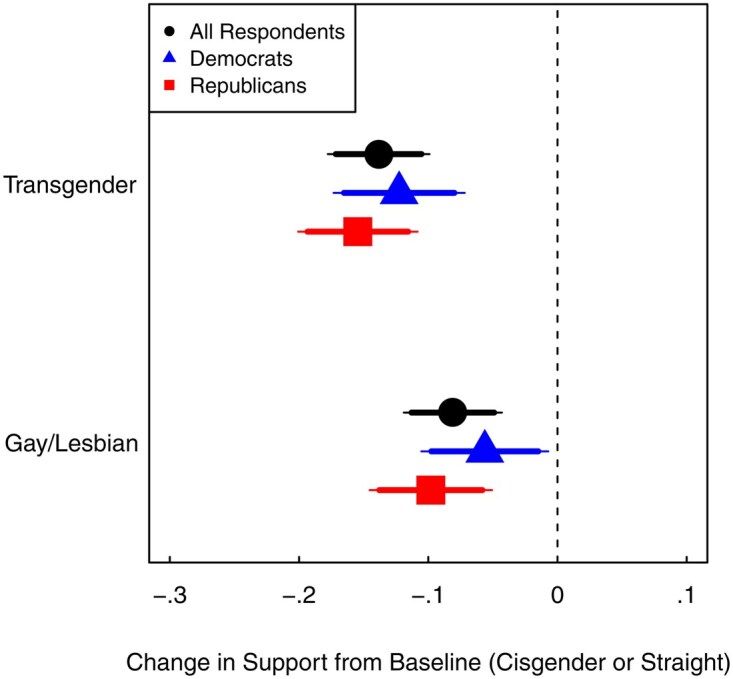 Figure 1
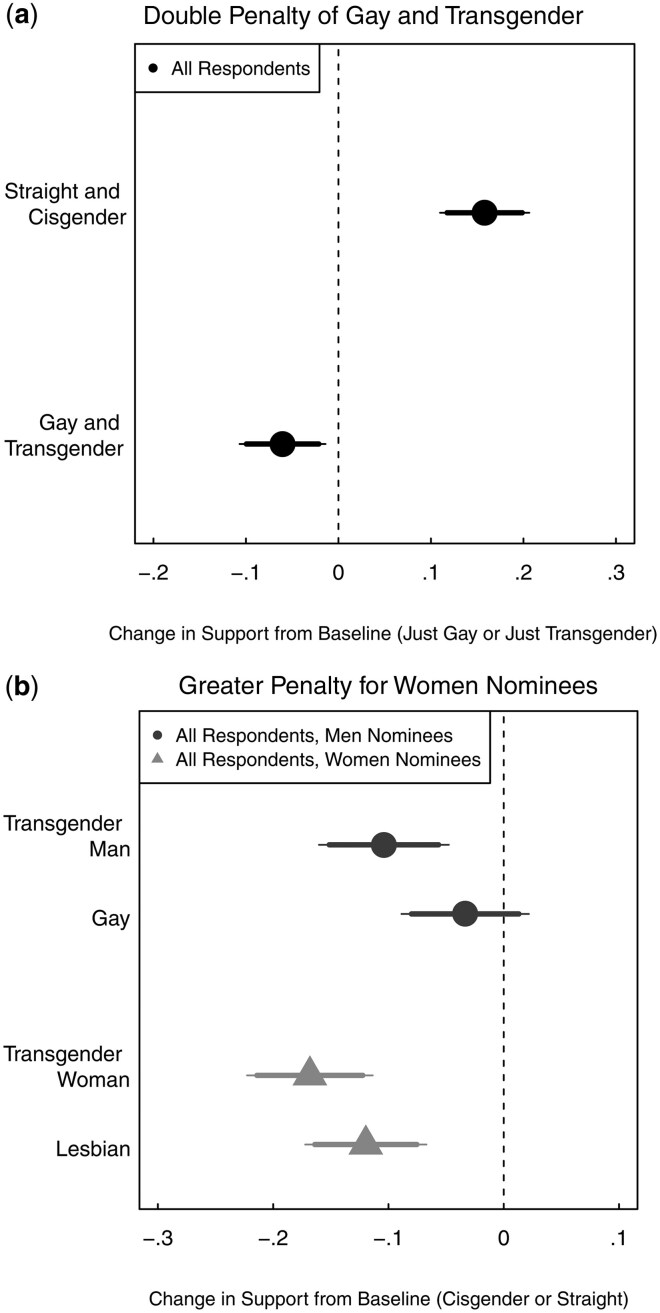 Figure 2
- —Washington University in St. Louis10.13039/100007268
Peer Reviews
No public reviews on file for this paper yet. If you reviewed it on a platform where reviews are public (OpenReview, ICLR, NeurIPS, ICML), you can paste yours below so the community can read it here.
Videos
No videos yet. Explain this paper in a talk, walkthrough, or lecture? Add one.
Taxonomy
TopicsJudicial and Constitutional Studies · Electoral Systems and Political Participation · Gender Politics and Representation
The American judiciary has played an active and critical role in one of the most contentious areas of policymaking in contemporary American politics: the promotion and restriction of LGBTQ rights (Bailey et al. 2025). At the same time, the demographic characteristics of judicial nominees, including gender and sexual identity, have gained greater political attention.1 These traits allow politicians to appeal to core political constituencies and mobilize support for nominees (Kaslovsky, Rogowski, and Stone 2021), shape confirmation hearings (Boyd, Collins, and Ringhand 2025), and influence the substantive decisions courts make on issues important to underrepresented groups (Boyd, Epstein, and Martin 2010; Kastellec 2013).
A key player in the nomination and confirmation process is the American public. Public attitudes toward nominees shape how politicians behave on judicial nominations (Kastellec, Lax, and Phillips 2010) and impact how Americans evaluate politicians (Bass, Cameron, and Kastellec 2022) and the judiciary as an institution (Glick 2023). In this way, public attitudes toward nominees shape the choices of presidents and senators and thus determine the descriptive traits of judges who end up on the bench.
In this study, we focus on how the gender and sexual identity of prospective judicial nominees impacts their public support, an area largely overlooked in previous research. A pioneering study by Bracic et al. (2023) finds that Democrats are more trusting of gay than straight judges, while Republicans exhibit the opposite pattern. Consistent with research on LGBTQ candidates (Jones and Brewer 2019; Magni and Reynolds 2021), Bracic et al. (2023) also find that both Republicans and Democrats view gay judges as more liberal than their straight counterparts. This study does not, however, disentangle perceptions of ideology from the sexuality of the judge and thus cannot speak to an important theoretical discussion in the study of attitudes toward LGBTQ politics: whether individuals genuinely support LGBTQ politicians or whether their identity provides an instrumental reason to do so (Kwon, Scarborough, and Taylor 2023; Turnbull-Dugarte and López Ortega 2024).
We build upon scholarship of instrumental inclusivity (Turnbull-Dugarte and López Ortega 2024) to theorize that Democrats’ support for LGBTQ judges is driven by ideological motivations (Sen 2017), revealing prejudice when ideological and partisan considerations are accounted for. To test this, we conduct a conjoint experiment to assess Americans’ support for prospective Biden Supreme Court nominees who are lesbian, gay, or transgender. We randomize nominee ideology to isolate the independent effects of these traits.
Our results reveal a substantial penalty for LGBTQ nominees among Democrats and Republicans alike, with only shared partisanship having a larger effect. Across all respondents, the penalty for transgender nominees (about 13.8 percentage points) is larger than for gay and lesbian nominees (8.1 p.p.); these penalties benchmark closely to the context of the US House (Magni and Reynolds 2021). We thus find limited evidence of genuine support for LGBTQ judges after disentangling perceptions of ideology from the traits themselves. We also find a “double penalty” for gay and transgender nominees and that respondents penalize women LGBTQ nominees more than men, in line with scholarship on public reactions to politicians with intersectional minority identities (Crenshaw 1991; Hancock 2007; López Ortega and Radojevic 2025).
Our study makes a significant contribution to understanding prejudice against LGBTQ politicians, judges, and individuals. We extend the theoretical framework of instrumental support for marginalized groups beyond ethnicity and nationalism to partisanship and ideology (Sen 2017; Kwon, Scarborough, and Taylor 2023; Turnbull-Dugarte and López Ortega 2024), revealing a sizable and widespread bias against LGBTQ judges. Although we focus on attitudes toward judges, in the conclusion we consider how our ideological instrumentality argument may apply to perceptions of other political figures, such as legislators and executives (Magni and Reynolds 2021; Thompson 2023), or policy areas such as adoption or education (Turnbull-Dugarte and López Ortega 2024; López Ortega and Blanco Forthcoming).
Instrumental Support for LGBTQ Judges
Despite decades of progress that has enhanced social acceptance of LGBTQ individuals and politicians (Ayoub 2015; Ayoub and Garretson 2017; Magni and Reynolds 2018; Abou-Chadi and Finnigan 2019), prejudice remains prevalent (Magni and Reynolds 2021; Thompson 2023). A growing body of research attributes this persistent bias to political ideology and partisanship. In the United States, scholars find that Democrats and liberals tend to be more supportive of LGBTQ individuals, politicians, and judges, whereas Republicans and conservatives are more likely to express opposition (Jones and Brewer 2019; Bracic et al. 2023). Further, scholarship shows that LGBTQ identity signals a politician’s liberal ideology (Jones and Brewer 2019; Bracic et al. 2023), much like other characteristics such as race (Sen 2017; Harrison, Michelson, and Perry 2024). These dynamics raise an important theoretical question: To what extent are liberals genuinely supportive of LGBTQ judges versus viewing their identity as an instrumental factor to secure policy representation (Turnbull-Dugarte and López Ortega 2024)?
Identifying whether support for LGBTQ individuals is instrumental or genuine is crucial, as instrumental support is opportunistic and conditional, offering little in terms of reducing the persistence of LGBTQ prejudice. In their groundbreaking study, Turnbull-Dugarte and López Ortega (2024) demonstrate that conservative and nationalistic individuals opposed to immigration strategically adopt pro-LGBTQ attitudes to align with their co-ethnic in-group. We argue that this instrumental inclusivity theory extends beyond right-wing homonationalism to left-wing support for LGBTQ judges. In short, what may appear as growing social acceptance of LGBTQ issues may be driven by instrumental liberalism.
Citizens have policy preferences and should be willing to align themselves with ideological in-groups. Left-leaning individuals have a strong incentive to strategically support LGBTQ judges, as doing so can advance liberal policy outcomes. Consequently, when ideological instrumental incentives are accounted for, liberals may not be as supportive of LGBTQ politicians and judges as existing studies suggest. Teasing out ideological cues from LGBTQ identity is thus important for assessing the independent effects of gender and sexual identity.
Scholarship on the courts provides support for our argument. The public values judges who share their political affiliations (Bartels and Johnston 2012) and evaluates the courts through the lens of identity, such as judge race and gender (Sen 2017; Zilis 2021; Ono and Zilis 2022). These patterns parallel the finding of Bracic et al. (2023) for LGBTQ judges. When ideological cues are not isolated from gender and sexual identity, LGBTQ individuals are more likely to be considered liberal and thus in-group by left-leaning citizens and out-group by those on the right. This should bolster support for LGBTQ judges among liberals and decrease support among conservatives.
After accounting for ideology and thus disentangling the effect of LGBTQ identity from its ideological signal, what should remain is the individual’s attitudes toward LGBTQ traits themselves. Scholarship illustrates how racial prejudice exists and shapes the political behavior of individuals across the political spectrum (e.g., Krupnikov and Piston 2015; Hooghe and Dassonneville 2018).2 Given extant prejudices that persist across partisan groups against LGBTQ individuals, we expect a similar penalty for judges with LGBTQ traits (Jones et al. 2018; Magni and Reynolds 2021; Thompson 2023). These negative effects should appear stronger for transgender judges, when compared to gay judges, given the higher level of prejudice against these individuals (Lewis et al. 2017; Magni and Reynolds 2021). Moreover, individuals with multiple intersecting minority traits (Hancock 2007) can receive additional backlash (López Ortega and Radojevic 2025). We expect that stronger effects may emerge for LGBTQ judges with other minority traits.
Support for LGBTQ judges provides an ideal test case for the theory of instrumental ideological inclusivity, as the federal judicial nomination and confirmation process has become increasingly polarized along political lines. Developments such as the removal of the filibuster and President Obama’s failed nomination of Merrick Garland exemplify this trend (Boyd, Lynch, and Madonna 2015; Cameron and Kastellec 2023). Public attitudes toward the judiciary have also grown more polarized (Levendusky et al. 2024), with elite cues playing a significant role in shaping these evaluations (Rogowski and Stone 2021). As with other institutions, Americans demand both policy and descriptive representation on the bench (Scherer and Curry 2010; Bartels and Johnston 2012; Kaslovsky, Rogowski, and Stone 2021). Given the parallels between judicial and electoral politics, our argument likely extends beyond judges to LGBTQ candidates more broadly.3
Experimental Design
To estimate the effect of a Supreme Court nominee’s gender and sexual identity on public evaluations, we employ a preregistered conjoint experiment.4 The design presents respondents with a hypothetical profile of a Supreme Court nominee that randomly varies several nominee attributes, including LGBTQ identity and ideology. This design has three important methodological benefits. First, we control for a nominee’s ideology, allowing us to isolate the independent effect of LGBTQ identity and test the extent to which Americans exhibit genuine support for these nominees. Second, it minimizes concerns about social desirability bias regarding attitudes toward LGBTQ individuals due to the presence of other traits apart from gender and sexual identity. Finally, this setup realistically reflects the information available to Americans when evaluating judicial nominees and has been used to study attitudes toward prospective nominees (Sen 2017; Rogowski and Stone 2021).
We draw upon a sample of 1,249 American adult respondents on the CloudResearch Connect online platform from December 22, 2023, to January 4, 2024. To provide an accurate picture of the preferences of the American population, we employed a quota to match US Census demographics on race, ethnicity, gender, and age. We also quota-sampled on partisanship to recruit a sufficient number of Republicans and Democrats, with leaners coded as partisans in main analyses. We do not employ weighting in any analyses. Over 95 percent of respondents passed our attention check (see Appendix A for details).
Our design was straightforward. Respondents were presented with a hypothetical profile of a Biden Supreme Court nominee and then evaluated their support for the nominee. Respondents completed two nominee evaluations, one at a time; our analyses cluster standard errors at the respondent level. Using Biden as the nominating president allows us to hold constant respondent views of the nominating president’s ideology. The profiles contained several randomized demographic characteristics and personal traits that are common points of discussion during nominations, including age, race/ethnicity, current job, and law school background. Half of respondents also received one of four statements endorsing the nominee from Biden. We present these varying traits in Appendixtable A1.
Our main treatment variables are the nominee’s gender identity (man, woman, transgender man, or transgender woman) and sexual orientation (straight or gay/lesbian). Because the nominee’s gender and sexual identities may cue their political ideology, we also randomized the nominee’s ideology (very liberal, liberal, somewhat liberal, or moderate); such a range reflects the plausible spectrum of Democratic Supreme Court nominees. This allows us to estimate the impact of sexual and gender identity on respondent evaluations while holding ideology constant.
After reviewing a nominee profile, respondents rated their nominee support on a five-point scale, which we recode into a binary variable, with “strongly support” and “somewhat support” coded as 1 and other options as 0.5 For additional survey information, see Appendix A.
Results
Figure 1 presents the average difference in binary support for nominees who are transgender or gay compared to their cisgender or straight counterparts, averaged across all other nominee characteristics (the Average Marginal Component Effect). We present separate effects for all respondents, Democrats, and Republicans. When averaging across all respondents, prospective nominees who identify as gay or lesbian experience an 8.1 percentage point (*p *< 0.001) decrease in support compared to straight nominees, and transgender nominees face a 13.8 percentage point (*p *< 0.001) decrease in comparison to cisgender nominees. Similar to previous studies, the negative effect observed for transgender individuals is significantly larger than that of gays and lesbians (*p = *0.037). These findings are robust across various alternative analyses (see Supplementary Materialsection E for a full discussion). Our findings provide clear evidence that LGBTQ nominees receive less public support than their straight and cisgender counterparts, with transgender individuals facing the greatest backlash.
All partisans penalize LGBTQ Supreme Court nominees. Estimated treatment effects (AMCE) of a nominee’s transgender or gay/lesbian identity (as compared to the baseline of cisgender or straight) on binary support for the nominee for all respondents, Democrats, and Republicans. There are 90 and 95 percent confidence intervals plotted for each estimate; standard errors are clustered by respondent. Leaners are coded as partisans. Full results are available in Supplementary Material figures D.1 and D.2.
Crucially, we find consistently lower support for LGBTQ nominees across partisan groups. Although baseline support for Biden’s prospective nominee is considerably higher among Democrats than Republicans (by 53.5 p.p.), the penalty for LGBTQ nominees is evident across all partisan groups. For instance, the decrease in support for transgender nominees is 15.4 percentage points (*p < *0.001) among Republicans and 12.3 percentage points (*p < *0.001) among Democrats. These treatment effects are not distinguishable from one another (*p = *0.361). Once we isolate ideological cues from gender and sexual identity, we uncover a consistent penalty for LGBTQ individuals across partisan lines (c.f. Bracic et al. 2023).
The magnitude of the negative treatment effects of gender and sexual identity is particularly noteworthy when juxtaposed with the results associated with other attributes (Supplementary Materialfigure D.1). The only other attribute yielding statistically and substantively significant results comparable to gender and sexual identity is the nominee’s law school. Judges who graduated from non–top 100 schools received 12.3 percentage points (*p < *0.001) lower support in comparison to elite Ivy graduates. Strikingly, the effects of gender and sexual identity overshadow the effect of ideology. When disaggregating by partisanship (Supplementary Materialfigure D.2), Republican respondents favor moderate nominees over very liberal nominees by 14.0 percentage points (*p < *0.001). In contrast, the effects of ideology for Democrats are substantively small and statistically insignificant, with, for example, a 3.2 percentage point (*p = *0.395) preference for very liberal over moderate nominees.
Intersectional traits and support for LGBTQ nominees. Panel (a) shows estimated treatment effects (AMCE) on binary support of judges who are transgender and gay/lesbian (bottom point) or judges who are cisgender and straight (top point) as compared to judges who are transgender or gay/lesbian (baseline). Panel (b) shows estimated treatment effects of men (top points) and women (bottom points) nominees who are gay and transgender. There are 90 and 95 percent confidence intervals plotted for each estimate; standard errors are clustered by respondent. Estimates pool all respondents. Full results are available in Supplementary Material figures D.3, D.4, and D.5.
We also assess, first, whether candidates who are both gay and transgender face an additional penalty, and second, whether our findings differ for women and men nominees. Both analyses speak to how the public reacts to the intersection of multiple minority traits (Crenshaw 1991; Hancock 2007; Cassese 2019). To conduct the first analysis, we set “just gay or just transgender” as the baseline category and assess how respondents differentially evaluate nominees with both (or neither) of these traits. For the second, we divide the sample based on nominee gender and conduct separate analyses for men and women nominees.
In figure 2a, we illustrate that judges who are both transgender and gay pay a greater penalty (6.0 p.p. lower support, *p = *0.011) than judges with just one of those traits. In figure 2b, we illustrate that the magnitude of the negative effect for both transgender and gay/lesbian status is larger for women (16.8 and 12.0 p.p., respectively) than men (10.4 and 3.3, respectively); this difference is statistically significant for gay/lesbian (*p = *0.027) but not transgender nominees (*p = *0.108). These findings highlight that, as in other political contexts, LGBTQ judicial nominees with intersectional identities face additional challenges in garnering public support.6
Discussion and Conclusion
By extending recent scholarship on instrumental inclusivity beyond right-wing homonationalism to left-wing support for LGBTQ judges (Turnbull-Dugarte and López Ortega 2024), we demonstrate that, after accounting for the ideology of judges, both Democrats and Republicans discriminate against LGBTQ judicial nominees. This challenges the common assumption that left-leaning individuals and parties are inherently more tolerant toward gender and sexual minorities and underscores the need to distinguish between strategic and genuine support for marginalized groups.
We conclude with a consideration of three important implications of our study. First, we consider the bipartisan nature of our findings. Does this suggest that Democrats and liberals falsify a true dislike of LGBTQ individuals when publicly advocating for LGBTQ rights and inclusion? We are hesitant to draw this conclusion. We see an important theoretical distinction between concealing one’s true preferences due to fear of public sanction and instrumental support. Democrats and liberals may truthfully support LGBTQ rights and representation, but their support could be driven more by self-interest, such as advancing liberal policy outcomes, than by genuine altruistic acceptance. Nevertheless, future studies should assess these dynamics, especially as our conjoint design minimizes the potential for social desirability bias and thus our ability to study conditions under which preference falsification may emerge.
Second, we consider the generalizability of our findings. We focus on LGBTQ judges, given the active role of the judiciary in shaping LGBTQ rights (Bailey et al. 2025), the role descriptive traits play in shaping judge behavior (Boyd, Epstein, and Martin 2010; Kastellec 2013), and the political importance to the public of contemporary judicial nominations (Bartels and Johnston 2012; Bass, Cameron, and Kastellec 2022). We expect that our theoretical framework of instrumental ideological inclusivity should largely apply to other politicians who require direct public approval, such as members of Congress and executives.7 However, extending our theory to public support for specific policies—such as adoption, surrogacy, immigration, or education—may be more complex. In these contexts, the instrumental ideological incentives to elect a representative or confirm a judge to secure desired ideological policy are not present. More research is needed to disentangle the specific calculations at play in these contexts.
Finally, we highlight the challenges marginalized groups face in achieving representation within the judiciary and American political institutions, especially for nominees with intersecting minority traits. As most Americans are cisgender and straight, our results are in line with scholarship illustrating that Americans of all partisan stripes desire judges who share their descriptive traits (Scherer and Curry 2010; Kaslovsky, Rogowski, and Stone 2021). Our findings help explain the underrepresentation of LGBTQ individuals on the bench given the public opinion pressures politicians face on judicial nominations (Bass, Cameron, and Kastellec 2022). Like Bracic et al. (2023), we see our findings as illustrative that LGBTQ judges may seek to avoid public discussion of their identity to avoid potential backlash; in contrast, our theory and empirical approach highlights that this disincentive likely exists for potential nominees across the political spectrum. Nevertheless, Presidents Obama, Trump, and Biden have all nominated openly gay judges. This illustrates that LGBTQ jurists still have a viable pathway to the federal bench, though none of these were Supreme Court nominees—who command considerably greater scrutiny than lower court nominees—and presidents have entirely avoided nominating openly transgender judges. While diversifying the judiciary would likely enhance LGBTQ substantive representation, public resistance creates a challenging path for prospective LGBTQ judges.
Supplementary Material
nfaf064_Supplementary_Data
The reference list from the paper itself. Each links out to its DOI / PubMed record.
- 1Abou-Chadi Tarik , Finnigan Ryan. 2019. “Rights for Same-Sex Couples and Public Attitudes Toward Gays and Lesbians in Europe.” Comparative Political Studies 52:868–95.
- 2Ayoub Phillip M. 2015. “Contested Norms in New-Adopter States: International Determinants of LGBT Rights Legislation.” European Journal of International Relations 21:293–322.
- 3Ayoub Phillip M , Garretson Jeremiah. 2017. “Getting the Message Out: Media Context and Global Changes in Attitudes toward Homosexuality.” Comparative Political Studies 50:1055–85.
- 4Bailey Christine M. , Collins Paul M., Rhodes Jesse H., Rice Douglas. 2025. “The Effect of Judicial Decisions on Issue Salience and Legal Consciousness in Media Serving the LGBTQ+ Community.” American Political Science Review 119:108–23.
- 5Bartels Brandon L. , Johnston Christopher D. 2012. “Political Justice? Perceptions of Politicization and Public Preferences Toward the Supreme Court Appointment Process.” Public Opinion Quarterly 76:105–16.
- 6Bass Leeann , Cameron Charles M., Kastellec Jonathan P. 2022. “The Politics of Accountability in Supreme Court Nominations: Voter Recall and Assessment of Senator Votes on Nominees.” Political Science Research and Methods 10:677–702.
- 7Boyd Christina L. , Epstein Lee, Martin Andrew D. 2010. “Untangling the Causal Effects of Sex on Judging.” American Journal of Political Science 54:389–411.
- 8Boyd Christina L. , Lynch Michael S., Madonna Anthony J. 2015. “Nuclear Fallout: Investigating the Effect of Senate Procedural Reform on Judicial Nominations.” The Forum 13:623–41.