The spoon illusion: A consistent rearward bias in human sound localisation
EunJi Baek, Min Hee Shim, Ecem Altan, Gene Tangtartharakul, Katherine Storrs, Paul Michael Corballis, Dietrich Samuel Schwarzkopf

TL;DR
Humans often mislocalize the source of a sound, perceiving it as coming from behind when it's actually in front.
Contribution
The study introduces a novel auditory illusion using spoons to reveal a consistent rearward bias in human sound localization.
Findings
Blindfolded participants mislocalized spoon sounds as coming from behind.
The rearward bias was consistent across multiple trials and participants.
The illusion suggests limitations in auditory spatial perception.
Abstract
Most humans have only two ears. To know where a sound is in external space, our auditory system must therefore rely on the limited information received by these ears alone. In an adventurous late-night attempt to test blindfolded humans’ ability to achieve this feat, we discovered that we mishear the sound of two spoons being hit right in front of us as coming from behind us.
Genes, proteins, chemicals, diseases, species, mutations and cell lines named across the full text — each resolved to its canonical identifier and authoritative record.
Click any figure to enlarge with its caption.
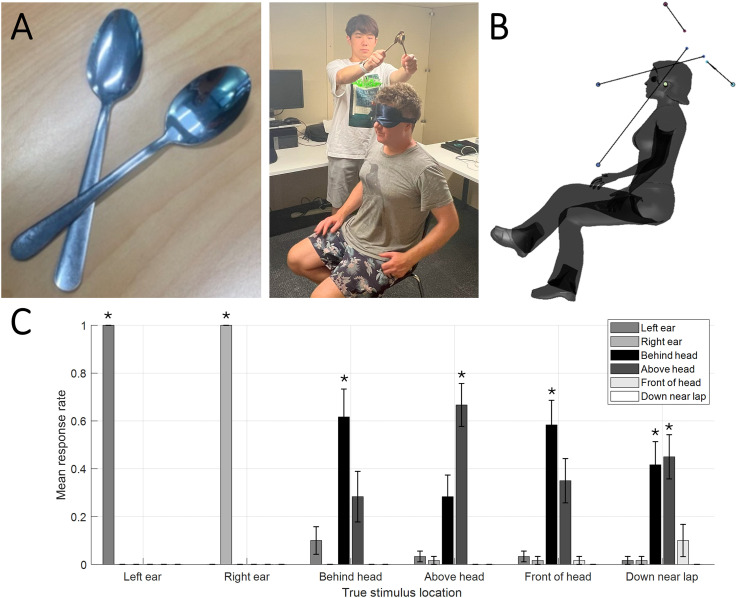 Figure 1
Peer Reviews
No public reviews on file for this paper yet. If you reviewed it on a platform where reviews are public (OpenReview, ICLR, NeurIPS, ICML), you can paste yours below so the community can read it here.
Videos
No videos yet. Explain this paper in a talk, walkthrough, or lecture? Add one.
Taxonomy
TopicsMultisensory perception and integration · Neuroscience and Music Perception · Tactile and Sensory Interactions
To test the consistency of this startling finding, we conducted a larger experiment on the senior author (DSS) and 11 naïve listeners (Figure 1A). We replicated a robust bias for listeners to hear sounds on the sagittal plane in front of them as coming from behind (Figure 1). No listener correctly localised sounds presented in front of their navel; in fact, only in a handful of trials did anyone report that sounds came from the front at all. Listeners were instead strongly biased to say frontal sounds came from behind or (somewhat less frequently) from above. They were better at locating sounds presented above the head, although they also often heard these as being behind the head. All listeners could tell with perfect accuracy whether sounds were on the left or right of the head.
These results speak for themselves. However, in this digital age many scientists cannot believe results without inferential statistics. We therefore compared for each of the six stimulus locations whether listeners’ average response rate was greater than guessing (Figure 1C).
We have since learned of independent replications of this phenomenon by others and have also tentatively replicated it in other contexts. Our tests suggest that the bias persists in a sound-attenuated chamber and outdoors on a rural lawn >10 m from any walls or other structure, which suggests it is not due to sound reflections from the walls of the testing room. The illusion also occurs when listeners are standing upright, rather than sitting down, and with other sounds than hitting spoons. While these follow-up experiments all included non-naïve listeners and authors who had participated in the first experiment, we also included naïve listeners who nevertheless also experienced the illusion. We assert that the illusion is extremely compelling—even when one knows that some stimuli must come from the front, they sound distinctly as coming from behind. We encourage readers to attempt their own replication and report their results back to us. We note that the illusion makes for an excellent party trick.
What could explain this pronounced perceptual bias? Errors in sound localisation between frontal and rear locations typically occur when binaural cues, intensity and timing differences between the ears, are ambiguous (Fischer et al., 2020; Shinn-Cunningham et al., 2000; Wightman & Kistler, 1999). But crucially, the illusion we report goes far beyond front-back confusion: it is a pronounced directional bias, rather than merely a heightened error rate. Sounds in front of the listener are presumably louder than those coming from behind them and probably also differ in spectral characteristics (Blauert, 1996; Ege et al., 2018; Montagne & Zhou, 2018; Oldfield & Parker, 1984). However, it is unclear why this should result in compellingly hearing the sounds from one direction.
The illusion might reflect prior expectations that unseen sounds originate from outside the visual field. Although it is also unclear why this should happen during blindfolding when there is no external visual input at all. This hypothesis could be tested in listeners after extended visual deprivation and in congenitally blind listeners. Expectations could also be manipulated by pairing sounds with visual stimuli. Localisation performance is known to be affected by synchronous visual stimuli (Jack & Thurlow, 1973; Montagne & Zhou, 2018). Despite the simplicity of using only two spoons to create this illusion, future research should strive for more controlled conditions, using a multi-speaker setup that allows exact control over stimulus location, loudness, spectral attributes, and audiovisual manipulations.
The reference list from the paper itself. Each links out to its DOI / PubMed record.
- 1Blauert J. (1996). Spatial Hearing: The Psychophysics of Human Sound Localization. The MIT Press. 10.7551/mitpress/6391.001.0001 · doi ↗
- 2Ege R. Opstal A. J. V. Van Wanrooij M. M. (2018). Accuracy-Precision trade-off in human sound localisation. Scientific Reports, 8(1), 16399. 10.1038/s 41598-018-34512-6 30401920 PMC 6219530 · doi ↗ · pubmed ↗
- 3Fischer T. Caversaccio M. Wimmer W. (2020). A front-back confusion metric in horizontal sound localization: The FBC score. 10.1145/3385955.3407928 . · doi ↗
- 4Jack C. E. Thurlow W. R. (1973). Effects of degree of visual association and angle of displacement on the “Ventriloquism” effect. Perceptual and Motor Skills, 37(3), 967–979. 10.1177/003151257303700360 4764534 · doi ↗ · pubmed ↗
- 5Montagne C. Zhou Y. (2018). Audiovisual Interactions in Front and Rear Space. Frontiers in Psychology, 9, 1-15, 10.3389/fpsyg.2018.00713 PMC 596267229867678 · doi ↗ · pubmed ↗
- 6Oldfield S. R. Parker S. P. A. (1984). Acuity of sound localisation: A topography of auditory space. I. Normal hearing conditions. Perception, 13(5), 581–600. 10.1068/p 130581 6535983 · doi ↗ · pubmed ↗
- 7Shinn-Cunningham B. G. Santarelli S. Kopco N. (2000). Tori of confusion: Binaural localization cues for sources within reach of a listener. The Journal of the Acoustical Society of America, 107(3), 1627–1636. 10.1121/1.428447 10738816 · doi ↗ · pubmed ↗
- 8Wightman F. L. Kistler D. J. (1999). Resolution of front–back ambiguity in spatial hearing by listener and source movement. The Journal of the Acoustical Society of America, 105(5), 2841–2853. 10.1121/1.426899 10335634 · doi ↗ · pubmed ↗