Opportunities, challenges, and ethical implications of online pediatric nutrition consultation: a nursing perspective
Ling-ling Ma, Ke-xin Wang

TL;DR
This paper explores the potential and challenges of online pediatric nutrition consultations, emphasizing ethical considerations and strategies for responsible development.
Contribution
The paper introduces a nursing ethics framework to guide the development of online pediatric nutrition consultations.
Findings
Online pediatric nutrition consultation can improve accessibility and efficiency in child nutrition services.
Challenges include technical barriers, professional practice issues, and ethical complexities.
Integrated strategies are proposed to ensure ethical and equitable care in digital consultations.
Abstract
Against the backdrop of rapid global expansion in digital healthcare and growing demand for child nutrition services, this perspective article examines the emerging model of online pediatric nutrition consultation. We argue that while this model offers significant potential to improve accessibility and efficiency, it faces multidimensional challenges. These include technical barriers such as the digital divide and limitations in remote assessment; professional practice issues like constrained communication and inadequate adaptation of clinical tools; and ethical complexities related to privacy, accountability, and equity. To support its responsible development, this perspective article applies a nursing ethics framework—centered on autonomy, non-maleficence, beneficence, and justice—to analyze these challenges. We further propose integrated strategies focusing on ethics-guided practice,…
Click any figure to enlarge with its caption.
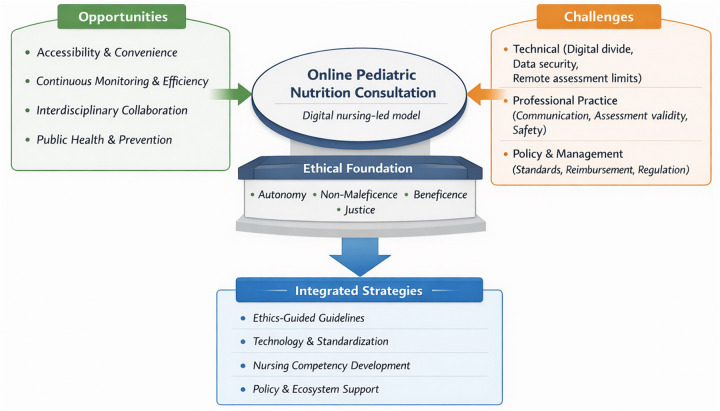 Figure 1
| Dimension | Key issues/features | Ethical implications | Corresponding strategies |
|---|---|---|---|
| Accessibility | Remote access, flexible scheduling | Justice, equity | Digital inclusion policies |
| Health management | Continuous monitoring, mHealth tools | Beneficence, non-maleficence | Validated tools, safety protocols |
| Professional practice | Communication limits, role expansion | Professional responsibility | Training, scope clarification |
| Data & privacy | Data transmission, storage | Confidentiality, autonomy | Secure platforms, consent standards |
| Policy & system | Lack of standards, reimbursement | Justice, accountability | Guidelines, insurance coverage |
Peer Reviews
No public reviews on file for this paper yet. If you reviewed it on a platform where reviews are public (OpenReview, ICLR, NeurIPS, ICML), you can paste yours below so the community can read it here.
Videos
No videos yet. Explain this paper in a talk, walkthrough, or lecture? Add one.
Taxonomy
TopicsHealth Literacy and Information Accessibility · Mobile Health and mHealth Applications · Child Nutrition and Feeding Issues
Introduction
1
The global trend towards digital healthcare is fundamentally transforming service delivery (1). Concurrently, issues of pediatric nutrition and health—such as malnutrition, obesity, and feeding disorders—present growing public health concerns. Within this context, online pediatric nutrition consultation has emerged as a significant development (2, 3). This growth is propelled by supportive regulatory frameworks for digital health, advancements in telecommunication technologies, and increasing parental demand for accessible, expert guidance (4). The use of telehealth in pediatric care—encompassing nutrition guidance, chronic disease management, and obesity interventions—has expanded considerably (5). Nevertheless, its implementation faces notable practical constraints, such as limitations in remote physical assessment, dependence on caregiver-reported data, potential communication barriers, and inequitable access stemming from technological and socioeconomic disparities (6). Examining this model is therefore critical for enhancing service quality, optimizing resources, and improving child health outcomes (7).
The application of online consultation to pediatric nutrition involves distinct challenges. Pediatric assessment relies heavily on nuanced data: growth metrics, detailed dietary histories, and observations of feeding behavior, which are more difficult to obtain and interpret remotely (6, 8). Furthermore, the process necessitates parents as active intermediaries, altering the traditional practitioner-patient dynamic (8). This expanded role for healthcare providers—encompassing clinician, educator, and coordinator—carries heightened ethical responsibilities (9, 10). These include ensuring accurate assessment in a virtual context, safeguarding minor patient privacy, maintaining professional boundaries, and exercising prudent clinical judgment despite potential informational gaps (11).
This study adopts the format of a perspective article, distinguishing it from systematic or scoping reviews. Its central purpose is to present a conceptual discussion of online pediatric nutrition consultation from a nursing ethics standpoint, rather than a comprehensive synthesis of existing evidence. The cited literature was selected for its representativeness and authority to support ethical reflection and practice-oriented discussion. Consequently, this work does not employ formal evidence appraisal or comparative methodological assessment. The article proceeds by critically engaging with this mode of digital healthcare. It opens by identifying the principal advantages and prospective value of remote pediatric nutrition services. Subsequently, it addresses the salient clinical, technical, and communication-related difficulties inherent in such services. A substantial portion is devoted to examining the accompanying ethical considerations, resulting in the formulation of a proposed structure for ethically sound nursing practice. Finally, the article presents a series of prospective recommendations designed to guide policy, clinical protocols, and subsequent inquiry in this emerging area, as summarized in Figure 1.
Conceptual framework of opportunities, challenges, and ethical principles in online pediatric nutrition consultation.
Opportunities in online pediatric nutrition consultation
2
Enhanced accessibility and convenience
2.1
Online pediatric nutrition consultation significantly improves service accessibility by overcoming geographical limitations (12). It provides vital support to families in remote or underserved areas, as well as to those with mobility constraints (13). The model also offers considerable scheduling flexibility, allowing consultations to be arranged outside conventional hours (6). This reduces travel time, waiting periods, and overall barriers to accessing professional guidance (14).
Improved efficiency in health management
2.2
Digital platforms facilitate more precise and continuous health monitoring (15). Parents can easily record and share their child's dietary intake, symptoms, and growth measurements through dedicated applications, enabling real-time tracking of developmental progress (16). This continuous data flow supports better clinical assessment and early intervention (17). Furthermore, the integration of multimedia educational materials—such as instructional videos and visual guides—enhances parental comprehension and adherence to nutritional recommendations more effectively than traditional methods (18).
Facilitated interdisciplinary collaboration and family engagement
2.3
Online systems promote coordinated care by allowing seamless communication among nutritionists, pediatricians, and other healthcare providers (19). This ensures a consistent and integrated approach to patient management (20). Importantly, the model actively involves parents and primary caregivers in the care process (21). By increasing their knowledge and self-efficacy, it strengthens their ability to implement dietary interventions, thereby improving long-term adherence and health outcomes (12).
Public health and preventive potential
2.4
From a public health perspective, online consultation platforms enable scalable nutrition screening and early identification of at-risk populations (22). Widespread implementation can support large-scale preventive initiatives (6). Additionally, securely aggregated and anonymized population data can inform nutritional epidemiology research, guide the evaluation of intervention programs, and contribute to evidence-based public health policy and planning (23).
Key challenges in online pediatric nutrition consultation
3
Technical challenges
3.1
Online pediatric nutrition consultation faces significant technical barriers. The “digital divide”—inequalities in internet access, device availability, and digital literacy—limits access for families in underserved or remote regions, creating disparities in service availability (24). Data security and patient privacy remain critical concerns, as the transmission and storage of sensitive health information require stringent safeguards (25). Moreover, the remote format inherently restricts physical assessment, making accurate growth measurements and direct clinical observation challenging, which may compromise the depth of nutritional evaluation (26, 27).
Professional practice challenges
3.2
The virtual environment imposes constraints on clinical interaction. Reduced non-verbal communication can hinder the clinician's ability to assess caregiver comprehension, emotional state, or environmental factors, potentially affecting therapeutic rapport and trust (28). Furthermore, traditional dietary assessment methods, such as 24 h recalls, may be less reliable when conducted remotely without visual aids or in-person guidance (29). A notable clinical gap is the lack of established protocols for identifying and managing urgent nutrition-related issues—such as severe feeding refusal or suspected allergic reactions—in a remote setting, raising potential safety concerns (30).
Management and policy challenges
3.3
The absence of standardized quality frameworks and evidence-based practice guidelines for online pediatric nutrition services results in inconsistent care quality and complicates regulatory oversight (6, 31). Reimbursement structures also lag behind service development; most public and private insurers do not consistently cover these consultations, undermining their financial sustainability and widespread adoption (32, 33). Furthermore, clear professional standards defining the scope of practice, documentation requirements, and ethical responsibilities for providers in digital health contexts are insufficiently developed, creating legal and operational uncertainties (31). Addressing these systemic issues requires coordinated policy development, professional guideline establishment, and structured support from healthcare institutions.
An ethical analysis framework for nursing practice
4
From a nursing perspective, online pediatric nutrition consultation functions as a hybrid practice model that combines clinical assessment, family education, care coordination, and ethical decision-making (6, 34, 35). In this model, nurses act as key intermediaries between families and digital health systems, undertaking roles that go beyond the scope of traditional in-person care.
Application of core ethical principles in online pediatric nutrition consultation
4.1
The transition to online service delivery necessitates a careful re-examination of core nursing ethics. Respect for autonomy involves navigating the balance between parental decision-making and the evolving capacity of the child (36, 37). The virtual setting complicates obtaining meaningful assent from the child and ensuring parents are fully informed (36, 38). Non-maleficence requires vigilance against potential harms inherent to remote care, such as diagnostic inaccuracies from limited data, inappropriate nutritional advice, or anxiety induced by digital information overload (36). Beneficence obligates providers to actively leverage digital tools—like tailored educational content and continuous monitoring—to optimize nutritional outcomes. Finally, justice calls for deliberate service design to mitigate the “digital divide,” ensuring equitable access across socioeconomic, geographic, and technological barriers (38, 39).
Specific ethical issues in digital nursing practice
4.2
Beyond the foundational principles, online pediatric nutrition care surfaces distinct ethical complexities (40). Relational ethics is challenged by the constraints of virtual interaction, which can inhibit the development of trust and therapeutic rapport, and limit the nurse's ability to provide nuanced emotional support (41). Confidentiality demands robust data security protocols to protect sensitive pediatric health information, while also navigating complex family dynamics regarding information sharing among caregivers (35). Professional responsibility requires clear delineation of the nurse's role in a hybrid care model. This includes defining the scope of online practice, establishing formal pathways for referral to in-person services, and clarifying accountability, thereby safeguarding both patient safety and professional integrity in a digitally mediated environment (36, 40).
Integrated strategies addressing opportunities, challenges, and ethics
5
To address the multifaceted challenges inherent in online pediatric nutrition consultation and to fully realize its benefits, a coordinated strategy integrating technology, practice, ethics, and policy is required (Table 1).
Develop ethics-guided practice guidelines
5.1
A specialized Code of Ethical Practice for Online Pediatric Nutrition Consultation should be established, grounded in core ethical principles (25). This code should standardize procedures for obtaining informed consent—with particular attention to developmentally appropriate methods for securing child assent—and define clear protocols for data privacy, security, and the permissible use of electronic health records (42, 43). Additionally, evidence-based, age-specific communication frameworks should be created to guide practitioners in respectfully engaging children according to their developmental stage (44).
Strengthen technology and standardization
5.2
Technology development should be purposeful and secure. This includes the validation and implementation of pediatric-specific remote assessment tools (e.g., reliable digital dietary instruments) and the establishment of secure, compliant data platforms (45, 46). Concurrently, standardized clinical safety protocols should be developed, detailing procedures for identifying urgent situations during remote consultations and ensuring seamless referral pathways to in-person care (47, 48).
Enhance nursing professional competency
5.3
The quality of online care depends directly on provider proficiency (49). Nursing education and continuing professional development should incorporate training in digital health literacy, remote assessment, and effective virtual communication—including techniques for building rapport and delivering empathetic support in a digital medium (50, 51). This training should be grounded in a clear ethical framework that provides practical guidance for nurses in structuring online consultations, determining appropriate criteria for escalating to in-person care, and maintaining therapeutic relationships within virtual settings. Concurrently, training curricula should emphasize interdisciplinary collaboration and ethical reasoning in complex, technology-mediated scenarios (35). The findings from such integrated training and ethical practice may subsequently inform the refinement of nursing education standards, the development of institutional protocols, and the evolution of professional guidelines, particularly for specialized fields such as pediatric digital nutrition services.
Optimize policy and ecosystem support
5.4
Sustainable integration requires supportive policy and infrastructure. Policymakers, in collaboration with professional bodies, should define clear service standards, scope of practice, and accountability mechanisms for online pediatric nutrition care (6, 52). Reimbursement models, including public and private insurance coverage for validated services, should be established to ensure financial viability (53, 54). At a systemic level, public investment in digital infrastructure and literacy is essential to bridge the digital divide and ensure equitable access for all families (55).
Summary
6
Online pediatric nutrition consultation represents a significant advancement in digital healthcare, offering substantial potential to improve the accessibility, continuity, and efficiency of child nutrition services. However, this model presents interconnected challenges across technical, clinical, regulatory, and ethical domains. Ethical considerations, in particular, require explicit frameworks and guidelines to ensure safe and equitable practice. Nurses play an indispensable role in this evolving landscape, necessitating both technical proficiency in digital tools and a steadfast commitment to maintaining therapeutic relationships, safeguarding patient welfare, and upholding ethical standards in a virtual environment. The effectiveness of online consultation fundamentally depends on this balanced integration of competence and care.
To ensure the responsible growth of this field, further rigorous research is needed to evaluate the efficacy, safety, and long-term outcomes of various online service models. This evidence is crucial for establishing best practices and standards. Moreover, as technology and service delivery continue to evolve, the core principle of patient- and family-centered care should remain paramount. The future of pediatric nutrition consultation lies in aligning innovation with this foundational ethic, ensuring that digital tools enhance rather than undermine compassionate, individualized care. Achieving this balance is essential for harnessing the full potential of digital health to support the well-being of children and families.
The reference list from the paper itself. Each links out to its DOI / PubMed record.
- 1Labrique A Agarwal S Tamrat T Mehl G. WHO digital health guidelines: a milestone for global health. NPJ Digit Med. (2020) 3:120. 10.1038/s 41746-020-00330-233015373 PMC 7501250 · doi ↗ · pubmed ↗
- 2Zhang X Liu J Ni Y Yi C Fang Y Ning Q Global prevalence of overweight and obesity in children and adolescents: a systematic review and meta-analysis. JAMA Pediatr. (2024) 178(8):800–13. 10.1001/jamapediatrics.2024.157638856986 PMC 11165417 · doi ↗ · pubmed ↗
- 3Azevedo LB Stephenson J Ells L Adu-Ntiamoah S De Smet A Giles EL The effectiveness of e-health interventions for the treatment of overweight or obesity in children and adolescents: a systematic review and meta-analysis. Obes Rev. (2022) 23(2):e 13373. 10.1111/obr.1337334747118 · doi ↗ · pubmed ↗
- 4Wu CT Ng JC Cheng YT Chang LY Kang EY Chiu HH The effects of teleinterventions on pediatric weight control: systematic review and meta-analysis of randomized controlled trials. J Med Internet Res. (2025) 27:e 68688. 10.2196/6868841359937 PMC 12685287 · doi ↗ · pubmed ↗
- 5Burke BL Jr Hall RW, Section on Telehealth Care. Telemedicine: pediatric applications. Pediatrics. (2015) 136(1):e 293–308. 10.1542/peds.2015-151726122813 PMC 5754191 · doi ↗ · pubmed ↗
- 6Haimi M Inchi L. Bridging distance, delivering care: pediatric tele-nutrition in the digital health era-A narrative review. Healthcare (Basel). (2025) 13(23):3107. 10.3390/healthcare 1323310741373324 PMC 12692263 · doi ↗ · pubmed ↗
- 7March CA Muzumdar R Libman I. How do virtual visits compare? Parent satisfaction with pediatric diabetes telehealth during the COVID-19 pandemic. Front Clin Diabetes Healthc. (2022) 2:794493. 10.3389/fcdhc.2021.79449336994343 PMC 10012131 · doi ↗ · pubmed ↗
- 8Mauldin K Gieng J Saarony D Hu C. Performing nutrition assessment remotely via telehealth. Nutr Clin Pract. (2021) 36(4):751–68. 10.1002/ncp.1068234101249 · doi ↗ · pubmed ↗