Moderate Wine Consumption, Defined by the Mediterranean Diet, Is Associated With Delayed Biological Aging in Men From the Moli-sani Study
Simona Esposito, Augusto Di Castelnuovo, Simona Costanzo, Alessandro Gialluisi, Antonietta Pepe, Emilia Ruggiero, Amalia De Curtis, Sara Magnacca, Mariarosaria Persichillo, Francesc Casanovas-Garriga, Chiara Cerletti, Maria Benedetta Donati, Giovanni de Gaetano, Licia Iacoviello

TL;DR
Moderate wine consumption, as defined by the Mediterranean Diet, is linked to slower biological aging in men.
Contribution
This study identifies a specific association between moderate wine consumption and delayed biological aging in men.
Findings
Moderate wine consumption (as per Mediterranean Diet guidelines) was associated with slower biological aging in men.
A J-shaped dose–response curve showed the slowest aging at around 170 mL/day of wine.
Overall ethanol intake at higher doses was linked to faster biological aging.
Abstract
To investigate the association between wine consumption and biological aging in the Moli-sani Study. Dietary data were assessed using a 188-item FFQ. Participants (n = 22,495) were classified as abstainers, former drinkers, moderate drinkers according to national guidelines (≤250 mL/d men; ≤125 mL/d women) or Mediterranean Diet (MD) (125–500 mL/d men; 62.5–250 mL/d women), and heavy drinkers (>500 mL/d men; >250 mL/d women). Biological age (BA) was estimated with a deep neural network using 36 circulating biomarkers, and Δage (BA–chronological age) served as an index of biological aging. In men, wine consumption, at doses defined moderate by a current MD Score, was associated with slower biological aging (Δage β = −0.39; 95%CI: −0.78, −0.01 vs. abstainers). Dose–response analyses showed a J-shaped curve, with the slowest Δage at ∼170 mL/d (Δage = −0.34 years; 95%CI: −0.66, −0.03).…
Genes, proteins, chemicals, diseases, species, mutations and cell lines named across the full text — each resolved to its canonical identifier and authoritative record.
Click any figure to enlarge with its caption.
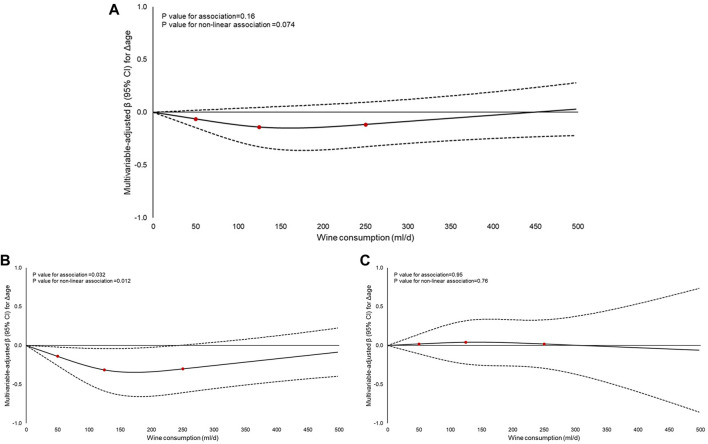 Figure 1
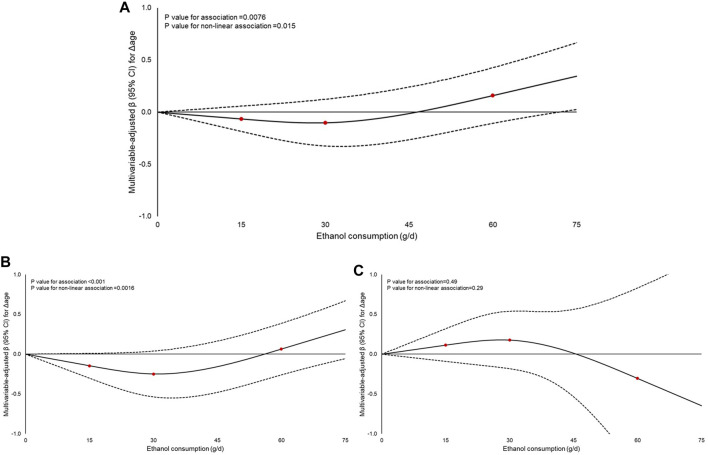 Figure 2
Peer Reviews
No public reviews on file for this paper yet. If you reviewed it on a platform where reviews are public (OpenReview, ICLR, NeurIPS, ICML), you can paste yours below so the community can read it here.
Videos
No videos yet. Explain this paper in a talk, walkthrough, or lecture? Add one.
Taxonomy
TopicsAlcohol Consumption and Health Effects · Fermentation and Sensory Analysis · Nutritional Studies and Diet